
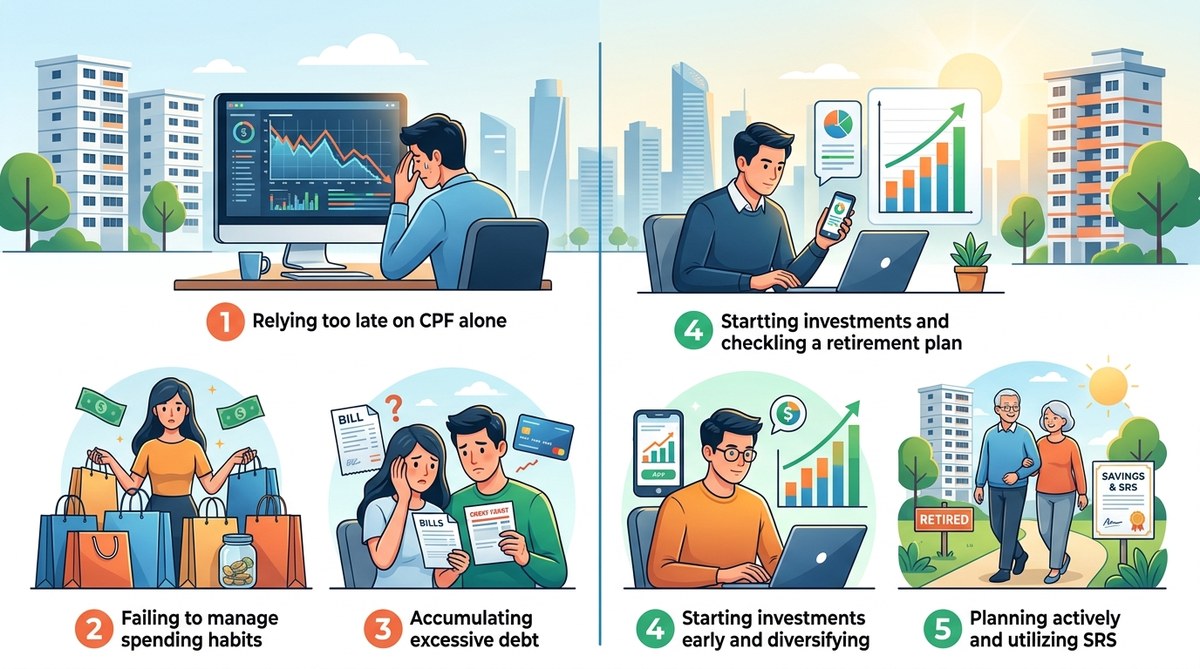
Planning for retirement in Singapore can feel like solving a puzzle without the picture on the box. You know you need to save, but between CPF rules, rising costs, and endless investment options, it is easy to slip up. The good news is that the most common errors are also the most fixable. Once you spot them, you can steer your finances back on track and build a retirement that actually works for you.
Many Singaporeans aged 35 to 55 make five predictable retirement mistakes: relying solely on CPF, starting too late, underestimating healthcare inflation, investing without a strategy, and ignoring the Supplementary Retirement Scheme. Each error can cost tens of thousands in lost growth. The fix involves a balanced approach using CPF, SRS, diversified investments, and realistic expense planning. Small course corrections today can double your retirement nest egg by 2026 and beyond.
Mistake 1: Putting All Your Trust in CPF Alone
CPF is a powerful foundation for retirement in Singapore. But treating it as your only source of income is a gamble. The CPF LIFE payouts, while steady, may not cover the lifestyle you want, especially if you are used to eating out regularly, traveling once a year, or helping your children with their housing.
Many people in their 40s assume their CPF Ordinary Account and Special Account balances will be enough. They forget that the CPF contribution rates drop after age 50, and the cap on contributions means your account grows slower in the later years. If you have not done the math recently, you may be in for a surprise.
| Retirement Planning Element | Typical Mistake | Smarter Approach |
|---|---|---|
| CPF reliance | Expecting full retirement lifestyle from CPF LIFE only | Treat CPF as a base, not the whole plan |
| Investment strategy | Keeping all savings in cash or fixed deposits | Build a diversified portfolio with growth assets |
| Healthcare costs | Ignoring medical inflation in old age | Budget for rising premiums and out-of-pocket expenses |
| Tax optimization | Skipping SRS contributions | Max out SRS for tax relief and long-term growth |
| Starting age | Delaying savings until after 50 | Begin compounding in your 30s or early 40s |
“The biggest mistake I see is people thinking their CPF will magically cover everything. It won’t. You need a side plan, even if it starts small.” — Anonymous financial advisor, speaking at a 2026 MoneySense webinar
If you want a clearer picture, read How Much Money Do You Really Need to Retire Comfortably in Singapore? to run your own numbers.
Mistake 2: Waiting Too Long to Start Investing
Time is the one resource you cannot replace. A person who starts investing at 30 with a modest $300 per month can end up with far more than someone who starts at 45 with $800 per month. That is the magic of compounding, and it works best when you give it decades.
The hesitation often comes from fear. You may worry about losing money or feel overwhelmed by the choices. But keeping your savings in a bank account earning 0.05% interest while inflation sits at 3% means you are losing purchasing power every single year.
Here is a simple 3-step process to get started without anxiety:
- Pick a low-cost platform like a robo-advisor or a brokerage that lets you buy exchange-traded funds (ETFs).
- Set up a monthly transfer of $100 to $500 into a diversified fund, such as the VWRA or a local Singapore market ETF.
- Ignore the daily ups and downs. Check your portfolio once a quarter and only adjust if your life goals change.
For a step-by-step guide, check out How to Start Investing in Singapore with Just $100 a Month. It is designed for people who think they do not have enough to begin.
Mistake 3: Underestimating Healthcare and Longevity Costs
Singaporeans are living longer. The average life expectancy is now above 84 years. That means your retirement could last 20 to 30 years, maybe more. And healthcare costs have been rising faster than general inflation for the last decade.
Many people forget to factor in medical expenses beyond MediShield Life. They assume subsidies will cover everything. But a serious illness or a prolonged stay in a nursing home can drain savings fast. The cost of a private hospital stay for a heart bypass can easily exceed $50,000.
To protect yourself, review your Integrated Shield Plan every two years. Make sure your rider covers enough for the type of ward you would actually use. Also, build a separate healthcare fund inside your retirement portfolio. Aim for at least $80,000 to $120,000 set aside for medical needs after age 65.
If you want to compare plans, the Complete Guide to Integrated Shield Plans: Comparing Riders and Upgrading Your MediShield Life can save you hours of research.
Mistake 4: Investing Without a Real Strategy
Throwing money at “hot stocks” or following tips from a WhatsApp group is not a strategy. It is gambling. Many Singaporeans in their 40s and 50s have lost significant sums by chasing penny stocks, cryptocurrencies, or get-rich-quick schemes.
A proper retirement strategy follows three rules:
- Diversify across asset classes. Do not put everything into property or just one REIT. Spread your money across equities, bonds, REITs, and cash.
- Match your risk to your timeline. If you are 15 years from retirement, you can afford more growth assets. If you are 5 years away, shift toward stability.
-
Rebalance once a year. Bring your portfolio back to its original allocation so you sell high and buy low automatically.
-
Avoid “tips” from friends or social media.
- Use dollar-cost averaging instead of trying to time the market.
- Keep your fees low. High expense ratios eat into your returns.
- Consider a robo-advisor if you prefer a hands-off approach.
For a deeper look at what not to do, read 7 Common Investment Mistakes Singaporeans Make and How to Avoid Them. It covers exactly the traps you want to dodge.
Mistake 5: Ignoring the Supplementary Retirement Scheme (SRS)
The SRS is one of the most underused tools in Singapore. You can contribute up to $15,300 per year (for Singaporeans and PRs) and claim the full amount as tax relief. If you are in a higher tax bracket, that could mean saving $2,000 to $4,000 in taxes every year.
The money inside the SRS can be invested in stocks, ETFs, unit trusts, or fixed deposits. It grows tax-deferred until you withdraw it at retirement. At that point, only 50% of the withdrawal is taxable, which means most people pay little to no tax on their SRS savings.
Yet many people skip it because they think it is complicated or they do not want to lock up their money. Yes, there is a penalty if you withdraw before retirement age (62), but the tax savings and compounding benefits often outweigh that risk, especially if you start in your 30s or 40s.
To learn more, see The Complete Guide to Supplementary Retirement Scheme (SRS) Tax Savings. It walks you through the exact steps to open and fund an SRS account.
How to Course Correct Starting Today
If you recognize yourself in any of these mistakes, do not panic. You can fix them one step at a time.
- Log into your CPF account and check your Special Account balance. Use the CPF retirement calculator to estimate your monthly payout at 65.
- Open a brokerage or robo-advisor account if you do not have one. Start with a monthly investment of $200.
- Set up an SRS account with DBS, OCBC, or UOB. Fund it by December 31 to get tax relief for the current year.
- Review your insurance coverage. Make sure your Integrated Shield Plan and rider match your expected healthcare needs.
- Create a retirement budget. List your expected monthly expenses, including housing, food, transport, healthcare, and leisure. Then compare that with your expected income from CPF LIFE, SRS, and personal investments.
You can also use tools like How to Use CPF Calculators to Plan Your Retirement to get precise numbers without guesswork.
Building Confidence for the Road Ahead
Retirement planning is not about being perfect. It is about being consistent and making informed choices. The five mistakes covered here are common, but they are also avoidable. Each small correction you make today will multiply over the years.
Start with one action this week. Maybe it is checking your CPF balance. Maybe it is setting up a $100 monthly investment. Maybe it is opening an SRS account. Whatever you choose, the important part is to begin. Your future self will thank you for it.