

You pay too much tax. That’s not an opinion. It’s a fact if you’re earning above $80,000 a year in Singapore and not using the Supplementary Retirement Scheme.
The Supplementary Retirement Scheme (SRS) is a voluntary tax-advantaged savings plan that lets Singapore residents reduce taxable income by up to $15,300 yearly for citizens and PRs, or $35,700 for foreigners. Contributions receive immediate tax relief, grow tax-free, and only 50% of withdrawals are taxed at retirement, potentially saving high earners thousands annually while building retirement funds.
What the Supplementary Retirement Scheme actually does
The supplementary retirement scheme SRS Singapore is a government program that trades tax breaks today for retirement savings tomorrow.
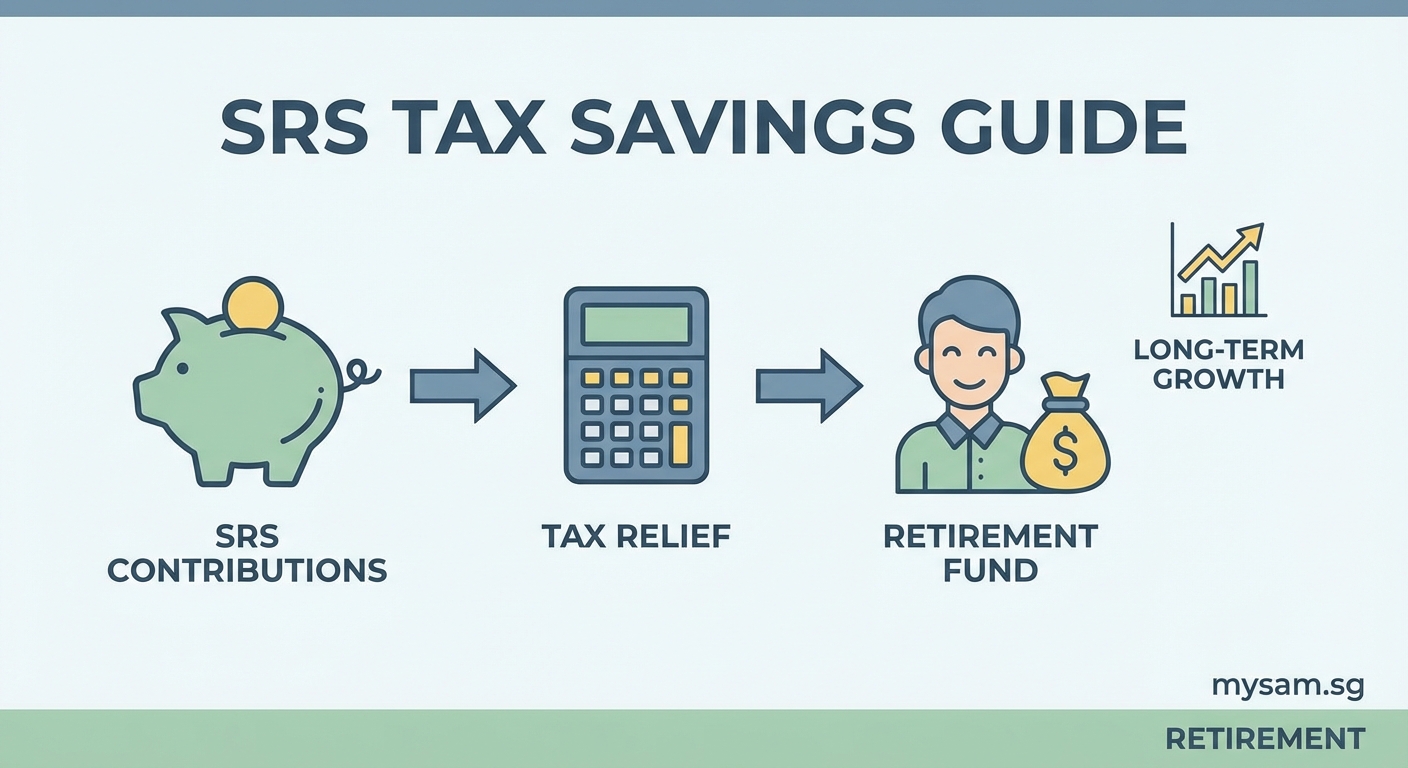
Here’s the deal. You put money into an SRS account. That money gets deducted from your taxable income immediately. Your tax bill drops.
The money sits in the account and you can invest it. Any gains are tax-free while inside the account.
When you retire and withdraw the money, only 50% of it counts as taxable income. The other half? Completely tax-free.
This matters because your tax rate at retirement will likely be lower than during your working years. You save twice.
The scheme works alongside CPF, not instead of it. CPF contributions are mandatory. SRS is voluntary and gives you control over how to invest the funds.
Who should open an SRS account
Not everyone benefits equally from SRS.
The higher your tax bracket, the more you save. Someone in the 11.5% tax bracket saves more than someone in the 4% bracket.
Here’s who gets the most value:
- Professionals earning $80,000 or more annually
- Self-employed individuals with irregular income
- Expatriates on high salaries (they get higher contribution caps)
- Anyone planning to retire in Singapore with lower income
If you’re in the lowest tax brackets, SRS might not move the needle much. Your CPF contributions already reduce your taxable income significantly.
But if you’re paying substantial income tax, ignoring SRS is like leaving money on the table.
How much you can contribute
Contribution limits differ based on your residency status.
Singapore citizens and permanent residents can contribute up to $15,300 per year. Foreigners can contribute up to $35,700 per year.
You don’t have to hit the maximum. Contribute whatever makes sense for your budget and tax situation.
The contribution must happen before December 31 to count for that tax year. Many people make their contribution in December to maximize their current year tax relief.
You can contribute in one lump sum or spread it across multiple deposits throughout the year. Both work the same for tax purposes.
Opening your SRS account step by step
Setting up an SRS account takes about 30 minutes.
-
Choose your bank. DBS, OCBC, and UOB all offer SRS accounts. Pick the one where you already have a relationship or prefer their investment platform.
-
Visit the branch with your NRIC or passport. You cannot open SRS accounts fully online yet. Some banks let you start the application online but require a branch visit to complete it.
-
Fill out the SRS account opening form. The bank staff will guide you through it.
-
Link your existing bank account for transfers. This makes contributing easier.
-
Set up your investment preferences if you plan to invest the funds immediately.
The account opens within a few days. You’ll receive account details and can start contributing.
Tax relief calculation that actually makes sense
Let’s use real numbers.
Say you earn $120,000 a year and contribute the maximum $15,300 to SRS.
Your taxable income drops from $120,000 to $104,700.
At this income level, you’re in the 11.5% marginal tax bracket. That $15,300 contribution saves you approximately $1,760 in taxes.
That’s $1,760 back in your pocket this year. Plus, the full $15,300 is now invested for your retirement.
Here’s a comparison table:
| Income Level | SRS Contribution | Tax Bracket | Approximate Tax Savings |
|---|---|---|---|
| $80,000 | $15,300 | 7% | $1,071 |
| $120,000 | $15,300 | 11.5% | $1,760 |
| $160,000 | $15,300 | 15% | $2,295 |
| $200,000 | $15,300 | 18% | $2,754 |
The higher your income, the more you save. This compounds over decades.
Investment options inside your SRS account
Your SRS money doesn’t have to sit idle.
You can invest it in:
- Unit trusts and mutual funds
- Singapore stocks
- Exchange-traded funds (ETFs)
- Fixed deposits
- Singapore Government Securities
- Bonds
- Insurance products
Different banks offer different investment platforms. DBS has DBS Vickers. OCBC has OCBC Securities. UOB has UOB Kay Hian.
Investment gains inside the SRS account grow tax-free. No capital gains tax. No dividend tax. Everything compounds without the tax drag.
This is powerful. A 7% return becomes actually 7%, not 7% minus taxes.
Most people use SRS funds to invest in diversified portfolios of stocks and bonds through ETFs or unit trusts. This balances growth with risk management.
“Think of your SRS account as a tax shelter for your investments. The tax-free growth over 20 to 30 years can add hundreds of thousands to your retirement nest egg compared to investing in a regular taxable account.” — Financial planning principle
The withdrawal rules you must understand
SRS has strict withdrawal rules. Break them and you lose the tax advantages.
The statutory retirement age in Singapore is currently 63. This is your penalty-free withdrawal age for SRS.
If you withdraw before 63, you pay a 5% penalty on the withdrawal amount. Plus, 100% of the withdrawal is added to your taxable income that year, not just 50%.
Early withdrawal kills the tax benefit.
After you hit 63, you must withdraw all your SRS funds over 10 years. You can withdraw any amount each year, as long as everything is out by year 10.
Only 50% of each withdrawal is taxable. The other 50% is tax-free.
This is where the magic happens. If you retire with little other income, your effective tax rate on SRS withdrawals could be close to zero.
Strategic withdrawal planning
Smart withdrawal timing saves thousands more.
Let’s say you retire at 63 with $300,000 in your SRS account.
You could withdraw $30,000 per year for 10 years. Only $15,000 per year is taxable.
If you have no other income, $15,000 falls well below the taxable threshold. You pay zero tax on those withdrawals.
You’ve received tax relief on contributions during your working years. You’ve grown the money tax-free. And now you’re withdrawing it tax-free.
That’s triple tax advantage.
Some people delay their first SRS withdrawal for a few years after 63 to let the money grow longer. The 10-year countdown starts when you make your first withdrawal, not when you turn 63.
Common mistakes that cost money
People make predictable errors with SRS.
Contributing without a plan. Some contribute just for tax relief but never invest the funds. The money sits in cash earning minimal interest. Inflation eats the value. Always invest your SRS contributions.
Early withdrawal. Life happens. Emergencies arise. But withdrawing SRS funds before 63 is expensive. Keep a separate emergency fund. Treat SRS as truly locked until retirement.
Ignoring the 10-year rule. Some people forget they must withdraw everything within 10 years. Poor planning means large withdrawals in later years, pushing them into higher tax brackets. Spread withdrawals evenly.
Not maximizing contributions in high-earning years. If you get a bonus or have an exceptional income year, max out your SRS contribution. The tax relief is worth more when your income is higher.
Here’s a comparison of smart versus poor SRS use:
| Approach | Smart Strategy | Poor Strategy |
|---|---|---|
| Contribution timing | December before tax year ends | Random, inconsistent |
| Fund management | Invested in diversified portfolio | Left in cash |
| Withdrawal planning | Spread evenly over 10 years | Large lump sums |
| Tax optimization | Withdraw during low-income years | Withdraw while still working |
SRS for self-employed professionals
If you’re self-employed, SRS becomes even more valuable.
Your income might fluctuate year to year. In high-income years, maximize SRS contributions to reduce your tax bill. In lower-income years, contribute less or skip it.
You have more flexibility than salaried employees.
Self-employed individuals also don’t have employer CPF contributions. SRS helps fill that retirement savings gap.
The tax relief provides immediate cash flow benefit. That $1,500 to $2,500 in tax savings can be reinvested into your business or personal savings.
Foreigners and SRS
Foreigners working in Singapore get a higher contribution cap of $35,700 per year.
This reflects that foreigners don’t have CPF benefits. The higher cap helps level the playing field for retirement savings.
If you’re a foreigner planning to retire in Singapore, SRS makes tremendous sense. The tax benefits are identical to citizens and PRs.
But if you plan to leave Singapore permanently, there’s a catch. You can close your SRS account and withdraw all funds, but 100% becomes taxable in that year. You lose the 50% tax-free benefit.
For foreigners, SRS works best if you’re committed to long-term residence in Singapore.
Combining SRS with CPF strategies
SRS and CPF work together as a retirement funding system.
Your CPF contributions are mandatory and provide a base layer of retirement savings. CPF also offers competitive risk-free returns, especially in the Special Account and Retirement Account.
SRS adds a voluntary layer with more investment flexibility. You control how to invest SRS funds across a wider range of assets.
A balanced approach uses both:
- Max out CPF top-ups if you want guaranteed returns
- Use SRS for tax relief and equity market exposure
- Keep cash emergency funds separate from both
Some people prioritize filling their CPF Special Account to the Full Retirement Sum first, then shift to SRS contributions. Others do both simultaneously.
There’s no single right answer. Your income level, risk tolerance, and retirement timeline determine the best mix.
What happens if you leave Singapore
If you’re a citizen or PR who emigrates, you can close your SRS account.
You’ll need to withdraw all funds. The entire withdrawal amount is taxable at 50%, regardless of your age. No penalty, but you lose the ability to spread withdrawals over 10 years.
The tax is calculated at your prevailing tax rate in the year of withdrawal. If you have no other Singapore income that year, the tax might be minimal.
For citizens and PRs, leaving Singapore doesn’t trigger penalties, just accelerated taxation.
For foreigners who lose employment pass status, similar rules apply. You can withdraw everything, with 50% taxable.
Making your first contribution
Ready to start? Here’s what to do this month.
Calculate your potential tax savings based on your income. Use IRAS tax calculators or consult a tax advisor to see exact figures.
Decide how much to contribute. Start with an amount that’s comfortable. You can always increase next year.
Transfer the funds to your SRS account before December 31 if you want the tax relief for this year.
Choose your investments immediately. Don’t let the money sit idle. Even a simple diversified ETF portfolio beats cash.
File your taxes next year and claim the relief. IRAS will automatically calculate it based on your SRS contribution.
Track your account annually. Review investment performance and rebalance as needed.
Building wealth while cutting taxes
The supplementary retirement scheme SRS Singapore isn’t complicated. It’s a straightforward trade: lock money until retirement, get tax breaks now and later.
For middle and high-income professionals, the math works strongly in your favor. The tax savings alone justify participation. The tax-free investment growth is bonus value.
Start small if you’re uncertain. Contribute $5,000 or $10,000 this year. See how it feels. Check your tax savings when you file next year.
Then adjust your strategy. Maybe you increase contributions. Maybe you refine your investment approach.
The key is starting. Every year you delay is a year of tax savings and compound growth you’ll never get back.
Your future self will thank you for the tax-advantaged wealth you’re building today.