
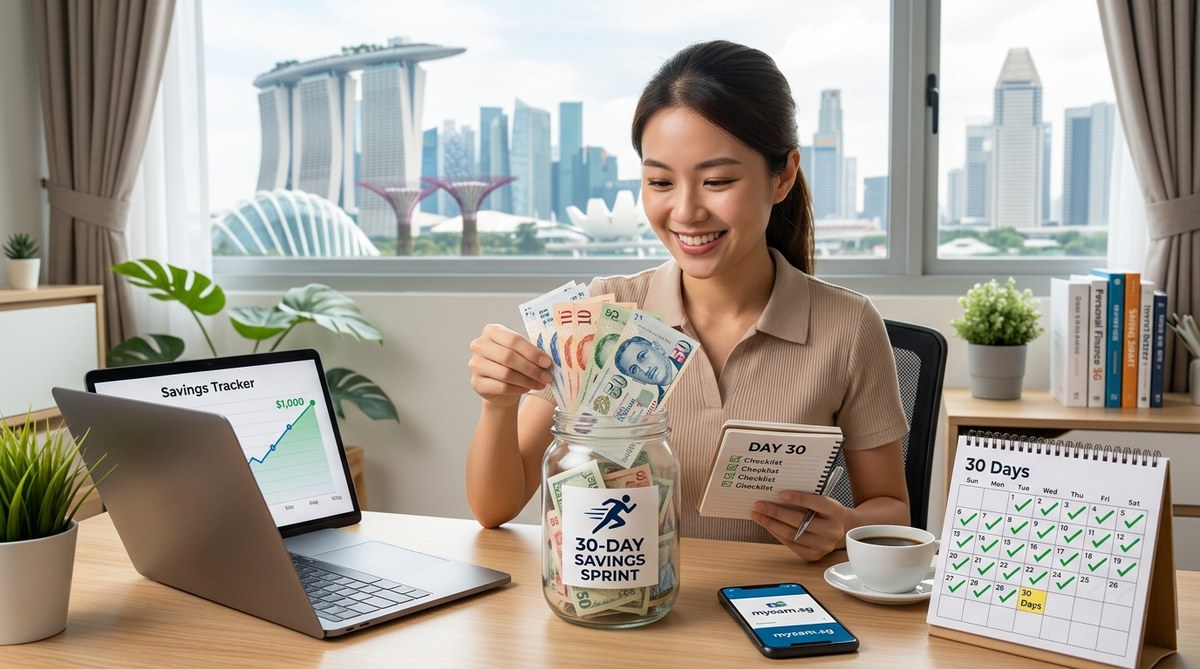
Saving a thousand dollars in 30 days sounds like a stretch when your rent, kopi, and Grab rides already eat up most of your paycheck. But here is the truth: most Singaporeans leak money in ways they do not even notice. A few deliberate swaps, a little extra hustle, and one month of intense focus can get you there. This guide shows you exactly how to do it without feeling like you are living on instant noodles and air.
Saving $1,000 in a single month in Singapore is possible when you combine three actions: cutting variable spending, earning extra income on the side, and redirecting fixed costs you can control. This 30 day sprint uses daily challenges, smart substitution, and small gigs to close the gap. By day 30 you will have a bigger bank balance and sharper money habits that last beyond the month.
Why 30 Days Can Change Your Savings Trajectory
A month is short enough to stay motivated and long enough to form new routines. The goal here is not to overhaul your entire financial life. It is to generate an extra $1,000 in cash that you can put toward an emergency fund, a goal, or a debt payment.
Many young professionals in Singapore earn a decent salary but still struggle to save. The problem is rarely income. It is that small daily expenses add up faster than we realize. A $6.50 coffee here, a $12 Grab ride there, a $8.90 bubble tea after work. Individually they feel harmless. Collectively they drain hundreds each month.
This plan addresses that leakage directly.
Step 1: Calculate Your Baseline and Set a Target
Before you start, you need to know where your money goes. Do not guess. Use a free budgeting app or a simple Google Sheet to track every single expense for three days. That gives you a snapshot.
Once you see the numbers, divide your spending into three buckets:
- Fixed essentials (rent, utilities, transport, insurance)
- Variable lifestyle (food delivery, shopping, entertainment, coffee)
- Savings and investments
Your mission is to trim the variable bucket and temporarily reduce some fixed costs. Aim to free up at least $500 from spending cuts. The other $500 will come from earning extra income during the month.
Here is a realistic breakdown of the $1,000 target:
| Source of Savings | Target Amount | How to Get There |
|---|---|---|
| Cut food and drink spending | $200 | Cook more, reduce delivery, skip bubble tea |
| Reduce transport costs | $100 | Walk, cycle, or use public transport instead of Grab |
| Cancel unused subscriptions | $50 | Audit streaming, gym, and app subscriptions |
| Lower utility and phone bills | $50 | Switch to a cheaper telco plan, use less aircon |
| Side hustle or gig income | $500 | Tutoring, freelancing, selling items, mystery shopping |
| Total | $1,000 | Combine cuts and extra income |
Step 2: The 7 Biggest Leaks in a Singaporean Budget
Most people do not have a spending problem. They have a leak problem. Here are the seven areas where money quietly escapes every month.
- Food delivery and dining out. A $20 GrabFood order twice a week adds up to $160 a month. Cooking at home costs half that.
- Ride hailing. A $10 Grab ride to work because you woke up late. A $12 ride home because the MRT was crowded. That is $110 a month if you do it five times.
- Bubble tea and specialty coffee. A $6.50 coffee every weekday costs $130 a month. A $4.90 bubble tea twice a week adds $39.
- Unused gym memberships and apps. Many people pay for ActiveSG, Anytime Fitness, Netflix, Spotify, and iCloud and barely use them.
- Bank fees. Late payment fees, foreign transaction fees, and atm fees can cost $10 to $30 a month without you noticing.
- Impulse purchases on Shopee and Lazada. Those $15 items you buy at 11pm because of a flash sale often get used once.
- Overpriced telco and utility plans. You might be on a $40 Singtel plan when a $10 SIM-only plan works just fine.
Pick two or three of these leaks and eliminate them for the month. That alone can free up $200 to $300.
Step 3: The 30 Day Savings Sprint Plan
This is a day by day approach that makes the goal manageable. You do not need to follow it perfectly. Use it as a framework.
Week 1: Audit and Cut
- Day 1: List all your subscriptions and cancel anything you have not used in the last 30 days.
- Day 2: Switch your telco plan to a SIM-only plan. Compare prices on MoneySmart or Singtel.
- Day 3: Cook all three meals at home. No eating out.
- Day 4: Walk or take the bus for every trip. No Grab or private hire.
- Day 5: Sell three unused items on Carousell. Aim for at least $50 total.
- Day 6: Call your insurance agent and ask for a policy review. Cancel riders you do not need.
- Day 7: Transfer the money you saved this week into a separate savings account immediately.
Week 2: Earn Extra
- Day 8: Sign up for a gig platform like Fiverr, Upwork, or Gumtree. Offer a skill you already have.
- Day 9: Complete one small freelance task. Even a $50 job helps.
- Day 10: Do a mystery shopping shift. Platforms like Ipsos and ShopBack offer paid tasks.
- Day 11: Tutor a subject you know well. Offer online or in person sessions.
- Day 12: Dog walk or pet sit for a neighbor. Charge $20 per walk.
- Day 13: Participate in a paid research study or focus group.
- Day 14: Transfer your earnings from the week into your savings account.
Week 3: Trim Fixed Costs
- Day 15: Review your electricity and water bill. Reduce aircon usage by one hour a day.
- Day 16: Call your broadband provider and ask for a cheaper plan or a loyalty discount.
- Day 17: Switch your credit card to one that offers higher cashback on groceries and petrol. See the best cashback credit cards in Singapore for everyday spending 2026.
- Day 18: Cancel any insurance riders that duplicate coverage.
- Day 19: Reduce your grocery bill by shopping at wet markets or using discount apps.
- Day 20: Check if you qualify for a cheaper HDB conservancy fee or utility rebate.
- Day 21: Transfer the savings from this week into your account.
Week 4: Push to the Finish
- Day 22: Do a no spend day. Spend zero dollars.
- Day 23: Another no spend day.
- Day 24: Sell one larger item on Carousell (electronics, furniture, bags).
- Day 25: Complete a second freelance gig or side job.
- Day 26: Do a no spend day.
- Day 27: Review your progress. Calculate how much you have saved and earned so far.
- Day 28: Do one final side gig or task to close any gap.
- Day 29: Transfer all remaining money into savings.
- Day 30: Celebrate. You saved $1,000 this month.
Step 4: The Side Hustle Path to $500
Cutting spending alone will not get you to $1,000 unless your income is high. That is why earning extra cash is half the plan. Here are four realistic side hustles for Singaporeans that can generate $500 in a month.
“The fastest way to save $1,000 in a month is not to cut more. It is to earn $500 and cut $500. That split is achievable for almost any working adult in Singapore.” — Personal finance coach based in Singapore
Tutoring
Singapore parents pay $30 to $80 an hour for tutors. If you teach two students for two hours each per week, that is $160 to $320 a month. Subjects like math, science, and Chinese language are in high demand. Platforms like TutorCity and SG Tutor connect you with families.
Freelancing
If you can write, design, edit videos, or manage social media, platforms like Upwork and Fiverr have global clients. A single $200 project can cover a large chunk of your $500 target. Start with a small job and deliver on time. Repeat clients follow.
Selling unused items
Most people have $500 worth of unused items in their home. Old phones, clothes, bags, electronics, furniture. Carousell is the top platform for secondhand sales in Singapore. Take clear photos, write honest descriptions, and price competitively.
Pet sitting and dog walking
Many Singaporeans work long hours and need help with their pets. Dog walking rates are $15 to $25 per walk. Pet sitting overnight can bring $40 to $70 per night. One weekend of sitting plus a few walks can add $150 to your savings.
Step 5: Use the Right Tools to Automate and Track
Saving $1,000 in a month requires discipline, but the right tools make it easier. Here are a few that help Singaporeans stay on track.
- A high interest savings account. Park your money in an account that pays you for saving. Compare high interest savings accounts in Singapore where to park your emergency fund in 2026.
- A budgeting app. Use Seedly, MoneyLion, or a simple Google Sheet. Track every dollar.
- Automatic transfers. Set up a recurring transfer from your main account to savings on payday. Treat it like a bill.
- Cashback credit cards. Use a card that gives you cashback on groceries, petrol, and dining. See which Singapore credit cards offer the best cashback for groceries and petrol in 2026.
Common Mistakes That Sabotage the Sprint
Even with a solid plan, it is easy to slip. Watch out for these pitfalls.
| Mistake | Why It Happens | How to Avoid It |
|---|---|---|
| Trying to cut everything at once | Overwhelm leads to giving up | Focus on two or three leaks only |
| Not tracking progress | Out of sight, out of mind | Check your savings balance every three days |
| Overestimating side hustle income | Gigs take time to land | Start hustling on day one, not day 20 |
| Forgetting to transfer savings | Money stays in your spending account | Automate transfers weekly |
| Going too extreme and rebounding | Deprivation leads to a spending spree | Allow one small treat per week |
What to Do With Your $1,000 After the Sprint
You did the work. Now do not waste it. Here is the smartest way to use that $1,000.
- If you have no emergency fund: Put it into a high yield savings account. Aim for three to six months of expenses.
- If you have credit card debt: Pay down the highest interest card first. That saves you more money than any investment.
- If you are debt free and have an emergency fund: Invest it. Look at how to start investing in Singapore with just $100 a month for a simple approach.
- If you want to grow it further: Consider dollar cost averaging in Singapore your guide to stress free investing.
How to Keep the Momentum Going Beyond 30 Days
A 30 day sprint is powerful, but it is the habits that last that build real wealth. Use the momentum from this month to make lasting changes.
Keep the no spend days. Keep cooking more. Keep the side hustle if you enjoy it. And keep tracking your spending.
If you saved $1,000 in one month, imagine what you can do in six months. That is $6,000. In a year, that is $12,000 plus interest. That is a real down payment on a goal.
Your 30 Day Sprint Starts Now
You do not need a perfect plan. You just need to start. Pick one expense to cut today. Pick one item to sell. Pick one side gig to try. Do those three things and you are already closer to $1,000 than you were this morning.
Saving money in Singapore is not about sacrifice. It is about making choices that align with your goals. This month, choose to keep more of your hard earned cash. You have 30 days. Make them count.