

Turning 55 is a milestone in Singapore. It’s when you can finally access your CPF savings. But just because you can withdraw doesn’t mean you should. The choice between taking your money now or letting it grow affects your retirement income for decades.
At 55, you can withdraw above your Full Retirement Sum, but money left in CPF earns up to 6% risk-free interest. Withdrawing reduces your retirement payouts from 65 onwards. The right choice depends on your financial needs, debt situation, and whether you have other investments that can beat CPF’s guaranteed returns safely.
What happens to your CPF when you turn 55
When you hit 55, CPF creates your Retirement Account automatically. Money from your Special Account and part of your Ordinary Account moves into this new RA.
The government sets three tier levels each year:
- Basic Retirement Sum (about half of the Full Retirement Sum)
- Full Retirement Sum (currently $205,800 for 2025)
- Enhanced Retirement Sum (1.5 times the Full Retirement Sum)
You can only withdraw amounts above your chosen retirement sum. If you own property, you might pledge it to meet the Basic Retirement Sum and withdraw more cash.
Any amount you keep in your RA earns interest. This compounds over time until you start receiving monthly payouts at your payout eligibility age, typically 65.
The interest rates matter here. Your RA earns up to 6% per year on the first $60,000 of your combined CPF balances, with an extra 1% on the first $30,000 if you’re above 55. That’s risk-free, government-guaranteed growth.
Reasons you might want to withdraw
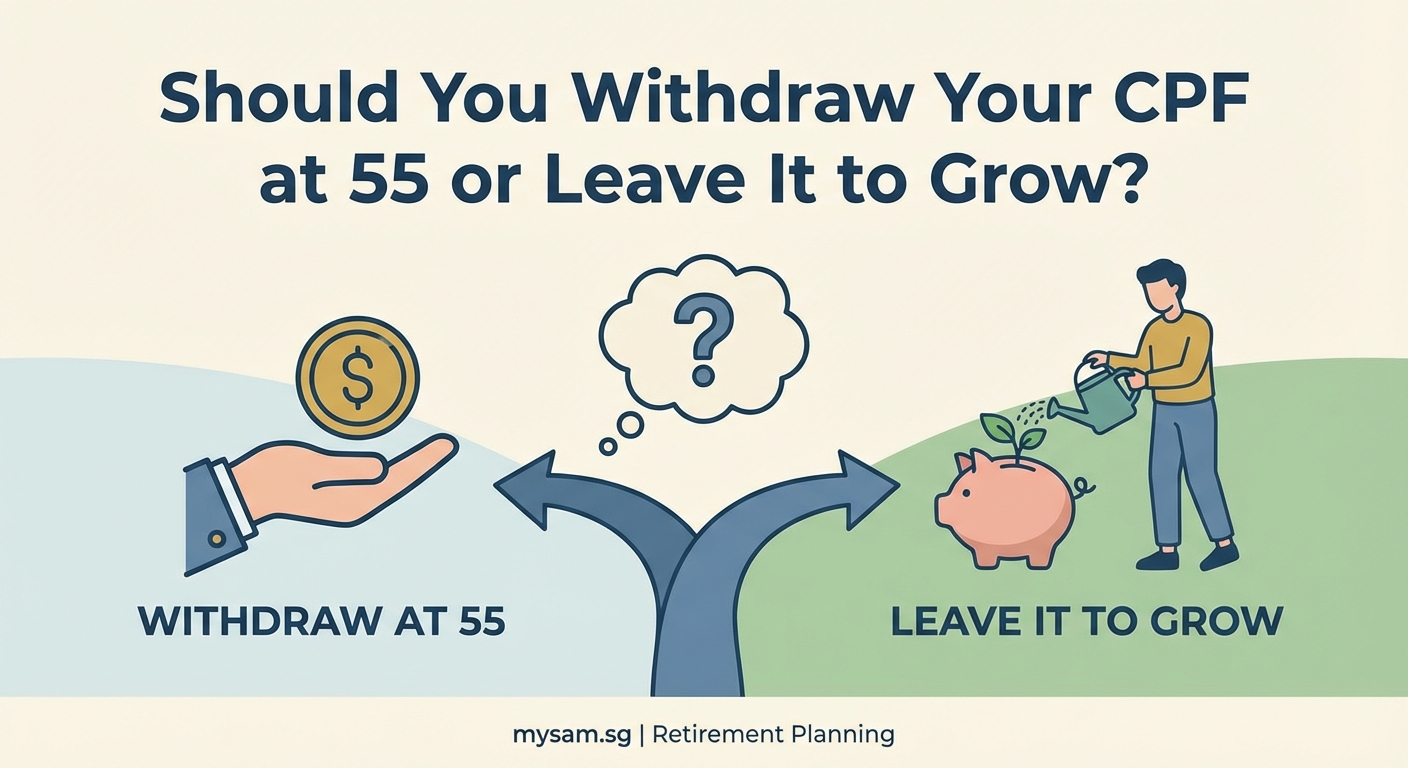
Some situations make early withdrawal sensible.
You have high-interest debt. Credit card debt at 26% annual interest or personal loans above 8% cost you more than CPF earns. Clearing these debts first makes mathematical sense.
You need emergency funds. If you have no liquid savings and face medical bills or urgent expenses, accessing CPF might be your only option. Building a buffer matters more than optimal returns when you’re in crisis.
You have better investment opportunities. Some people can reliably earn more than 4% to 6% elsewhere. But be honest about your track record. Most retail investors underperform simple index funds after fees and emotional trading.
You want to enjoy your money now. Life is uncertain. Some people prefer experiences and purchases in their 50s when they’re healthier. This isn’t purely financial, but it’s valid.
You’re emigrating permanently. If you’re leaving Singapore for good, you can withdraw your entire CPF balance regardless of the retirement sums.
Reasons you should probably leave it alone
The case for not withdrawing is strong for most people.
Your CPF RA earns 4% base interest, up to 6% on certain amounts. No bank fixed deposit comes close. No investment offers the same guarantee with zero risk.
The money grows tax-free. You don’t pay income tax on CPF interest. You don’t pay capital gains tax when it compounds. This tax advantage adds up significantly over 10 years.
Starting payouts at 65 gives you inflation-adjusted income for life. CPF LIFE provides monthly payments that increase slightly each year. You cannot outlive these payments. No private annuity in Singapore offers comparable rates.
Withdrawing reduces your future payouts permanently. Every dollar you take out at 55 means less monthly income from 65 onwards. For someone living to 85 or 90, that’s 20 to 25 years of reduced cash flow.
“The biggest retirement planning mistake I see is people withdrawing CPF at 55 for non-urgent reasons, then struggling with insufficient income at 70 when medical costs rise and they can’t work anymore.” – Financial planner with 15 years of experience
How much you can actually withdraw
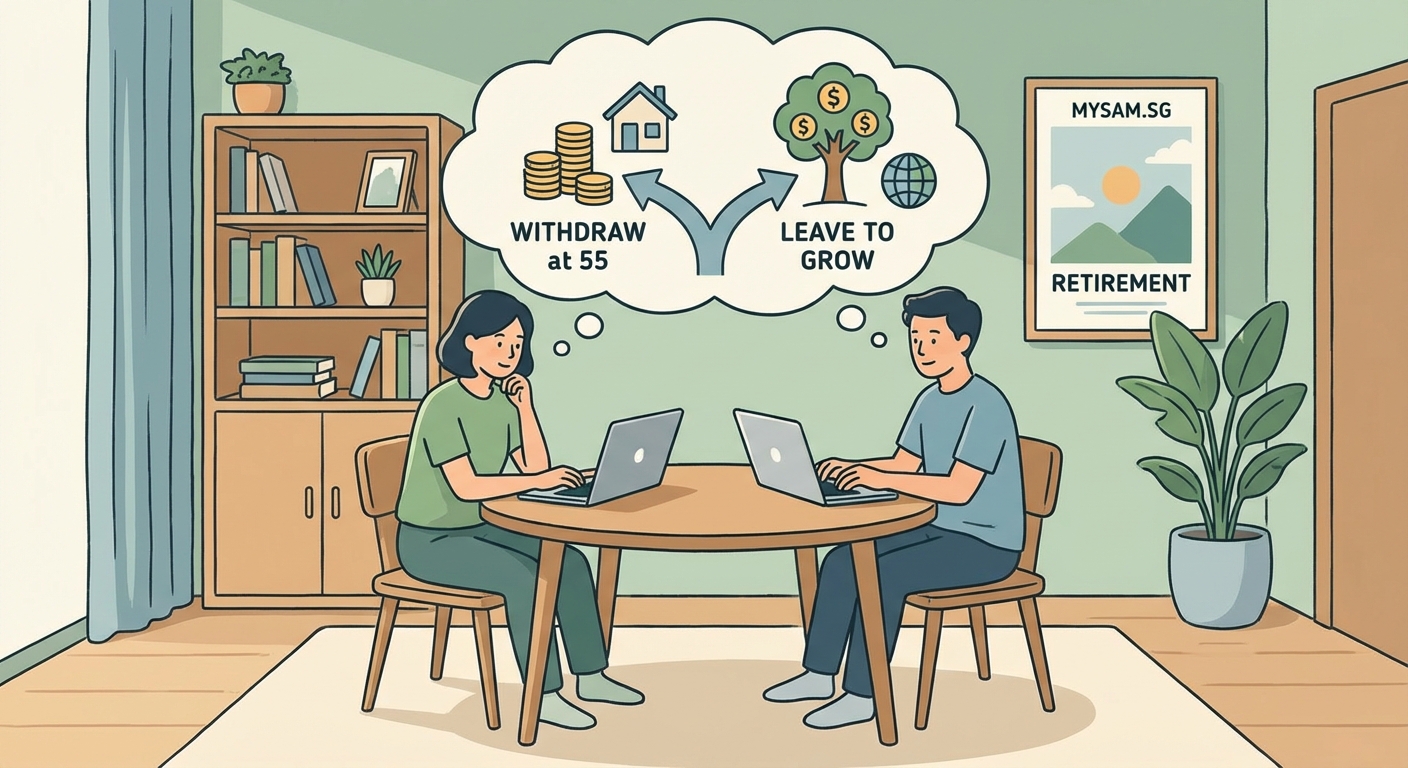
The withdrawal amount depends on your retirement sum choice and property ownership.
| Your situation | What you can withdraw |
|---|---|
| Meet Full Retirement Sum in cash | Everything above $205,800 |
| Meet Basic Retirement Sum + pledge property | Everything above $102,900 |
| Cannot meet Basic Retirement Sum | $5,000 maximum, rest stays locked |
| Turn 55 before July 2025 | Use the retirement sum from your cohort year |
Here’s a real example. Sarah turns 55 in 2025 with $250,000 in combined OA and SA balances.
If she chooses the Full Retirement Sum option, $205,800 moves to her RA. She can withdraw $44,200.
If she pledges her paid-up HDB flat and chooses Basic Retirement Sum, only $102,900 stays in her RA. She can withdraw $147,100.
The second option gives her more cash now but much lower monthly payouts from 65 onwards.
The math behind leaving it to grow
Numbers make the choice clearer.
Let’s say you leave $100,000 in your RA at 55. It earns 4% annually (conservative estimate, ignoring the extra interest on first $60,000).
After 10 years at 65, you’ll have about $148,000. That’s $48,000 in risk-free interest.
This amount then converts to monthly CPF LIFE payouts. Under the Standard Plan, $148,000 might give you roughly $1,200 monthly for life.
If you withdrew that $100,000 at 55 and spent it, you’d receive zero from that amount at 65. You’d need to fund those years entirely from other sources.
The break-even point typically comes around age 80 to 85. If you live longer, keeping money in CPF wins significantly. If you pass away earlier, you would have enjoyed less of your savings.
Your beneficiaries receive any unused CPF balances, so the money doesn’t disappear. But the monthly payout structure means you can’t leave as much compared to a lump sum investment.
Steps to make your decision
Follow this process to choose wisely.
-
Calculate your total CPF balances at 55. Add up your OA and SA. Subtract any amounts used for property or investments that need to be refunded.
-
List your current monthly expenses. Include housing, food, transport, insurance, medical costs, and discretionary spending. Be realistic about what you’ll need at 65 and beyond.
-
Check your other retirement income sources. Do you have investment properties? Dividend stocks? A pension? SRS savings? Add up what these will provide monthly.
-
Estimate your CPF LIFE payout. Use the CPF calculator online to see monthly amounts under different retirement sum choices.
-
Identify any urgent financial needs. Do you have debt? Medical expenses? Necessary home repairs? Quantify these clearly.
-
Compare the opportunity cost. Can you truly earn more than 4% to 6% safely elsewhere? Be honest about fees, taxes, and your investment discipline.
-
Consider your health and family longevity. If your parents lived to 90, you probably will too. If you have serious health issues, your timeline might be shorter.
Common mistakes people make
Avoid these errors that hurt long-term security.
Withdrawing to invest in risky schemes. Every year, people pull CPF money to invest in property overseas, cryptocurrency, or business ventures that fail. CPF’s guaranteed return beats most speculative investments.
Underestimating how long they’ll live. Singaporeans have among the highest life expectancies globally. Planning only to 75 or 80 leaves you vulnerable in your late 80s when you’re least able to work.
Forgetting about healthcare costs. Medical expenses increase dramatically after 70. MediShield Life and MediSave help, but you’ll still face co-payments and non-covered treatments.
Giving money to children prematurely. Some withdraw CPF to help adult children buy property or start businesses. While generous, this leaves you dependent on others for your own retirement.
Ignoring inflation. $2,000 monthly might feel comfortable today. In 20 years, the same amount buys much less. CPF LIFE payouts include small annual increases to counter this.
What about partial withdrawals
You don’t have to make an all-or-nothing choice.
If you have $150,000 at 55 and the Full Retirement Sum is $205,800, you cannot withdraw anything. But if you have $250,000, you could withdraw part of the $44,200 excess and leave some.
The CPF system doesn’t force you to withdraw everything above your retirement sum immediately. You can leave excess amounts in your RA to earn interest.
This middle path works well if you need some cash for specific purposes but want to maximize your future payouts.
One strategy: withdraw only what you need for genuine emergencies or debt clearance. Leave the rest growing at 4% to 6%. You can always withdraw more later if your situation changes, but you cannot undo a withdrawal.
Special considerations for different groups
Your situation affects the calculation.
Self-employed individuals often have lower CPF balances because contributions aren’t mandatory. If you’re in this group, preserving what you have matters even more.
Those with rental income might not need CPF withdrawals since property already provides cash flow. Leaving CPF intact gives you diversification.
People planning to work past 65 can afford to take more risk with withdrawals because they’ll have continued employment income. But health isn’t guaranteed, so be cautious.
Singles without dependents might prioritize enjoying their money earlier since they’re not leaving an inheritance. But they also lack family safety nets if funds run out.
Couples should coordinate their CPF decisions. If one spouse has higher balances, they might keep theirs growing while the other makes a partial withdrawal.
Your money, your timeline, your choice
The decision to withdraw CPF at 55 isn’t about right or wrong. It’s about matching your choice to your specific circumstances.
For most Singaporeans, leaving money in CPF makes financial sense. The guaranteed returns, tax advantages, and lifetime income protection are hard to replicate elsewhere. Withdrawing reduces your future security for present consumption.
But rules have exceptions. If you’re clearing expensive debt, facing genuine emergencies, or have legitimate investment expertise with a proven track record, withdrawing part of your CPF might work.
Take time with this decision. Run the numbers multiple times. Talk to family members who depend on you. Consider speaking with a fee-only financial planner who doesn’t earn commissions from selling you products.
Your CPF at 55 represents decades of savings. Treat this choice with the seriousness it deserves. Your 75-year-old self will thank you for thinking carefully today.