
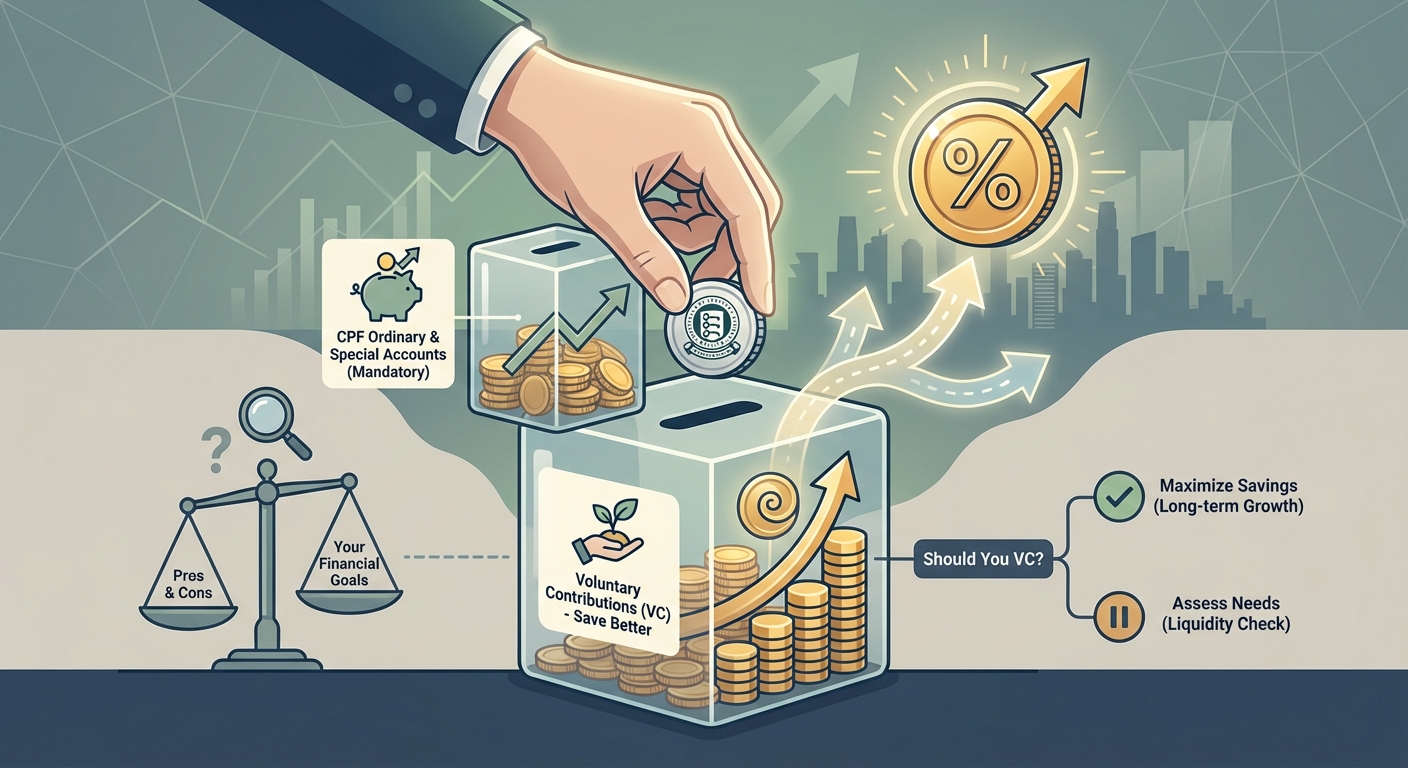
You’re earning well, hitting your career stride, and starting to think seriously about retirement. The CPF system is powerful, but you’ve heard whispers about voluntary contributions and wonder if they’re worth your time and money.
CPF voluntary contributions let you top up your retirement accounts beyond mandatory contributions, earning up to 6% interest while enjoying tax relief up to $16,000 annually. They work best for professionals with surplus cash, stable income, and at least 10 to 15 years before retirement. The strategy requires understanding contribution caps, account allocation rules, and withdrawal restrictions to avoid locking up money you might need sooner.
Understanding CPF voluntary contributions
CPF voluntary contributions are extra payments you make to your CPF accounts on top of what your employer deducts from your salary each month.
Think of them as topping up a high-interest savings account that you can’t touch until retirement.
The government offers two main schemes: the Voluntary Contribution (VC) scheme and the Retirement Sum Topping-Up (RSTU) scheme. Each serves different purposes and comes with distinct rules.
The VC scheme lets you top up your own Special Account (SA) or Ordinary Account (OA). The RSTU scheme allows you to top up your own or a family member’s Retirement Account (RA) or SA.
Both schemes offer tax relief, but the amounts and conditions differ.
Your contributions earn the same interest rates as mandatory contributions. That’s 2.5% for OA and up to 6% for SA and RA, with an extra 1% on the first $60,000 of combined balances (capped at $20,000 from OA).
These rates beat most savings accounts and many fixed deposits without market risk.
Who benefits most from voluntary top-ups
Not everyone should rush to make voluntary contributions.
You’re a strong candidate if you’re earning above $100,000 annually and already maxing out other tax relief options like SRS contributions. The tax savings alone can justify the strategy.
Professionals in their 30s and 40s with stable income and no immediate need for large cash outlays get the most value. You have time for compound interest to work its magic while building a retirement cushion.
Self-employed individuals benefit significantly because they don’t receive employer CPF contributions. Voluntary contributions help bridge that gap while reducing taxable income.
You should think twice if you’re carrying high-interest debt, lack an emergency fund, or need cash for major life events in the next five years. CPF money stays locked until retirement age, currently 65 for most members.
Parents saving for children’s education or couples planning to buy property soon might find better uses for spare cash. Liquidity matters when life throws curveballs.
Step-by-step process to make voluntary contributions
Making voluntary contributions is straightforward once you understand the mechanics.
- Log in to your CPF account through Singpass on the CPF website or mobile app.
- Navigate to the “My Request” section and select “Contributions”.
- Choose between making a Voluntary Contribution or Retirement Sum Top-Up based on your goals.
- Specify the amount and select which account to credit (SA, OA, or RA depending on the scheme).
- Complete payment via internet banking, GIRO, or PayNow.
- Save the transaction receipt for tax filing purposes.
The system processes most contributions within three business days. You’ll see the updated balance in your CPF account shortly after.
For RSTU contributions to family members, you’ll need their NRIC details and relationship proof. The recipient must be a Singapore Citizen or Permanent Resident.
Contributions made by December 31 qualify for tax relief in that assessment year. Don’t wait until the last minute as processing delays can push your contribution into the next year.
Tax relief limits and calculation strategies
The tax relief structure rewards strategic planning.
You can claim up to $8,000 in tax relief for topping up your own accounts under the RSTU scheme. Another $8,000 is available for topping up family members’ accounts, bringing total potential relief to $16,000 annually.
VC scheme contributions don’t offer tax relief. That makes RSTU the better choice for most people focused on tax optimization.
Here’s how the math works. If you’re in the 11.5% tax bracket and contribute $8,000 to your SA, you save $920 in taxes. At the 22% bracket, that jumps to $1,760.
Higher earners see bigger absolute savings, making voluntary contributions increasingly attractive as income rises.
Plan your contributions around your tax bracket. If you’re expecting a bonus or salary increase that pushes you into a higher bracket, time your top-up to maximize relief in that year.
Consider spreading contributions across multiple years if you have a large lump sum. Annual caps mean you can’t claim relief on more than $16,000 in a single year, but consistent contributions over time compound beautifully.
Account allocation and contribution caps
Understanding where your money goes matters as much as how much you contribute.
RSTU contributions go directly to your SA if you’re below 55. After 55, they flow to your RA up to the Full Retirement Sum, currently $213,000 for members turning 55 in 2026.
VC contributions let you choose between OA and SA. Most people target SA for the higher 4% to 6% interest rate versus OA’s 2.5%.
There’s a catch. Your combined OA and SA balances can’t exceed the Current Full Retirement Sum. Once you hit that limit, additional voluntary contributions aren’t allowed.
For members turning 55 in 2026, that cap sits at $213,000. It increases annually, so check the latest figures before planning large contributions.
| Contribution Type | Target Account | Interest Rate | Tax Relief | Best For |
|---|---|---|---|---|
| RSTU (self) | SA or RA | Up to 6% | Up to $8,000 | Tax optimization and retirement focus |
| RSTU (family) | SA or RA | Up to 6% | Up to $8,000 | Supporting parents or spouse |
| VC | OA or SA | 2.5% to 6% | None | Flexibility without tax benefit |
The table shows why most people prioritize RSTU for themselves first, then family members, before considering VC.
Common mistakes to avoid
Many well-intentioned savers trip over preventable errors.
Contributing too much too fast is the biggest mistake. Once money enters CPF, you can’t withdraw it except under specific circumstances like property purchase, medical needs, or retirement.
People forget about the annual caps and make contributions that don’t qualify for full tax relief. Anything above $8,000 for yourself or $8,000 for family gets no tax benefit.
Timing errors cost money. Contributions processed after December 31 don’t count for that year’s tax relief, even if you initiated payment in December.
Some contribute to OA instead of SA, sacrificing 3.5% in annual interest. Unless you’re planning to use OA funds for property or investment soon, SA makes more sense.
Parents sometimes top up children’s CPF accounts expecting tax relief. That doesn’t work. Relief only applies to contributions for yourself, spouse, parents, or grandparents.
Neglecting your emergency fund to maximize CPF contributions creates risk. You might face expensive debt if unexpected expenses arise and you’ve locked all spare cash in CPF.
Balancing CPF with other financial priorities
CPF voluntary contributions are one tool in a larger financial toolkit.
Your emergency fund comes first. Aim for six months of expenses in accessible savings before considering voluntary contributions. Building that buffer protects you from having to tap expensive credit when emergencies strike.
High-interest debt should be eliminated before adding to CPF. Credit card balances at 26% annual interest destroy wealth faster than CPF builds it at 6%.
Investment opportunities outside CPF deserve consideration. If you’re comfortable with market risk and have a long time horizon, starting an investment portfolio might generate higher returns than CPF’s guaranteed rates.
Property down payments compete for the same dollars. If you’re planning to buy in the next few years, keep funds liquid rather than locking them in CPF.
SRS contributions offer similar tax benefits with more flexibility. The Supplementary Retirement Scheme allows penalty-free withdrawals after 62, versus CPF’s stricter rules.
The sweet spot for many professionals is splitting surplus cash between CPF top-ups for guaranteed returns and tax relief, plus market investments for growth potential.
Maximizing returns through compound interest
The real power of voluntary contributions shows up over decades, not years.
A 35-year-old contributing $8,000 annually to SA will accumulate approximately $476,000 by age 55, assuming 4% interest. That’s $160,000 in contributions plus $316,000 in interest.
Wait until 45 to start the same contribution pattern and you’ll have about $242,000. You’ve saved $80,000 but earned only $162,000 in interest.
The ten-year head start nearly doubles your final balance. Time is your biggest ally.
Extra interest kicks in on the first $60,000 of combined balances. Getting to that threshold early through voluntary contributions accelerates growth meaningfully.
Consider a member with $40,000 in combined balances earning 4% on SA. Adding a $20,000 voluntary contribution triggers the extra 1% on $60,000, generating an additional $600 annually.
That bonus interest compounds over decades, adding tens of thousands to your retirement nest egg.
Alternative uses for surplus cash
Before committing to voluntary contributions, consider what else you could do with the money.
Paying down your mortgage reduces interest costs and builds home equity. With mortgage rates around 3% to 4%, the savings compete with CPF SA returns.
Upskilling through courses or certifications can boost earning power. Negotiating a higher salary after gaining new skills might generate more long-term wealth than CPF interest.
Starting a side business or pursuing side hustles offers unlimited upside compared to CPF’s fixed returns. The trade-off is higher risk and time investment.
Insurance coverage protects your family’s financial security. Adequate life insurance prevents catastrophic losses that could wipe out years of savings.
Travel and experiences while you’re young and healthy have value beyond spreadsheets. Retirement savings matter, but so does living well today.
The right choice depends on your personal situation, risk tolerance, and life stage. Most people benefit from a balanced approach rather than putting all surplus cash in one bucket.
When voluntary contributions make perfect sense
Certain situations make voluntary contributions a no-brainer.
You receive a year-end bonus in November or December and want to reduce that year’s tax bill. An $8,000 RSTU contribution to your SA immediately cuts taxable income.
You’re self-employed with irregular income and want to build retirement savings systematically. Regular voluntary contributions create the discipline that employer contributions provide for salaried workers.
Your parents or spouse have low CPF balances and you want to help them retire comfortably. The $8,000 tax relief for family top-ups makes generosity tax-efficient.
You’ve maxed out all other tax relief options and still have surplus income. After SRS, insurance relief, and course fees, CPF top-ups are the next logical step.
You’re approaching 55 and want to ensure you hit the Full Retirement Sum for maximum CPF LIFE payouts. Understanding your payout options helps you plan the right contribution amount.
You’re conservative with money and prefer guaranteed returns over market volatility. CPF’s government backing and consistent interest rates provide peace of mind.
Putting your CPF strategy into action
CPF voluntary contributions work best as part of a comprehensive financial plan, not as an isolated tactic.
Start by assessing your complete financial picture. List your emergency fund, debts, short-term goals, and long-term retirement needs.
Calculate your tax bracket and potential relief from various contribution amounts. Run the numbers to see actual savings, not just percentages.
Set a sustainable contribution schedule that doesn’t strain your monthly budget. Consistency matters more than occasional large lump sums.
Review your strategy annually as your income, tax situation, and life circumstances change. What made sense at 35 might need adjustment at 45.
Track your CPF balance growth and celebrate milestones. Watching your retirement savings compound provides motivation to maintain the discipline.
Your future self will thank you for the contributions you make today. Each dollar you add to CPF is a dollar that’s working for you, guaranteed by the government, growing tax-free until you need it most.