

Asking for more money feels uncomfortable. Your palms sweat. Your voice shakes. You worry the hiring manager will pull the offer or your boss will think you’re ungrateful.
But here’s the truth: most employers in Singapore expect you to negotiate. They build buffer room into their first offer. If you accept immediately, you leave thousands of dollars on the table every year. Over a career, that compounds into hundreds of thousands.
This guide shows you exactly how to negotiate salary in Singapore, whether you’re handling a new job offer or preparing for your annual review. You’ll get step-by-step scripts, timing strategies, and real examples that work in Singapore’s job market.
Salary negotiation in Singapore requires research, timing, and confidence. Know your market value using tools like MyCareersFuture and Glassdoor, wait for a written offer before negotiating, anchor high with specific numbers backed by data, and practice your script out loud. Most employers expect negotiation and build flexibility into initial offers, so asking professionally rarely costs you the job.
Why negotiation works in Singapore
Singapore employers typically offer 10 to 20% below their maximum budget. This buffer protects them if you negotiate. It also means accepting the first number costs you real money.
A $5,000 monthly salary negotiated up by 15% becomes $5,750. That’s $9,000 more per year. Over five years, even without raises, you earn $45,000 extra. Add CPF contributions and bonuses calculated on base salary, and the gap widens further.
Many professionals avoid negotiating because they fear seeming greedy or losing the offer. But hiring managers view negotiation as normal professional behavior. They’ve already invested weeks screening candidates and conducting interviews. They want you to accept. A reasonable request won’t make them withdraw the offer.
Research your market value first
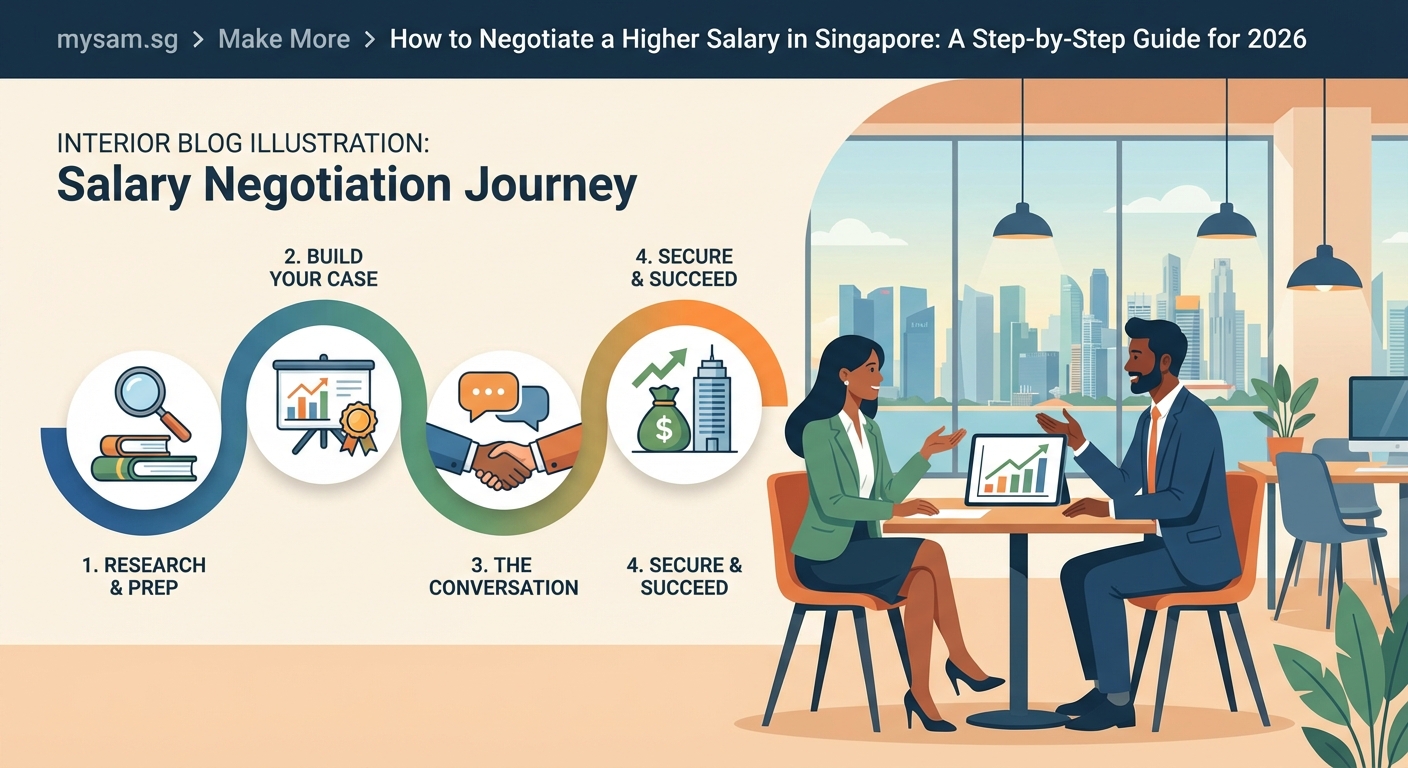
You can’t negotiate effectively without knowing what you’re worth. Singapore salary data is more transparent than ever, thanks to government initiatives and crowdsourced platforms.
Start with these resources:
- MyCareersFuture: Government job portal showing salary ranges for posted positions
- Glassdoor Singapore: Employee-reported salaries by company and role
- LinkedIn Salary: Crowdsourced data filtered by experience and industry
- Robert Walters Salary Survey: Annual report covering multiple sectors
- Recruitment agencies: Call two or three agencies in your field and ask about current rates
Look for roles matching your job title, years of experience, and industry. Note the 25th percentile, median, and 75th percentile. If you’re a strong performer with in-demand skills, aim for the 75th percentile or higher.
Document specific numbers. Vague statements like “I deserve more” carry no weight. Saying “Based on Robert Walters data, senior analysts with five years of experience in fintech earn between $7,500 and $9,200” shows you’ve done homework.
Timing matters more than you think
Never negotiate before receiving a written offer. Discussing salary too early gives the employer information without commitment. They can use your current salary or expectations to anchor low.
When asked about salary expectations in early interviews, deflect politely:
“I’m focused on finding the right role and team fit first. Once we’re both confident this is a good match, I’m sure we can agree on fair compensation.”
If pressed, provide a wide range based on your research:
“Based on my research for this role and experience level, I’ve seen ranges from $7,000 to $9,500. I’m flexible depending on the full package and growth opportunities.”
Once you receive a written offer, wait 24 to 48 hours before responding. This pause shows you’re thoughtful, not desperate. It also gives you time to review the entire package: base salary, bonus structure, AWS, leave days, benefits, and stock options if applicable.
The negotiation conversation structure

Most salary negotiations in Singapore happen over email, with one or two phone calls. Here’s the step-by-step process:
-
Thank them for the offer: Start positive. Express genuine enthusiasm for the role and company.
-
State your ask clearly: Use a specific number, not a range. Ranges invite the employer to pick the bottom.
-
Provide justification: Reference market data, your skills, or unique value you bring.
-
Keep it brief: Two to three short paragraphs maximum. Long emails dilute your message.
-
End with openness: Signal you’re willing to discuss, not issuing an ultimatum.
Here’s a sample email script:
Subject: Re: Offer for Senior Marketing Executive
Hi Sarah,
Thank you for the offer. I’m excited about joining the team and contributing to the Q3 product launch.
I’ve reviewed the package carefully. Based on my research and the value I’ll bring, particularly my experience scaling campaigns in Southeast Asian markets, I’d like to propose a base salary of $8,200 instead of $7,500. This aligns with market rates for senior marketing roles with my background, according to recent Robert Walters and LinkedIn data.
I’m confident I can deliver strong ROI from day one. Would you be open to discussing this adjustment?
Best regards,
Alex
Notice the structure: gratitude, specific number, justification, confidence, and openness.
What to do when they say no
Employers often respond with “That’s our best offer” or “We can’t go higher.” Don’t fold immediately. This is usually a test to see if you’ll accept.
Try these responses:
Response 1: Ask what’s possible
“I understand budget constraints. Is there flexibility in other areas, like sign-on bonus, performance bonus structure, or additional leave days?”
Response 2: Probe for future increases
“Would you be open to a six-month performance review with a salary adjustment if I hit specific targets?”
Response 3: Request time
“I appreciate you working with me on this. Can I have another day to consider the full package?”
Many employers will find room to move if you’re professional and persistent. Even if base salary is fixed, you might secure a $3,000 sign-on bonus or an extra three days of annual leave.
Common mistakes that kill negotiations
| Mistake | Why it fails | Better approach |
|---|---|---|
| Accepting the first offer | Leaves money on the table | Always counter, even if just 5-10% higher |
| Using your current salary as anchor | Locks you into past underpayment | Focus on market value and role requirements |
| Negotiating before written offer | Gives away leverage | Wait for commitment first |
| Making it personal | “I need this because of rent” | Keep it professional and data-driven |
| Ultimatums | Forces employer to say no | Stay collaborative and open |
| Negotiating multiple times | Looks indecisive | Make one strong counter, then decide |
The biggest mistake is not negotiating at all. Even a modest 5% increase compounds significantly over your career.
Scripts for different scenarios
New job offer
“Thank you for the offer of $6,500. I’m excited about the role. Based on my research and the specialized skills I bring, particularly my Python automation experience, I’d like to propose $7,200. This aligns with current market rates for this position. Can we discuss this?”
Annual review
“I’d like to discuss my compensation. Over the past year, I’ve led the client onboarding process redesign, reducing turnaround time by 30%, and brought in three new enterprise clients worth $240K in annual revenue. Based on this impact and market benchmarks for account managers at my level, I’m requesting an increase to $7,800 from my current $7,000.”
Internal promotion
“I’m grateful for the promotion to team lead. I noticed the proposed salary is $6,800. Given the expanded responsibilities, including managing four direct reports and owning the department budget, and based on market data for team lead roles, I’d like to discuss $7,500. Does that work within the budget?”
Recruiter cold call
“I’m open to hearing about the role. Before we go further, can you share the salary range? I want to make sure we’re aligned before investing time in interviews.”
Handling the counteroffer
After you counter, the employer typically responds in one of three ways:
They accept: Congratulations. Get the new number in writing and confirm your start date.
They meet you halfway: This is common. They might offer $7,850 when you asked for $8,200 and they offered $7,500. Decide if the middle ground works for you. If yes, accept graciously. If not, you can try one more push, but know that multiple counters frustrate employers.
They hold firm: Evaluate the full package. If the base salary won’t budge, can you improve other elements? If not, you have two choices: accept or walk away. Only walk if you have other options or the offer genuinely undervalues you.
Beyond base salary
Total compensation includes more than monthly pay. Consider these elements:
- Annual Wage Supplement (AWS): Typically one month, but some companies offer more
- Variable bonus: What’s the target percentage? Is it realistic based on company performance?
- Sign-on bonus: One-time payment to bridge the gap if base won’t move
- CPF contribution: Employers contribute 17% on top of salary (for citizens and PRs)
- Stock options or RSUs: Common in tech and startups, can be significant
- Leave days: Extra annual leave has real value
- Flexible work arrangements: Hybrid or remote work saves commuting costs
- Learning budget: Courses, certifications, or conference attendance
- Medical benefits: Outpatient coverage, dental, dependents included
A $7,500 salary with 20 days leave and full medical coverage might be better than $8,000 with 14 days leave and basic coverage. Calculate the total value before deciding.
Practice makes perfect
Negotiation feels awkward because most people do it once every few years. The solution is practice.
Write out your script. Say it out loud. Record yourself on your phone and listen back. Do you sound confident or apologetic? Adjust your tone.
Practice with a friend. Have them play the hiring manager. Let them push back. Get comfortable with silence after you state your number. Silence feels uncomfortable, but it’s powerful. Don’t fill it by lowering your ask.
The more you practice, the more natural it becomes. Confidence matters as much as the words you use.
What if you’re worried about seeming difficult?
This fear stops many people from negotiating. You don’t want to start the job on bad terms or seem ungrateful.
Here’s the reality: professional negotiation makes you look competent, not difficult. Employers respect candidates who know their value and advocate for themselves. These are the same skills you’ll need in the job when negotiating with clients, vendors, or cross-functional teams.
You become difficult when you’re aggressive, make personal attacks, or issue ultimatums. You’re professional when you’re polite, data-driven, and collaborative.
“Negotiation is a signal of competence, not greed. The best employees know their worth and aren’t afraid to discuss it professionally.” — Common hiring manager perspective in Singapore
If an employer reacts badly to a reasonable, well-researched request, that’s a red flag about company culture. You probably don’t want to work there anyway.
Special considerations for Singapore
A few factors unique to Singapore’s job market:
Work passes: If you’re on an EP or S Pass, your approved salary is on your pass. Negotiating upward might require MOM approval for a pass amendment, which takes time. Discuss this timeline with your employer.
Probation adjustments: Some companies offer a lower salary during probation (first three months) with an increase upon confirmation. Get this in writing and confirm the post-probation number before accepting.
Notice period buyouts: If you need to start quickly, negotiate for the company to compensate your current employer for shortening your notice period. This is common for senior roles.
Relocation packages: For candidates moving to Singapore, negotiate flights, temporary housing, and settling-in allowances separately from base salary.
Your next steps
You now have the framework, scripts, and confidence to negotiate salary in Singapore. Here’s what to do next:
Research your market value this week. Spend two hours gathering data from MyCareersFuture, Glassdoor, and industry reports. Document the numbers.
If you have an offer pending, draft your counter email using the script structure above. Sleep on it. Edit it the next morning. Send it.
If you’re preparing for an annual review, document your achievements now. Quantify your impact with numbers: revenue generated, costs saved, time reduced, projects delivered.
Practice your script out loud. Record yourself. Listen back. Adjust until you sound confident and natural.
Negotiation isn’t about being aggressive or greedy. It’s about fair compensation for the value you bring. Most employers expect it. The only person who loses when you don’t negotiate is you.
Start small if you need to. Even a 5% increase matters. Over time, as you practice and see results, you’ll get more comfortable asking for what you’re worth.
Your career is a decades-long journey. Every salary negotiation sets the baseline for your next role. Invest the time to do it right. Your future self will thank you.