

You’ve probably seen the ads. Smiling families, happy endings, and promises of financial security. But when it comes to actually buying life insurance, most people freeze at one question: how much do I actually need?
Too little coverage leaves your family struggling. Too much means you’re paying for protection you don’t need. The good news? Figuring out the right amount doesn’t require a finance degree.
Life insurance coverage in Singapore should cover your outstanding debts, replace lost income for dependents, and fund future expenses like children’s education. Most working adults need between 8 to 12 times their annual income, but your exact amount depends on your financial obligations, dependents, existing savings, and CPF coverage. Use simple calculation methods to determine your personal coverage gap.
Why most people get their coverage wrong
Walk into any insurance office and you’ll hear different numbers thrown around. Some agents push for massive policies. Others suggest bare minimum coverage.
The problem? Generic formulas don’t account for your actual life.
A single 28-year-old living with parents has vastly different needs than a 35-year-old with two kids and a mortgage. Your coverage should reflect your reality, not a one-size-fits-all rule.
Many Singaporeans also forget about existing coverage. Your company might already provide group term insurance. CPF has dependents’ protection. These reduce the gap you need to fill with personal policies.
The three things your life insurance must cover
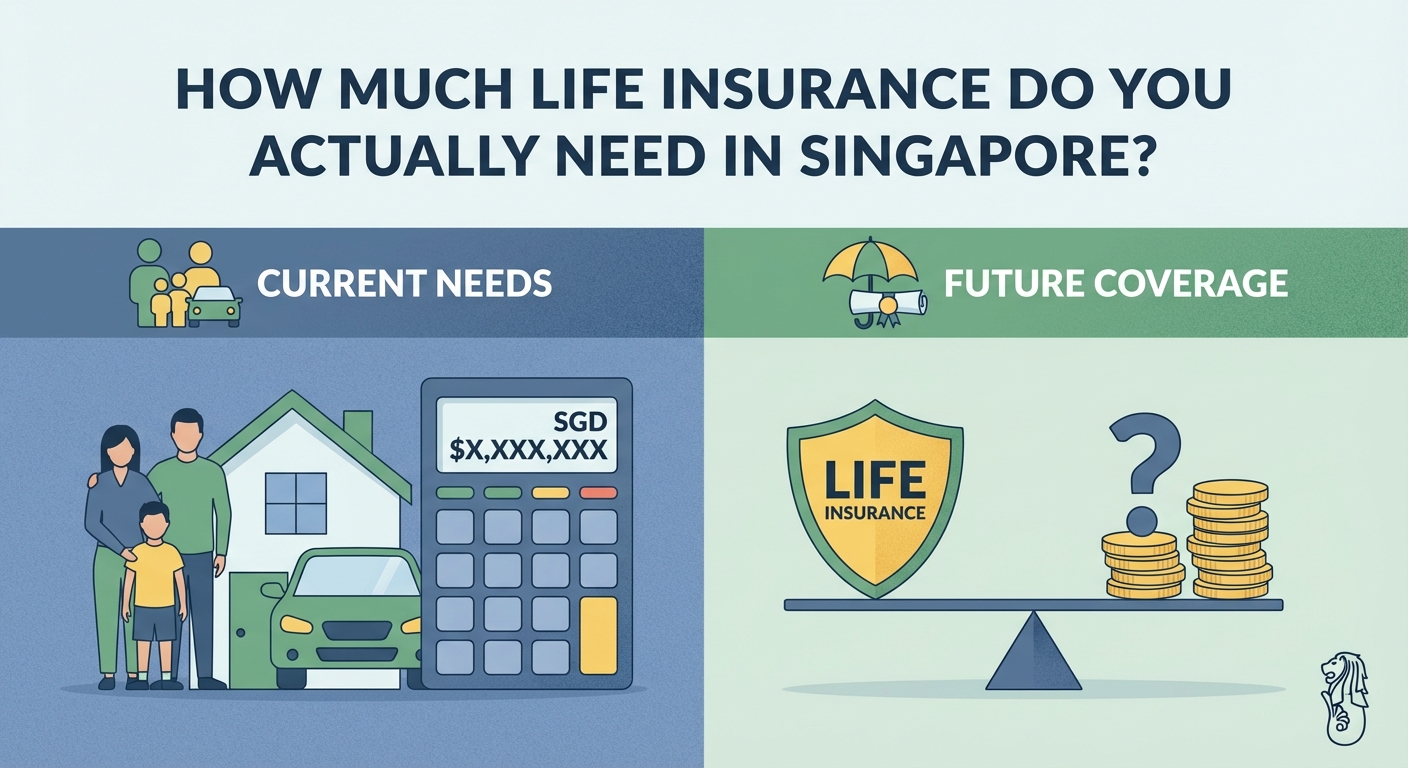
Before calculating numbers, understand what you’re protecting against. Life insurance replaces you financially when you’re gone.
That breaks down into three main categories.
Outstanding debts and immediate expenses
Your family shouldn’t inherit your financial burdens. Calculate what you owe:
- HDB or private property mortgage balance
- Car loans
- Personal loans or credit card debt
- Final expenses (funeral costs typically range from $8,000 to $20,000 in Singapore)
If you have a $400,000 mortgage with 20 years remaining, that’s a real obligation your spouse would face alone.
Income replacement for dependents
How long would your family need financial support without your income? This depends on:
- Number of dependents (spouse, children, aging parents)
- Ages of your children
- Whether your spouse works
- Time needed for your family to adjust financially
A parent with young children might need 15 to 20 years of income replacement. Someone with teenage kids might need less.
Future major expenses
Life insurance can fund goals you won’t be around to pay for:
- Children’s university education (local universities cost $30,000 to $40,000 for a degree, overseas can exceed $200,000)
- Aging parents’ medical care
- Spouse’s retirement if they’ve been out of the workforce
These aren’t luxuries. They’re commitments you’ve already made to your family.
Simple methods to calculate your coverage
You don’t need complex spreadsheets. Here are three practical approaches used in Singapore.
The income multiplier method
Multiply your annual income by a factor between 8 and 12.
If you earn $60,000 annually, that’s $480,000 to $720,000 in coverage.
This method is fast but rough. It works best as a starting point, not your final answer. The multiplier should be higher if you have young children or significant debts, lower if you’re closer to retirement or have substantial savings.
The needs-based calculation
This gives you a more accurate picture. Add up everything your family would need:
- Total all outstanding debts
- Calculate income replacement (annual income × years needed)
- Add future major expenses
- Subtract existing coverage and liquid assets
Here’s an example for a 32-year-old earning $72,000 annually:
| Category | Amount |
|---|---|
| Mortgage balance | $350,000 |
| Income replacement (15 years) | $1,080,000 |
| Two children’s education | $120,000 |
| Final expenses | $15,000 |
| Total needs | $1,565,000 |
| Existing coverage (work + CPF) | $200,000 |
| Savings and investments | $80,000 |
| Coverage gap | $1,285,000 |
This person should aim for about $1.3 million in personal life insurance.
The DIME method
DIME stands for Debt, Income, Mortgage, Education. It’s another needs-based approach that’s easy to remember.
- D: Add all debts except mortgage
- I: Annual income × years until retirement
- M: Remaining mortgage balance
- E: Estimated education costs for all children
Sum these four numbers. Subtract your existing coverage and savings. That’s your target.
Adjusting for your life stage
Your coverage needs change as you age. Here’s how to think about different stages.
Starting out (25 to 30 years old)
You might have minimal dependents but growing debts. Focus on:
- Covering any personal loans
- Protecting parents if they depend on you financially
- Building a foundation of affordable term insurance while you’re young and premiums are low
Even if you’re single, life insurance can cover debts that might otherwise fall to your parents or siblings.
Building a family (30 to 40 years old)
This is when coverage needs peak. You likely have:
- A mortgage
- Young children
- A spouse who might have reduced work hours for childcare
- Aging parents starting to need support
Your coverage should be highest during these years. The good news? Term insurance remains affordable even at these coverage levels.
Approaching retirement (40 to 55 years old)
Your needs gradually decrease as:
- Children become financially independent
- Mortgage balance reduces
- Savings and CPF balances grow
- Retirement approaches
You might reduce coverage or shift from pure protection to policies with cash value, depending on your goals.
Common mistakes that leave families underinsured
Watching real cases reveals patterns in how people miscalculate.
Forgetting inflation
$100,000 today won’t have the same purchasing power in 15 years. When calculating income replacement or education costs, factor in at least 2% to 3% annual inflation.
A university education costing $40,000 today might cost $55,000 in 10 years.
Ignoring the non-working spouse
Stay-at-home parents provide enormous economic value through childcare, household management, and elder care. If something happened to them, the working spouse would need to pay for:
- Full-time domestic help
- Childcare or after-school care
- Elderly parent care
Insure the non-working spouse for at least 50% of what you’d insure the breadwinner.
Relying too heavily on company coverage
Group term insurance from your employer is great. But it disappears when you leave the company, and you can’t take it with you.
Build your protection on personal policies you control. Treat company coverage as a bonus, not your foundation.
Buying whole life when term makes more sense
Whole life insurance costs significantly more than term insurance for the same coverage amount. For most young families, term insurance provides better protection per dollar spent.
You can always convert or add whole life later when your budget allows. Don’t sacrifice adequate coverage for policy features you might not need.
What about CPF and existing coverage?
Singapore provides several safety nets that reduce your personal insurance needs.
CPF Dependents’ Protection Scheme (DPS) covers up to $70,000 for CPF members under 65. That’s a start but rarely enough for a family.
Your employer might provide group term insurance, typically 1 to 3 times your annual salary. Check your employee benefits carefully.
Some people have insurance from old policies bought years ago. Don’t assume these are adequate. Coverage that seemed sufficient at 25 might be woefully short at 35 with two kids and a mortgage.
“The biggest mistake I see is people buying insurance based on what they can afford monthly, rather than what their family actually needs. Start with the right coverage amount, then find ways to structure it affordably.” Financial advisor, Singapore
Making coverage affordable
The right amount might seem overwhelming when you see the premium. Here’s how to make it work.
Start with term insurance
Term life insurance provides pure protection at the lowest cost. A healthy 30-year-old can get $1 million in coverage for $50 to $80 monthly.
Lock in coverage while you’re young and premiums are low. You can always add other policy types later.
Layer your coverage
You don’t need $1 million in coverage for your entire life. Structure it in layers:
- Base layer: $300,000 whole life (permanent coverage)
- Second layer: $500,000 term to age 65 (working years)
- Top layer: $200,000 term for 20 years (while kids are dependent)
This gives you maximum protection when you need it most, at a manageable total premium.
Review every major life change
Recalculate your needs when you:
- Get married
- Have a child
- Buy property
- Change jobs
- Receive an inheritance or windfall
- Send kids to university
Your coverage should evolve with your life.
Getting the numbers right for your situation
Generic calculations give you a ballpark. But your actual needs depend on factors only you know.
Consider these questions honestly:
- How risk-averse is your family? Some spouses could manage with less; others need more security.
- What’s your risk of health issues based on family history? This might affect your ability to get affordable coverage later.
- Do you have business obligations or guarantees that would pass to family?
- Are there special needs children or dependents who’ll need lifelong support?
If your situation is complex, spending $200 to $300 for a fee-based financial planning session can save you from costly mistakes.
Coverage that actually protects your family
Life insurance isn’t about hitting a magic number. It’s about making sure the people who depend on you can maintain their lives if you’re not there.
Start with the needs-based calculation. Be honest about your debts, income, and future obligations. Subtract what you already have. The gap is what you need to fill.
Then structure it affordably with term insurance as your foundation. Review it yearly. Adjust as your life changes.
The right amount of life insurance is the amount that lets you sleep soundly, knowing your family is protected no matter what happens. Calculate that number today, and you’ll have one less thing to worry about tomorrow.