
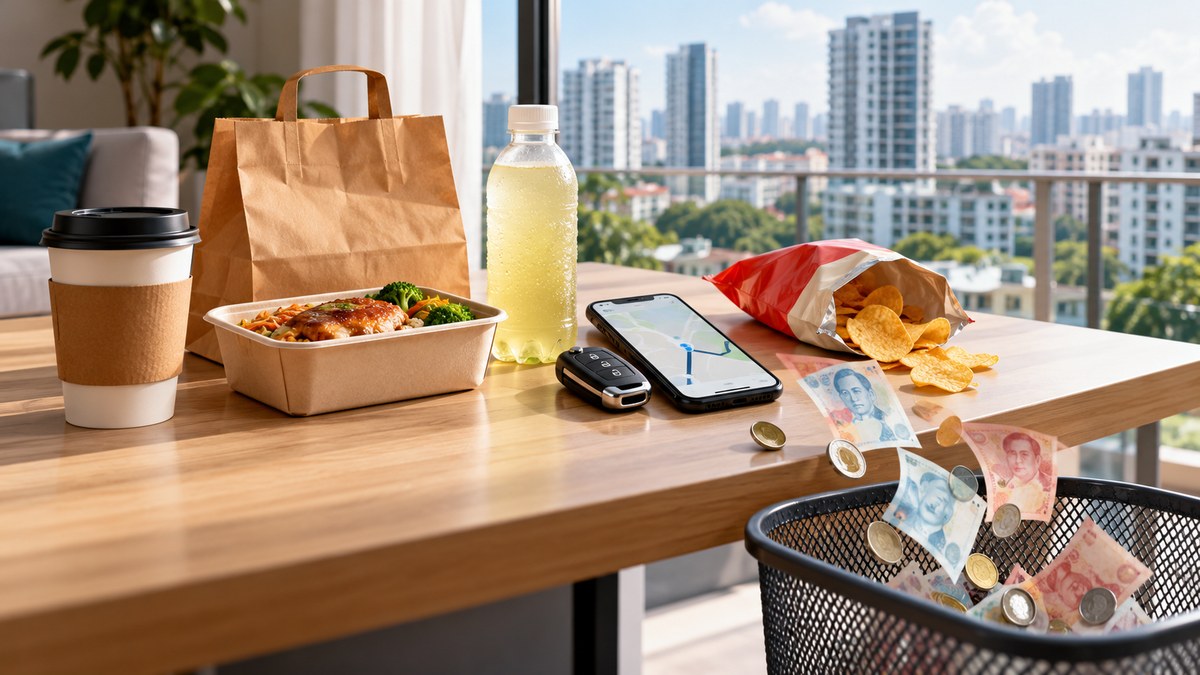
You check your bank account at the end of the month and feel a knot in your stomach. The numbers don’t match your memory. You didn’t buy anything big. No new phone, no vacation, no expensive electronics. Yet somehow, $200 has evaporated from your budget. This money leak is real, and it’s almost always caused by convenience purchases. The good news is that these habits are the easiest to fix once you know what to look for.
Most people waste $200 a month on convenience purchases without realizing it. This guide identifies the five biggest culprits: daily coffee, food delivery fees, unused subscriptions, processed snacks, and ride-hailing trips. You will learn a simple three-step process to cut these expenses and redirect the savings toward your financial goals.
The Five Hidden Leaks Draining Your Wallet
Convenience spending is sneaky because each transaction feels small. A $5 coffee, a $3 delivery fee, a $10 lunch upgrade. Alone, these amounts seem harmless. But together, they form a powerful drain on your monthly budget. Let us look at the five most common ways this happens.
1. The Daily Coffee and Breakfast Habit
Buying a latte or a breakfast sandwich on the way to work feels like a treat. At $6 to $8 per stop, it adds up fast. If you do this five days a week, you are spending between $120 and $160 a month. That is almost your entire $200 leak from just one habit.
The fix: Brew coffee at home. A good thermos costs less than three cafe visits. Buy a bag of quality beans for $15, and you have coffee for two weeks. You save at least $100 a month.
2. Food Delivery Fees and Markups
Ordering dinner through an app seems harmless on a tired weeknight. But the math is brutal. A $12 bowl of noodles from the hawker costs $18 after delivery fees, service charges, and a tip. Do this ten times a month, and you have spent $60 extra on nothing but convenience.
The fix: Pick up your own food. A 15-minute walk or a short bus ride saves you $5 to $8 per order. Alternatively, cook a batch of meals on Sunday. You save time and money during the week.
3. Unused or Duplicate Subscriptions
Streaming services, gym memberships, cloud storage, meal kits, and app subscriptions pile up. A 2026 survey found the average person pays for three subscriptions they do not use. At $10 to $15 each, that is $30 to $45 a month going to services you forgot about.
The fix: Audit your subscriptions every three months. Cancel anything you have not used in 30 days. Use a free budgeting app to track recurring charges.
4. Packaged Snacks and Bottled Drinks
Buying a bag of chips, a chocolate bar, or a bottle of iced tea from the convenience store every afternoon costs more than you think. A $2.50 snack five days a week is $50 a month. Over a year, that is $600.
The fix: Buy snacks in bulk from the supermarket. A large bag of nuts or dried fruit costs the same as five single servings. Pack your own water bottle. You cut the cost by 70 percent.
5. Ride-Hailing for Short Trips
Taking a Grab or Gojek for a 10-minute ride when the bus would take 20 minutes is a classic convenience trap. At $8 to $12 per trip, doing this ten times a month costs $80 to $120.
The fix: Use public transport or walk for trips under 2 kilometers. You save money and get a little exercise. For longer trips, plan ahead and share rides with colleagues.
How to Audit Your Own Spending in Three Steps
You do not need to guess where your money is going. Follow this simple process to find your personal $200 leak.
-
Track everything for one week. Use a notes app or a small notebook. Write down every single purchase, no matter how small. Include the $1.50 can of soda and the $4 parking fee. Do this for seven days.
-
Categorize each expense. Create three groups: Needs, Wants, and Convenience. Needs are rent, utilities, and groceries. Wants are things you enjoy but could skip. Convenience is anything you bought to save time or effort. Be honest. That $8 salad from the office canteen because you forgot to pack lunch is a convenience expense.
-
Add up the convenience column. Total the numbers. If your convenience spending is over $50 a week, you have found your leak. Most people in Singapore see a number between $60 and $120 a week.
Common Mistakes People Make When Cutting Costs
Even after identifying the problem, many people fall into these traps. Here is what to avoid.
| Mistake | Why It Fails | Better Approach |
|---|---|---|
| Going cold turkey | You feel deprived and binge spend later | Cut one habit at a time over 30 days |
| Ignoring small purchases | You think $2 does not matter | Track every dollar for one month |
| Using willpower alone | You rely on memory and motivation | Automate your savings so the money is gone before you can spend it |
| Replacing one convenience with another | You switch from cafe coffee to fancy bottled coffee | Make your own coffee from basic ingredients |
“The fastest way to save $200 a month is not to earn more. It is to stop paying a premium for time you are not actually saving. Most convenience purchases save you five minutes but cost you $5. That is a terrible trade.” – Personal finance coach based in Singapore
Where That $200 Could Go Instead
Imagine redirecting that $200 every month. Here is what it adds up to over a year.
- $2,400 in a high-interest savings account earning 3.5 percent becomes $2,484 after one year.
- Invested in a low-cost index fund with an average 7 percent return, it grows to $2,568.
- Used to top up your CPF Special Account, it earns a guaranteed 4.08 percent interest, giving you $2,498.
That $200 is not just disappearing. It is costing you future wealth. If you invest it monthly for 10 years at 7 percent, you end up with over $34,000. That is a real down payment, a car, or a year of university fees.
If you want to learn more about building that habit, read our guide on how to start investing in Singapore with just $100 a month. The same principle applies here.
Practical Tools to Help You Stay on Track
You do not need complex spreadsheets. These simple tools work.
- A cash envelope system for convenience spending. Withdraw $100 in cash at the start of the month. That is your entire budget for coffee, snacks, and delivery. When the cash is gone, you stop.
- A 24-hour rule for any purchase over $20. Put the item in your cart and wait one day. Most impulse buys feel less urgent tomorrow.
- A “cost per use” calculation. Before buying a subscription or a service, divide the monthly fee by how many times you will realistically use it. If the cost per use is higher than the alternative, skip it.
For a deeper look at managing your daily spending, check out our article on how to save money on daily purchases in Singapore without sacrificing quality.
The Real Reason You Keep Spending on Convenience
Convenience spending is rarely about laziness. It is usually about feeling tired, rushed, or overwhelmed. You buy the coffee because you did not sleep well. You order delivery because your energy is drained. You take the ride because you are running late.
The solution is not more discipline. It is better systems. Prepare your coffee the night before. Cook double portions so you have leftovers. Set alarms to leave home earlier. When your environment supports good choices, you do not need willpower.
If you struggle with impulse spending, our guide on how to avoid impulse spending in Singapore and save your hard-earned money offers specific strategies that work in our local context.
Your First Step Toward Taking Control
You now know the five leaks and how to fix them. The next part is action.
Pick one habit from the list above. Just one. Commit to changing it for 30 days. If you choose to stop buying coffee, put the $6 you save each day into a separate jar or transfer it to a savings account. Watch the number grow. After 30 days, you will have $120 to $180 extra. That proof is powerful.
Once you succeed with one habit, tackle the next. Within three months, you can reclaim your full $200 a month and put it toward something that actually matters to you.
For more ideas on cutting your overall expenses, read our piece on 11 proven ways Singaporeans are cutting their monthly expenses by $500 or more.
A Final Word on Spending with Intention
This is not about living a life of deprivation. It is about choosing where your money goes instead of letting it slip away on autopilot. The $200 you save is not just money. It is freedom. It is a buffer against unexpected expenses. It is a step toward a larger goal, whether that is a vacation, a home, or a secure retirement.
Start today. Pick one change. See what happens. You might be surprised at how easy it is to stop wasting $200 a month on convenience purchases once you know where to look.