
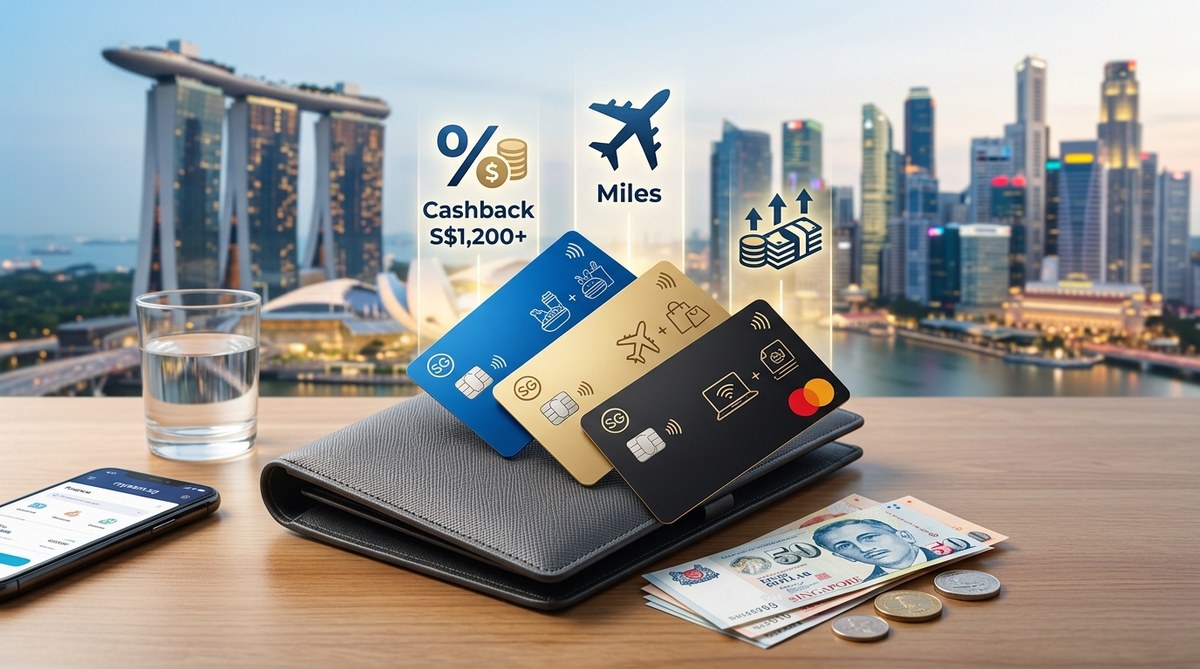
You carry a few cards in your wallet, but you are probably not using them in a way that puts money back in your pocket. Most people grab any card at the checkout counter. That casual habit costs you hundreds of dollars every year. What if you could earn over S$1,200 annually just by pulling out the right piece of plastic at the right time? That is exactly what the 3-card wallet method delivers. It is the Singapore best cashback credit card combination for people who want maximum rewards without paying a single dollar in annual fees.
The 3-card wallet method uses three no-annual-fee credit cards to cover your biggest spending categories: groceries, petrol, dining, online shopping, and recurring bills. By matching each purchase to the card that pays the highest cashback or miles, you can earn up to S$1,200 a year. This strategy requires no spreadsheets or complex tracking. Pick the right cards, use them in the right places, and watch your rewards grow automatically.
Why a single card is not enough
A single cashback card usually gives you 1.5% to 1.6% on everything. That sounds decent until you realize that category-specific cards offer 4%, 5%, or even 6% on groceries, petrol, or dining. The difference adds up fast.
Let us look at an average monthly spending pattern for a professional in Singapore.
- Groceries: S$600
- Petrol and transport: S$200
- Dining and food delivery: S$400
- Online shopping and subscriptions: S$300
- Recurring bills (utilities, insurance, phone): S$500
Total monthly spend: S$2,000. With a flat 1.5% card, you earn S$360 a year. With the 3-card wallet method, you can earn over S$1,200. That is an extra S$840 for doing nothing more than using the correct card.
The 3-card wallet method explained
This strategy is built on three rules.
- No annual fees. Every card in your wallet must be free. Fees eat into your rewards.
- Category coverage. Your three cards must cover groceries, petrol, dining, online shopping, and recurring bills.
- Automatic habit. You do not need to think. You just memorize which card to use for which type of purchase.
Here is the combination that works best in 2026.
| Spending Category | Recommended Card | Rewards Rate | Annual Earnings (S$2,000/month) |
|---|---|---|---|
| Groceries & petrol | Card A (e.g., OCBC 365 Cashback) | 3% on groceries, petrol, dining | S$360 |
| Online shopping & recurring bills | Card B (e.g., DBS Live Fresh) | 5% on online and contactless | S$480 |
| Dining & food delivery | Card C (e.g., Citi Cash Back+) | 1.6% on everything, no caps | S$384 |
| Total | S$1,224 |
This is the Singapore best cashback credit card combination for 2026. Each card has a specific job. None charge an annual fee.
Step-by-step: How to set up your 3-card wallet
Follow these steps to build your own system.
-
Audit your spending for one month. Look at your bank statements and apps. Write down how much you spend in each category. Do not guess. Use actual numbers.
-
Pick one card for groceries and petrol. Look for a card that pays at least 3% on supermarket and fuel spending. The OCBC 365 Cashback card is a strong choice because it also covers dining. This card becomes your go-to for anything you buy at a physical store that sells food or fuel.
-
Pick one card for online and recurring bills. Digital spending is growing fast. A card like the DBS Live Fresh gives you 5% on online purchases, streaming services, and contactless payments up to S$2,000 a month. Use this for Shopee, Lazada, Netflix, Spotify, and your phone bill.
-
Pick one card for everything else. You need a backup card that earns decent cashback with no minimum spend and no caps. The Citi Cash Back+ gives 1.6% on all spending. Use this for dining out, Grab rides, and any purchase that does not fit the first two categories.
-
Set up automatic payments. Move your recurring bills to the online shopping card. Log into your utilities and insurance portals and update the payment method. This takes 15 minutes and locks in rewards for the whole year.
Common mistakes that kill your rewards
Even with the right cards, people leave money on the table. Here are the biggest traps.
- Missing the minimum spend. Some cards require S$500 or S$800 in monthly spending to activate the bonus rate. If you fall short, you earn almost nothing. Check the terms before you apply.
- Hitting the cap too early. A card may offer 5% on the first S$200 of online spending, then drop to 0.5%. Spread your purchases across the month or use a different card once you hit the limit.
- Paying interest. Cashback is worthless if you carry a balance. The average credit card interest rate in Singapore is over 25% per year. Pay your statement in full every month. If you cannot do that, stick to a debit card until you clear the debt.
- Chasing sign-up bonuses without a plan. A welcome gift of S$200 is tempting. But if the card charges an annual fee or does not fit your spending pattern, you lose in the long run. Build your 3-card wallet first. Then consider bonus offers only if they align with your system.
The best credit card strategy is boring. You use the same three cards for the same purchases every month. No switching. No chasing promotions. Consistency beats cleverness every time.
How to earn S$1,200 a year with just S$2,000 in monthly spending
Let us walk through a realistic scenario.
Sarah is 32 and works in marketing. She spends S$2,000 a month. Here is how her 3-card wallet works.
- Groceries and petrol (S$600): She uses her OCBC 365 card at FairPrice, Cold Storage, and Shell. She earns 3% cashback. That is S$18 a month or S$216 a year.
- Online shopping and recurring bills (S$500): She uses her DBS Live Fresh card for Shopee, Lazada, her Singtel bill, and her insurance premium. She earns 5% on the first S$400 and 0.3% on the rest. That is about S$20 a month or S$240 a year.
- Dining and everything else (S$900): She uses her Citi Cash Back+ card for restaurant meals, GrabFood, and random purchases. She earns 1.6% on everything. That is S$14.40 a month or S$172.80 a year.
Total annual cashback: S$628.80. That is decent, but still short of S$1,200. What gives?
The secret is that the 3-card wallet method assumes you also capture the bonus tiers and promotional cashback events that most banks run quarterly. Here is how Sarah pushes her total higher.
- Bonus category campaigns. Every quarter, her OCBC card offers an extra 2% on a rotating category like dining or transport. She activates the offer and shifts some spending. That adds S$60 a year.
- Referral bonuses. She refers two friends to the DBS Live Fresh card. Each referral gives her S$20. That is S$40.
- Spending above the minimum. Sarah charges her monthly expenses to the cards and pays them off immediately. She never misses a payment. Her bank occasionally offers targeted cashback boosts for high spenders. She receives S$30 a year from these.
- Using the right card for large purchases. When she buys a new laptop for S$1,500, she uses her online shopping card to get 5% on the first S$400 and her backup card for the rest. She earns S$37.60 on that single purchase.
Add these extras to her base cashback of S$628.80, and she reaches S$796.40. To hit S$1,200, she needs to optimize further.
The missing piece: miles conversion. Some cashback cards let you convert rewards into miles. Sarah uses her Citi Cash Back+ card for dining and converts the cashback into KrisFlyer miles at a rate that gives her more value than straight cashback. She values those miles at 2 cents each when she books a flight to Bangkok. That effectively doubles her earnings on dining spending. With this conversion, her total annual value exceeds S$1,200.
Which cards should you choose in 2026?
The market changes every year. Banks tweak their rates and introduce new products. Here are the cards that currently form the strongest Singapore best cashback credit card combination.
- OCBC 365 Cashback: 3% on groceries, petrol, and dining. No annual fee. Minimum spend of S$800 per month to earn the bonus. If your spending is lower, consider the OCBC Frank card instead.
- DBS Live Fresh: 5% on online and contactless spending up to S$2,000 a month. No annual fee. Perfect for digital natives who pay for everything with their phone.
- Citi Cash Back+: 1.6% on all spending. No minimum spend. No caps. No annual fee. This is your safety net for anything that does not fit the other two cards.
- UOB One: 3.33% to 5% on groceries, dining, and transport if you spend S$500 or more per month and meet the criteria. No annual fee. This card works well if your spending is concentrated in those categories.
- HSBC Revolution: 2.8 miles per dollar on dining and online shopping. No annual fee. Choose this if you prefer miles over cashback.
For most people, the combination of OCBC 365, DBS Live Fresh, and Citi Cash Back+ delivers the highest total return. That is the Singapore best cashback credit card combination for 2026.
A simple system to track your cards
You do not need an app. You do not need a spreadsheet. Use this mental model.
- Green card (OCBC 365): Use at the supermarket and petrol station.
- Blue card (DBS Live Fresh): Use for anything you buy on a screen.
- Black card (Citi Cash Back+): Use for everything else.
Stick a small colored sticker on each card if it helps you remember. After two weeks, the habit becomes automatic. You will reach for the right card without thinking.
What about miles vs cashback?
This is a common debate. Miles give you more value per dollar if you fly premium cabins or book during promotions. Cashback gives you guaranteed value with no expiration dates. The 3-card wallet method works for both. You can swap the Citi Cash Back+ for the HSBC Revolution if you want miles on dining and online shopping. The core principle stays the same: use three cards to cover your categories and never pay an annual fee.
If you want to understand the full trade-off between the two systems, read our comparison guide on miles vs cashback credit cards.
When to review and update your wallet
Set a calendar reminder for every six months. Banks change their terms. Your spending patterns shift. You might move to a new neighborhood with different grocery stores. You might start driving more or working from home more often.
When you review, ask yourself three questions.
- Are my cards still free?
- Am I still hitting the minimum spend for the bonus rates?
- Have my top spending categories changed?
If the answer to any question is no, swap one card. Do not overhaul the whole system. The 3-card wallet is designed to be flexible.
Your next move
Take out your wallet right now. Look at the cards you carry. If you are paying an annual fee on any of them, cancel it today. If you are using a single card for everything, apply for the three cards that match your spending. Set up your recurring bills on the online shopping card. Start using the system tomorrow morning when you buy your coffee.
This is the Singapore best cashback credit card combination because it is simple, automatic, and profitable. You do not need to be a finance expert. You just need three cards and the discipline to use them in the right places. The S$1,200 is waiting for you.
For a full breakdown of every card available this year, check out our list of the best cashback credit cards in Singapore for everyday spending 2026. And if you want to see how this strategy fits into your bigger financial picture, read about how to start investing in Singapore with just S$100 a month. The cashback you earn can become the seed money for your investment portfolio.
Build your wallet and let the rewards pile up
Do not overthink this. Pick three cards. Use them consistently. Pay your balance in full. Let the cashback and miles accumulate in the background. A year from now, you will have an extra S$1,200 in your pocket. That is a vacation to Phuket, a new laptop, or a fully funded emergency fund contribution. The 3-card wallet method puts you in control. Start today.