
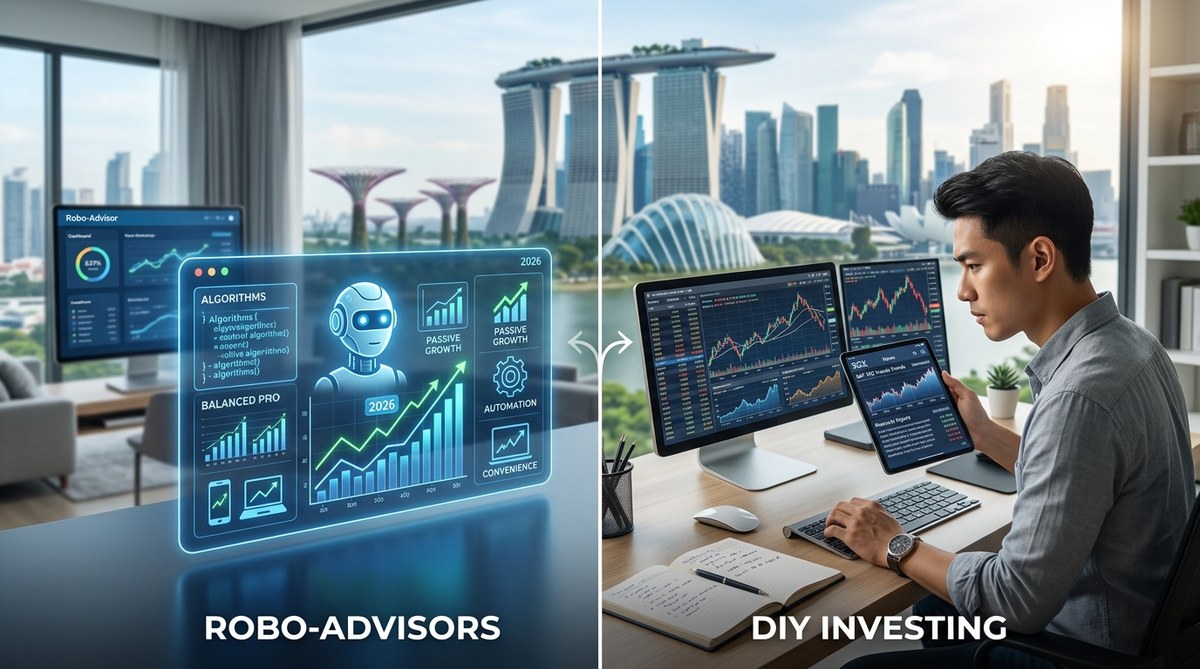
You have probably thought about growing your money beyond the bank account. The options in Singapore are better than ever. You can let a robo-advisor handle everything, or you can take the DIY route and manage your own portfolio. Both paths can help you build wealth. But they fit very different lifestyles. Let us look at the real tradeoffs between robo-advisors vs DIY investing in Singapore for 2026.
Choosing between a robo-advisor and DIY investing in Singapore for 2026 comes down to your time, confidence, and goals. Robo-advisors offer a hands off, automated solution with low fees, perfect for busy professionals who want a simple approach. DIY investing gives you full control and potentially lower costs, but requires research and discipline. This guide breaks down the pros and cons to help you decide which path fits your lifestyle.
Understanding the Robo-Advisor Advantage
A robo-advisor is a digital platform that builds and manages a diversified portfolio for you. You answer a few questions about your risk tolerance and goals. The platform then invests your money into a mix of low cost ETFs.
The biggest benefit is convenience. You do not need to research stocks or rebalance your portfolio. The platform does it automatically. This is ideal for busy professionals who want a set and forget solution.
Popular options in Singapore include Endowus, StashAway, and Syfe. Each offers different features. For example, Endowus gives you access to institutional share classes of funds. StashAway uses its own ERAA framework to manage risk. If you are unsure which to pick, our comparison of Endowus vs StashAway can help you decide.
Robo-advisors also handle the emotional side of investing. Markets drop, and when they do, it is tempting to sell everything. A robo-advisor sticks to the plan. It rebalances your portfolio automatically, buying low and selling high without human panic getting in the way.
The DIY Investing Mindset
DIY investing puts you in the driver seat. You open a brokerage account with a platform like Tiger Brokers, moomoo, or Interactive Brokers. You choose your own ETFs or individual stocks. You decide when to buy and sell.
This approach gives you more control over your portfolio. It can also be cheaper. If you stick to buying a single global ETF like VWRA or CSPX, your costs can be very low compared to a robo-advisor fee.
However, it requires time and discipline. You need to learn the basics of dollar-cost averaging and portfolio rebalancing. You also need the emotional strength to hold during market downturns. A good starting point is our guide on how to start investing in Singapore with just $100 a month.
DIY also means you take on more responsibilities. You need to track your dividends, manage currency exposure, and file your own taxes if you invest in US listed stocks. For some, this is a rewarding challenge. For others, it becomes a chore.
Side-by-Side Comparison
Let us put them head to head. Here is a breakdown of the most important factors for Singapore investors.
| Factor | Robo-Advisor | DIY Investing |
|---|---|---|
| Annual Fees | 0.5% to 0.8% of assets under management | 0.2% to 0.5% per trade plus exchange fees |
| Time Required | 15 minutes to set up, then monthly check ins | Ongoing research and quarterly rebalancing |
| Control | Limited to pre-set portfolios based on risk score | Full control over individual stocks and ETFs |
| Minimum Investment | Often $0 to $1,000 | Depends on the share price of your chosen asset |
| Best For | Passive investors and busy professionals | Active learners and enthusiasts |
| Emotional Guardrails | Automated rebalancing reduces panic selling | Requires personal discipline to avoid mistakes |
“I started with a robo-advisor because I was too busy to learn about stocks. After a year, I felt confident enough to open a DIY brokerage account. Now I use both. The robo-advisor handles my retirement savings, and I use my brokerage for learning and active bets.” – A typical experience shared by many in the r/singaporefi community.
Fees are a major difference. Robo-advisors charge a percentage of your assets each year. If you invest $10,000, you might pay $50 to $80 annually. DIY platforms charge per trade. If you invest monthly, these costs can add up, but they are often lower for large portfolios.
Another factor is emotional investing. DIY investors often chase hot stocks or sell during panics. A robo-advisor removes emotion from the equation. It follows a systematic strategy regardless of market noise.
For those considering retirement, robo-advisors can integrate with your CPF and SRS accounts. This is a huge plus for maximizing tax relief and building long term wealth.
A Simple 3-Step Process to Decide
Here is a practical way to choose your path in 2026.
-
Look at your calendar. How much time do you have each month for investing? If the answer is less than one hour, a robo-advisor is probably the better fit. You can automate your monthly investment and forget about it.
-
Check your interest level. Do you enjoy reading about markets and companies? Do you like analyzing financial statements? If yes, DIY investing can be a rewarding hobby. If it sounds like a chore, let a robo-advisor do the heavy lifting.
-
Calculate the impact of fees. Use an online calculator to see how fees affect your long term returns. A 0.5% fee difference can compound into thousands of dollars over 20 years. For a $50,000 portfolio, the difference could be over $15,000 in fees saved by going DIY.
Before you invest a single dollar, make sure you have a safety net. Read our guide on how to build a 6-month emergency fund in Singapore on any salary to get started on the right foot.
Common Pitfalls on Both Paths
Here are the mistakes I see Singaporean investors make most often.
- Over-diversifying: Buying too many ETFs or funds. This complicates your portfolio and increases fees. A simple three fund portfolio is enough.
- Ignoring currency risk: Investing globally means dealing with USD or EUR. Currency fluctuations can impact your returns. Consider hedged ETFs if this worries you.
- Checking your portfolio too often: Daily checking leads to stress and bad decisions. Set a quarterly review schedule instead.
- Chasing past performance: Last year’s top fund is often this year’s laggard. Stick to a diversified strategy based on your goals.
- Forgetting about taxes: US listed stocks have a 30% withholding tax on dividends for Singapore residents. Irish domiciled ETFs have a 15% rate. This can significantly affect your long term returns.
Avoiding these mistakes can dramatically improve your outcomes. For a full list, check out 7 Common Investment Mistakes Singaporeans Make and How to Avoid Them.
Can You Do Both?
Yes! Many savvy investors use a hybrid approach. They use a robo-advisor for the core of their portfolio. This is the steady, long term foundation. Then they use a DIY brokerage account for a smaller portion of their money. This lets them trade individual stocks or sector ETFs without risking their retirement savings.
For example, you might put 80% of your monthly savings into Endowus or Syfe. The other 20% goes into your DIY account for buying companies you believe in. This gives you the best of both worlds.
A portfolio tracker can help you manage both accounts. Look at our recommended tools in Which Investment Portfolio Tracker Should You Use in Singapore?
You can also mix in other asset classes. Learn about REITs vs Property Investment to see if real estate fits your plan. For very stable returns, Singapore Savings Bonds are a great addition to any portfolio.
Your Investing Strategy for 2026 and Beyond
The decision between robo-advisors vs DIY investing in Singapore is deeply personal. There is no single right answer. The best choice depends on your goals, your habits, and your temperament.
If you want a hands off approach that still gives you market returns, use a robo-advisor. If you want to learn deeply and control every dollar, go DIY.
What matters most is that you start. Time in the market beats timing the market. Pick the method that allows you to invest consistently, even when life gets busy.
Start with one account. Fund it regularly. Let compound interest do its work. Your future self will thank you.