
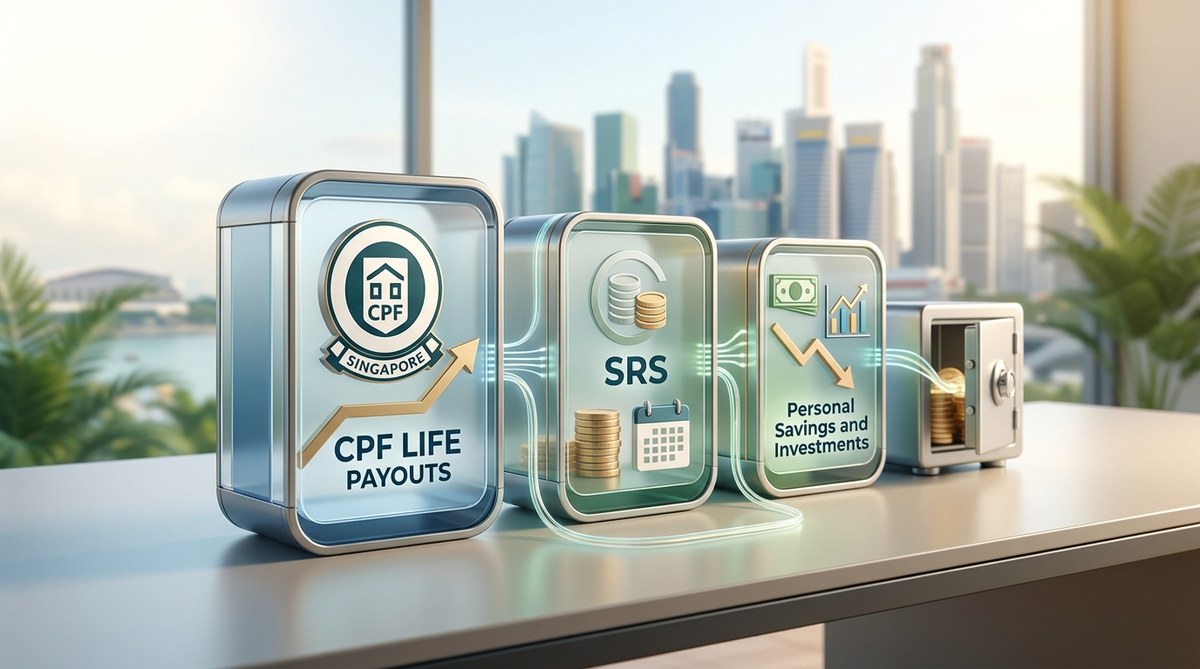
If you are a Singaporean approaching or in retirement, you have saved across multiple accounts: CPF, Supplementary Retirement Scheme (SRS), cash, and investments. But when you start taking money out, the sequence matters far more than you might think. Withdraw from the wrong account first and you could pay thousands in extra taxes or shorten the life of your savings. This guide walks you through the optimal withdrawal order tailored to Singapore’s unique rules so you keep more of what you earned.
The smartest withdrawal order in Singapore is: start with your CPF Ordinary Account savings after age 55 (keeping enough for a Basic Retirement Sum), then use cash and taxable investments, then dip into your SRS (which is partly taxable when withdrawn), and last, withdraw from CPF Special Account and any Roth-like accounts that grow tax free. This sequence minimizes your lifetime tax bill and extends how long your savings last.
Why the withdrawal order changes everything
Singapore does not tax CPF payouts (including CPF LIFE). SRS withdrawals are 50% taxable at your marginal income tax rate. Dividends and interest from cash accounts are taxed, but capital gains are not. If you pull from the wrong pot first, you could push yourself into a higher tax bracket unnecessarily. The goal is to manage your taxable income year by year so you stay in the lowest possible bracket.
The four step plan for withdrawing your savings
Here is the recommended sequence, from first to last. Adjust based on your personal income, health, and spending needs.
1. Spend down your CPF Ordinary Account (OA) cash after age 55
Once you turn 55, you can withdraw any amount above your Full Retirement Sum (FRS) or Basic Retirement Sum (BRS) from your OA and Special Account (SA). Since these withdrawals are tax free, they are ideal for immediate living expenses. But do not drain the entire sum. Keep enough in your Retirement Account to fund CPF LIFE payouts later. For most people, the OA balance above the BRS is the best source of income from 55 to 65.
2. Draw from taxable cash and interest paying accounts
After your free CPF money, tap your cash savings, high interest savings accounts, and short term investments such as Singapore Savings Bonds. Interest earned is taxable, but your personal reliefs and the first S$20,000 of interest income (if you are below age 55) may keep the tax low. Many retirees have little other income, so this may fall into the 0% or low tax bracket. The key is to keep your taxable income below S$20,000 to pay zero tax as long as possible.
3. Withdraw from your SRS account
SRS withdrawals are 50% taxable. That means if you take out S$40,000 in a year, only S$20,000 counts as chargeable income. If your total chargeable income stays below S$20,000, you pay no tax at all. So plan to withdraw from SRS only after you have used up your CPF OA surplus and before you dip into tax free accounts. Spread SRS withdrawals over several years to keep each year’s income low. Avoid taking a large lump sum that pushes you into a higher bracket.
4. Leave tax free growth accounts for last
Your CPF Special Account and any investment accounts that grow tax free (like a Roth IRA structure is not available in Singapore, but similar principal applies to CPF SA) should be kept for later years. The longer they compound without tax, the bigger your buffer for age 80 and beyond. Start withdrawing from these only after you have exhausted the other three pools and after you begin CPF LIFE payouts.
Expert advice: “Many retirees deplete their CPF OA first then later regret they have no flexibility for large medical bills. Keep at least BRS in your Retirement Account to ensure lifetime payouts, and only withdraw the OA surplus. This balance gives you a safety net.” Financial planner, Singapore
Key factors that affect your personal withdrawal order
- Your marginal tax rate now vs expected future rate
- The size of your SRS balance and how much you need to withdraw before age 70 (mandatory from 70)
- Whether you have dependents or high medical costs
- Your CPF LIFE payout start age and plan type
- Any expected inheritance or property sale proceeds
Use this table to compare common withdrawal strategies:
| Strategy | Tax impact | Best for | Risk |
|---|---|---|---|
| Withdraw CPF OA first | No tax | Anyone age 55+ with surplus above BRS | You may overspend and deplete emergency fund |
| Use SRS before age 70 | 50% taxable | Those with low other income | If you delay, lump sum at 70 may cause high tax |
| Cash first (after CPF) | Interest taxed at marginal | Those with small cash nest egg | Misses opportunity to let tax free accounts grow |
| Drawdown investments last | Capital gains tax free | Those with large portfolio | Need to sell in down market |
Each strategy has trade offs. The ideal order is not one size fits all, but the sequence above works for most retirees with typical savings.
Common mistakes that cost you money
- Withdrawing all CPF at 55 and spending it. That removes the 4% floor from your Retirement Account and reduces your lifetime CPF LIFE payouts.
- Taking a lump sum from SRS without planning. A single S$200,000 withdrawal means S$100,000 taxable income, which could push you into the 15% or higher bracket. Spread it over 10 years at S$20,000 per year and you pay zero tax.
- Tapping your CPF SA early. The SA earns up to 4.08% interest (as of 2026) and is shielded from market risk. Leave it for later unless you need emergency cash.
- Ignoring the mandatory SRS withdrawal at age 70. You must withdraw the entire SRS balance over 10 years starting from age 70, or pay a penalty. Plan ahead to avoid a big tax hit in your 70s.
To help you visualise, here is a bullet list of what to prioritise:
- Use CPF OA surplus first (tax free)
- Use cash and low tax investments second (keep income under S$20k)
- Use SRS third (50% taxable, spread over years)
- Use CPF SA and long term growth last (tax free compounding)
How to personalise this order for your situation
You do not follow this sequence rigidly. If you have a high SRS balance and expect your income to drop after age 70, you might accelerate SRS withdrawals earlier. If you have a chronic illness, you may need more cash early for medical bills, so adjust by taking more from CPF OA or cash first.
For deeper planning, read our guide on how much money you really need to retire comfortably in Singapore, and if you are considering leaving your CPF untouched, see should you withdraw your CPF at 55 or leave it to grow. Also, learn about CPF LIFE payout plans explained to choose the right payout scheme.
A worked example: Ah Hock and Mei Ling
Ah Hock, 62, and Mei Ling, 60, have S$200,000 in CPF OA above the BRS, S$150,000 in SRS, and S$100,000 in cash savings. Their annual expenses are S$36,000. They want to retire now.
Following the best order: They first withdraw S$36,000 from CPF OA (tax free). After five years, the CPF OA surplus runs low. They then take S$33,000 per year from SRS (S$16,500 chargeable income after 50% inclusion, well under S$20k threshold, so zero tax). After five years, SRS is mostly drained. By then, they are age 67 and CPF LIFE payouts begin, covering a portion of expenses. They use remaining CPF OA and cash to top up. This plan keeps them in the 0% tax bracket for 10 years.
If they had taken SRS first, they would have paid tax earlier and depleted their tax free buffer sooner.
Adjusting for the 2026 CPF changes
In 2026, the CPF Retirement Sums have increased. The Basic Retirement Sum is now S$102,900, and the Full Retirement Sum is S$205,800. The top up limit for CPF LIFE payouts also shifted. Check the latest figures from CPF Board before making decisions. If you have questions about using CPF calculators to plan your retirement, our tool can help.
Smart sequencing in your 60s and beyond
As you move through your 60s, revisit your withdrawal plan every two years. Your health, spending, and tax rules may change. The best order to withdraw retirement savings Singapore remains the same principle: use taxable sources first in low income years and save tax free sources for later.
Final layer: how to integrate with your whole portfolio
- If you own a property and plan to sell, that cash injection can replace CPF OA withdrawals. Sell at age 65 and use the proceeds as your new first bucket.
- If you have a spouse, coordinate withdrawals to maximise the overall household tax relief. Withdraw from the lower earner’s SRS first.
- Consider using CPF voluntary contributions in your 50s to build up the SA before you retire, then withdraw OA first. This is discussed in our article should you use CPF voluntary contributions to maximize your savings.
Create your personalised withdrawal calendar
- Total your retirement accounts (CPF OA above BRS, cash, SRS, investments).
- Estimate your annual spending in retirement.
- Decide your CPF LIFE start age (65, 70, or later) and calculate the payout.
- Simulate withdrawing from CPF OA first until age 65, then SRS from 65 to 70, then cash and investments from 70 onward.
- Adjust based on your top up needs and tax brackets each year.
Remember, the earlier you start planning, the more control you have. You built this nest egg through years of saving and investing. Now you deserve to enjoy it without giving extra to the taxman.
One last piece of advice
Do not treat this as a one time decision. Review your withdrawal order each year during tax filing season. If your income drops unexpectedly, accelerate SRS withdrawals. If you receive a windfall, slow down your CPF OA draw. The best order to withdraw retirement savings Singapore is not fixed in stone; it moves with your life.
We have covered a lot of ground here. For step by step help with budgeting and saving, check our guide on the 50/30/20 budget rule and how it works for Singapore’s cost of living. And if you are still years from retirement, read smart retirement planning strategies for Singaporeans nearing 50 to build a strong foundation.
You have the tools. Now go make your money last.