

Your mortgage repayment just jumped by $300 a month. Your fixed deposit finally pays more than 3%. Your landlord is raising rent because borrowing costs have climbed.
These aren’t random events. They’re all connected to how the Monetary Authority of Singapore manages interest rates. Unlike most central banks that set a policy rate directly, MAS uses a different tool: the Singapore dollar exchange rate. This approach shapes every loan, savings account, and investment decision you make.
MAS controls Singapore interest rates through exchange rate policy, not direct rate setting. When MAS tightens the Singapore dollar band, borrowing costs rise and savings rates improve. This affects your mortgage, fixed deposits, and cost of living. Understanding MAS policy helps you time major financial decisions like refinancing, locking in savings rates, or adjusting your budget for rate changes ahead.
How MAS controls interest rates differently from other central banks
Most countries have a central bank that sets an overnight lending rate. The US Federal Reserve adjusts the federal funds rate. The European Central Bank moves its main refinancing rate. These direct rate changes ripple through the economy.
Singapore does it backwards.
MAS manages the Singapore dollar nominal effective exchange rate, or S$NEER. This is a trade-weighted basket of currencies from Singapore’s major trading partners. MAS allows the Singapore dollar to trade within a policy band. The band has a slope (appreciation or depreciation), a width (how much the currency can fluctuate), and a center point.
When MAS wants to tighten monetary policy, it shifts the band upward. This makes the Singapore dollar appreciate. A stronger Singapore dollar reduces import costs, which helps control inflation. But it also makes Singapore interest rates rise to attract capital and support the currency.
When MAS wants to ease policy, it flattens the slope or widens the band. This allows the Singapore dollar to weaken, making exports more competitive. Interest rates typically fall as a result.
This system works because Singapore is a small, open economy. More than 300% of GDP flows through trade. Exchange rate policy directly affects inflation through import prices, which make up a large share of the consumer price basket.
Why Singapore interest rates follow global trends but with a local twist
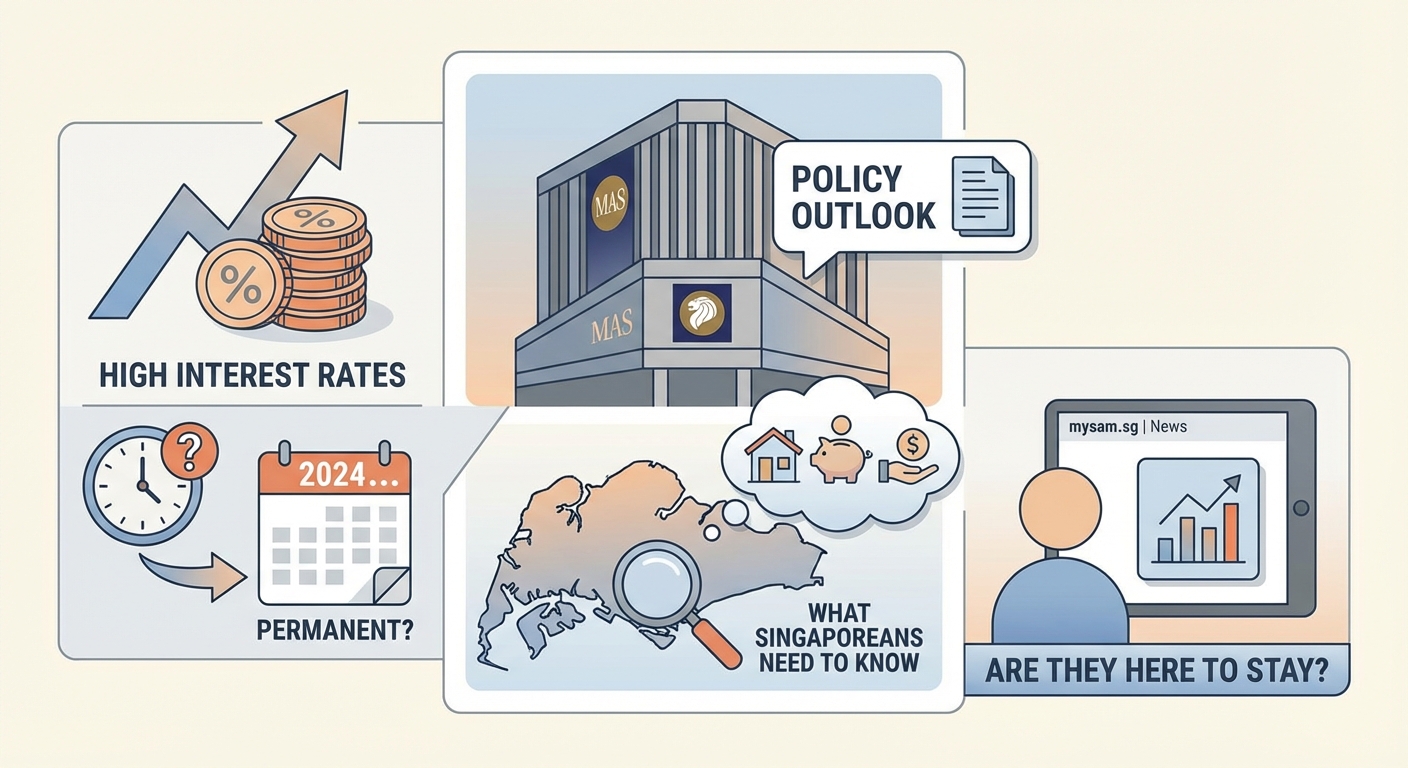
Singapore banks set their lending and deposit rates based on two benchmarks: SORA (Singapore Overnight Rate Average) and the US dollar LIBOR replacement rates. SORA reflects actual overnight borrowing costs in Singapore. It moves in response to local liquidity conditions and MAS policy.
But Singapore interest rates also track US rates closely. The Singapore dollar and US dollar are deeply linked through trade, investment flows, and the currency peg history. When the US Federal Reserve raises rates, capital flows toward US assets. To prevent excessive Singapore dollar weakness, Singapore rates must rise too.
This creates a balancing act. MAS cannot let Singapore rates drift too far below US rates, or investors will dump Singapore dollars. But MAS also cannot let rates climb so high that they crush the domestic economy.
The result: Singapore interest rates usually sit slightly below US rates, reflecting Singapore’s lower inflation and stronger fiscal position. But they move in the same direction.
What rising interest rates mean for your mortgage and housing costs
Most Singaporean homeowners have floating-rate mortgages tied to SORA or the bank’s internal board rate. When Singapore interest rates climb, your monthly repayment rises.
A 1% increase in interest rates on a $500,000 loan over 25 years adds roughly $270 to your monthly payment. Over the loan life, that’s more than $80,000 in extra interest.
Here’s how different rate environments affect a typical HDB or private property loan:
| Interest Rate | Monthly Payment ($500k, 25 years) | Total Interest Paid |
|---|---|---|
| 2.5% | $2,245 | $173,500 |
| 3.5% | $2,501 | $250,300 |
| 4.5% | $2,777 | $333,100 |
If you locked in a fixed-rate package before rates climbed, you’re protected for now. But when your fixed period ends, you’ll face repricing at current market rates.
Renters feel the squeeze too. Landlords with mortgages pass higher financing costs to tenants. Rental prices in Singapore rose more than 30% from 2021 to 2023, partly driven by rising interest rates and tight housing supply.
How to adjust your savings strategy when rates are high
Higher interest rates aren’t all bad. Your cash finally earns a decent return.
Singapore fixed deposits now offer 3% to 3.8% for 12-month tenures at major banks. High-yield savings accounts pay 2.5% to 4% on balances up to certain limits. T-bills and Singapore Savings Bonds yield above 3%.
This changes the math on where to park your emergency fund. Leaving $50,000 in a zero-interest account costs you $1,500 a year in forgone interest at 3%.
Here’s a simple process to maximize your cash returns:
- Move your emergency fund (3 to 6 months of expenses) into a high-yield savings account with no lock-in period.
- Park medium-term savings (1 to 3 years) in fixed deposits or Singapore Savings Bonds for higher rates.
- Use T-bills for lump sums you won’t need for 6 to 12 months, buying through your bank or the MAS portal.
Avoid chasing the highest advertised rate without reading the fine print. Some accounts require minimum spending on a linked credit card. Others cap the high rate at $50,000 or $100,000, paying almost nothing on balances above that.
If you’re already building a 6-month emergency fund, now is the time to make sure it’s earning at least 3% while staying liquid.
What MAS policy signals mean for your financial planning
MAS announces its monetary policy stance twice a year, in April and October. The statement reveals whether MAS is tightening, easing, or holding the S$NEER policy band steady.
You can’t predict MAS decisions with certainty, but you can watch the same indicators MAS does:
- Core inflation trends: MAS targets core inflation (excluding private transport and accommodation) of 1% to 2% over the medium term. If core inflation runs above 3% for several quarters, MAS will likely tighten.
- Global interest rate moves: When the US Federal Reserve signals rate cuts, Singapore rates will eventually follow, though MAS may move more gradually.
- GDP growth and labor market strength: If Singapore’s economy is overheating with tight labor markets, MAS may tighten to cool demand.
- Currency movements: If the Singapore dollar weakens sharply against the basket, MAS may tighten to support the currency.
These signals help you time major financial decisions. If MAS is in a tightening cycle, lock in fixed-rate mortgages or fixed deposits before rates climb further. If MAS is easing, wait before committing to long-term fixed deposits, as rates may fall.
Common mistakes Singaporeans make when interest rates shift
Many homeowners and savers make costly errors during rate cycles. Here are the biggest traps and how to avoid them:
| Mistake | Why It Hurts | Better Approach |
|---|---|---|
| Ignoring repricing dates on fixed-rate mortgages | You get hit with a 2% rate jump overnight | Set a calendar reminder 6 months before your fixed period ends to compare refinancing options |
| Chasing the highest savings rate without checking conditions | You earn 4% on the first $50k but 0.05% on the rest | Calculate the blended rate on your full balance before switching accounts |
| Locking into long-term fixed deposits at the peak | Rates fall and your money is stuck earning 3.5% when new deposits pay 2% | Ladder your fixed deposits across 6, 12, and 24 months so some mature regularly |
| Panic-selling investments when rates rise | You lock in losses and miss the recovery | Rebalance gradually and keep 6 months of expenses in cash to avoid forced selling |
The biggest mistake is doing nothing. Rates moved from near zero in 2021 to above 3.5% by 2023. Homeowners who didn’t refinance paid thousands more. Savers who didn’t move their cash earned almost nothing while inflation ate into their purchasing power.
How interest rate changes affect your broader financial life
Rising Singapore interest rates touch more than your mortgage and savings. They reshape your entire financial landscape.
Credit card debt becomes more expensive. If you carry a balance, the interest rate on that debt (often 24% to 28% annually) compounds faster. Paying off high-interest debt becomes even more urgent.
Car loans and renovation loans cost more. A 1% increase on a $50,000 car loan over 7 years adds roughly $1,800 to your total interest bill.
Insurance premiums may rise. Some insurers adjust premiums based on investment returns. When bond yields rise, this can eventually put downward pressure on premiums, but the lag can be long.
Your investment portfolio shifts. Higher interest rates make bonds more attractive relative to stocks. The 60/40 stock-bond portfolio may deliver better returns in a higher-rate environment than it did when rates were near zero.
If you’re looking to boost your income to offset higher costs, consider proven ways Singaporeans are cutting their monthly expenses by $500 or more or high-paying side hustles in Singapore that actually work.
“Interest rates are the price of time. When rates rise, the future becomes more expensive. Every financial decision you delay or accelerate has a different cost. Understanding that cost is the first step to making smarter money moves.”
Practical steps to protect yourself from rate volatility
You can’t control MAS policy, but you can control your response. Here’s a step-by-step action plan:
- Review your mortgage structure. If you’re on a floating rate and expect rates to stay high, compare fixed-rate packages. If you’re locked in at a high fixed rate and rates are falling, check the penalty for early exit.
- Optimize your cash allocation. Move idle cash into accounts paying at least 3%. Use T-bills or Singapore Savings Bonds for money you won’t need for 6 to 12 months.
- Stress-test your budget. Calculate how your monthly expenses change if your mortgage rate rises another 1%. If that breaks your budget, you need a bigger emergency fund or lower fixed costs.
- Diversify your income sources. Higher rates often coincide with slower economic growth. Building a side income or upskilling for a higher salary reduces your vulnerability. Check out how to negotiate a higher salary in Singapore if your primary income needs a boost.
- Rebalance your investments. If rates are high, bonds and fixed-income assets become more attractive. If you’re young and have decades to invest, this might be a chance to start investing in Singapore with just $100 a month while stock valuations are more reasonable.
The goal isn’t to predict every MAS move. It’s to build a financial structure that doesn’t collapse when rates shift.
How government policies interact with MAS rate decisions
MAS doesn’t operate in a vacuum. Other government policies amplify or offset the impact of interest rate changes.
Cooling measures on property. Additional Buyer’s Stamp Duty, Total Debt Servicing Ratio limits, and Loan-to-Value caps all restrict how much you can borrow, even if interest rates are low. These measures work alongside MAS policy to control property prices.
CPF interest rates. Your CPF Ordinary Account earns 2.5% and Special Account earns 4%. These rates don’t move with market rates. When market rates are 1%, CPF looks great. When market rates hit 4%, CPF is just average. This affects whether you should leave extra cash in CPF or invest it elsewhere.
Budget transfers and rebates. When inflation rises due to global factors, the government often announces GST vouchers, U-Save rebates, and other transfers to cushion the blow. These don’t change interest rates but reduce the real impact of higher costs.
Tax policies. The Supplementary Retirement Scheme offers tax relief on contributions. When interest rates and investment returns are higher, the compounding benefit of tax-deferred growth becomes more valuable.
Understanding how these policies interact helps you see the full picture. How Singapore’s 2026 budget changes will affect your wallet and investments gives a broader view of fiscal policy alongside monetary policy.
When to lock in rates and when to stay flexible
Timing is everything with interest rates. Lock in too early and you miss out on better deals. Wait too long and you pay more than necessary.
For mortgages, consider a fixed-rate package if:
- You believe rates will rise or stay high for the next 2 to 3 years.
- You want payment certainty and can’t handle monthly swings.
- You’re stretching your budget to afford the property.
Stay on a floating rate if:
- You expect rates to fall within 12 to 18 months.
- You have a comfortable buffer in your budget.
- You want the flexibility to refinance without penalties.
For savings and fixed deposits, ladder your maturities. Put one-third in 6-month deposits, one-third in 12-month, and one-third in 24-month. This way, you always have cash coming due to reinvest at current rates.
For investments, dollar-cost averaging smooths out the impact of rate changes. Investing a fixed amount monthly means you buy more when prices are low and less when they’re high.
What to watch in 2026 and beyond
Singapore interest rates in 2026 will depend on global and local factors. Here’s what to monitor:
- US Federal Reserve policy. If the Fed cuts rates aggressively, Singapore rates will follow. If the Fed holds rates high to fight stubborn inflation, Singapore rates stay elevated.
- China’s economic recovery. A strong China recovery boosts Singapore exports and growth, potentially keeping MAS policy tight. A weak China means slower growth and possible MAS easing.
- Geopolitical risks. Trade tensions, supply chain disruptions, and energy price shocks can all push inflation higher, forcing MAS to tighten even if growth is weak.
- Local inflation trends. Watch core inflation closely. If it stays above 3%, MAS will keep policy tight. If it falls toward 2%, MAS has room to ease.
You don’t need to become a macro economist. Just check the MAS monetary policy statement twice a year and adjust your financial plan accordingly.
Making interest rate policy work for you, not against you
Singapore interest rates MAS policy isn’t an abstract economic concept. It’s the invisible hand that raises your mortgage payment, boosts your fixed deposit returns, and shifts the value of every dollar you save or borrow.
The good news: once you understand how MAS uses exchange rate policy to control interest rates, you can anticipate changes and act before they hit your wallet.
Review your mortgage structure every year. Move your cash into accounts that pay real returns. Stress-test your budget for higher rates. Build multiple income streams so you’re not vulnerable to any single economic shift.
Interest rates will rise and fall over your lifetime. The winners are those who adjust their financial strategy to match the cycle, not those who hope the cycle will adjust to them.