
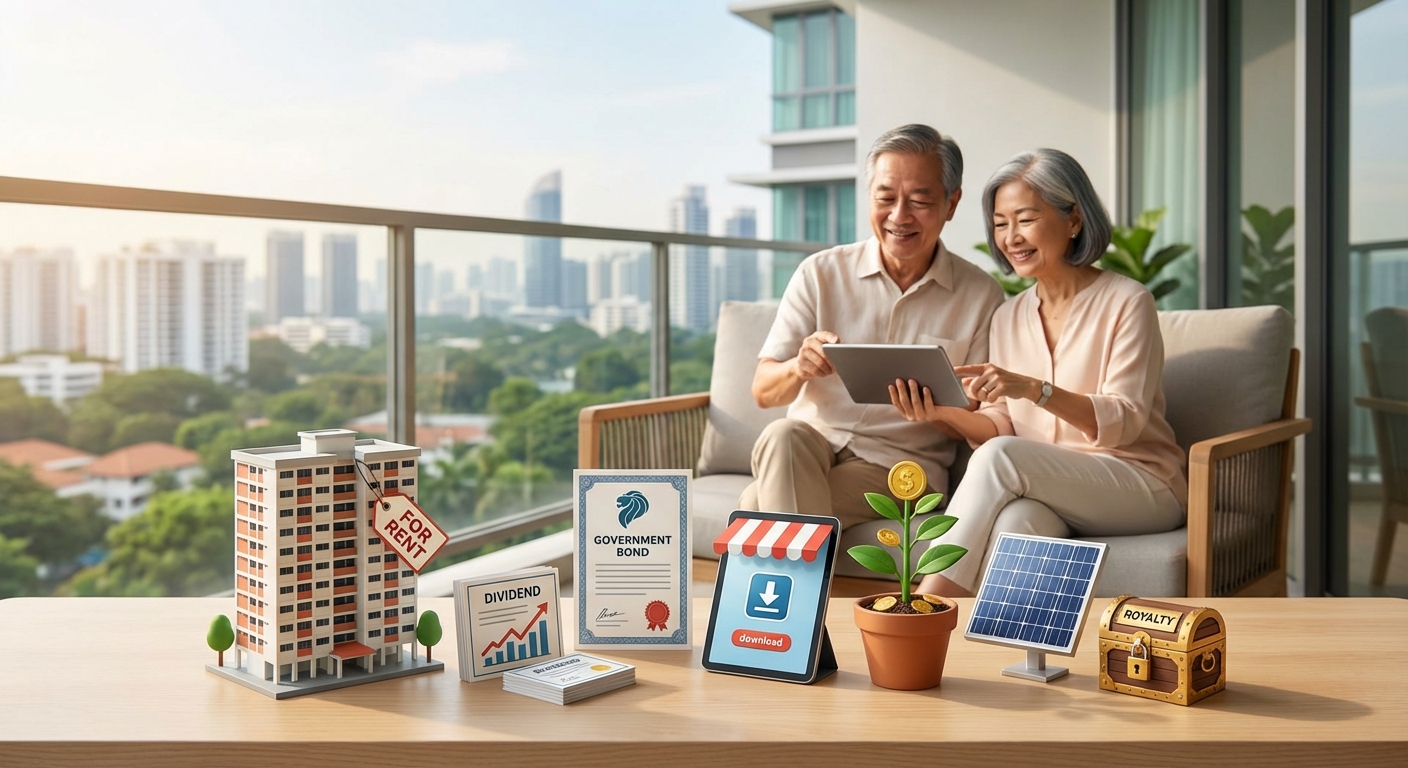
Retirement in Singapore should feel comfortable, not stressful. But with rising costs and longer lifespans, many retirees find their CPF payouts and savings stretched thin. The good news? You can build passive income Singapore streams that work for you while you sleep, travel, or spend time with grandchildren.
Singaporean retirees can generate sustainable passive income through seven practical methods: CPF LIFE optimization, dividend stocks, REITs, rental property income, Singapore Savings Bonds, robo-advisors, and peer-to-peer lending. Each stream requires different capital levels and risk tolerance, but all offer ways to supplement retirement funds without active daily work. Start with low-risk options like SSBs, then gradually diversify as you gain confidence.
What counts as passive income for retirees
Passive income means money that flows in regularly without trading your time for it. You set things up once, then collect payments monthly or quarterly.
This differs from active income where you work hourly or provide services. A retiree doing part-time consulting earns active income. Someone collecting rental payments earns passive income.
For Singaporean retirees, the best passive income sources share three traits:
- Low daily maintenance requirements
- Reasonable risk levels suitable for retirement portfolios
- Steady, predictable cash flow
- Singapore-based or Singapore-regulated investments
You should not need to monitor markets daily or handle complex transactions. The goal is supplementing your retirement income, not creating a second career.
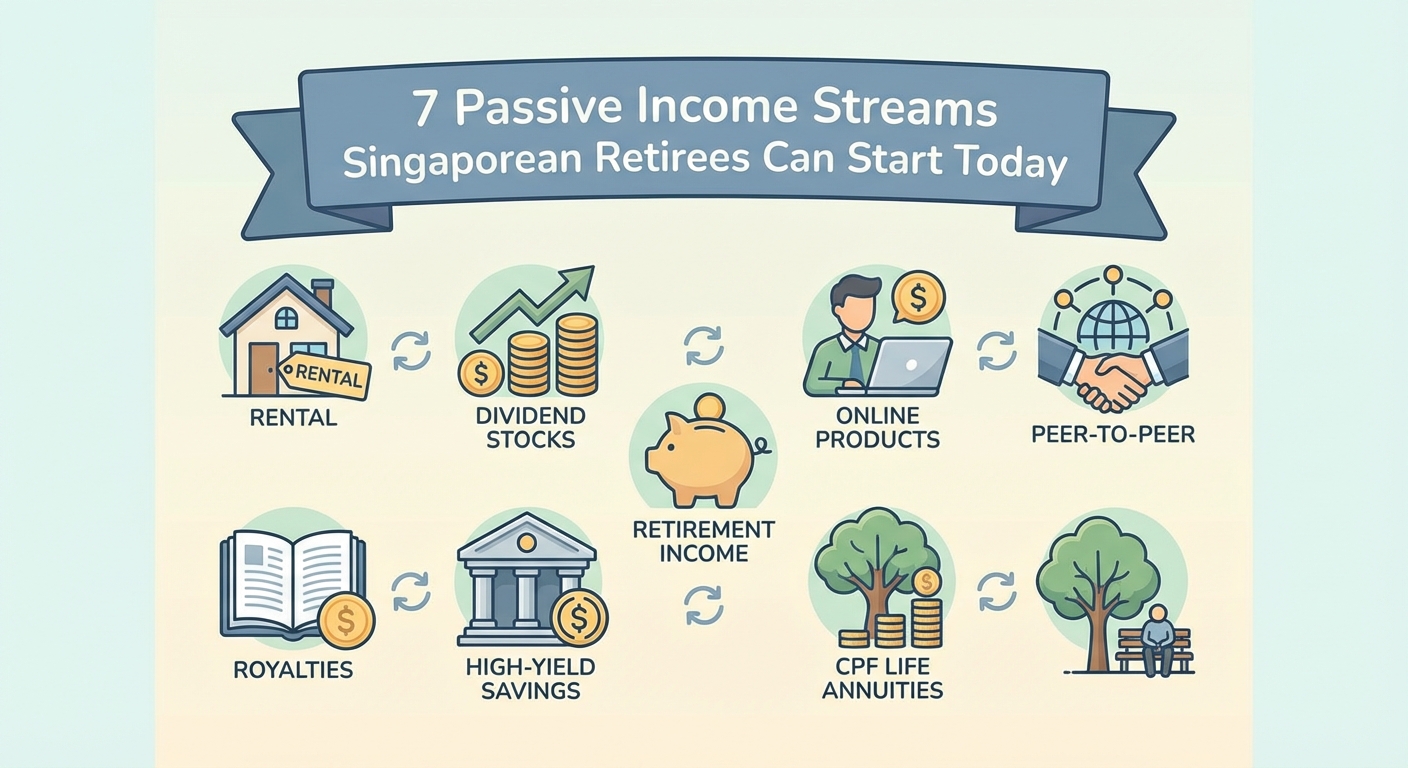
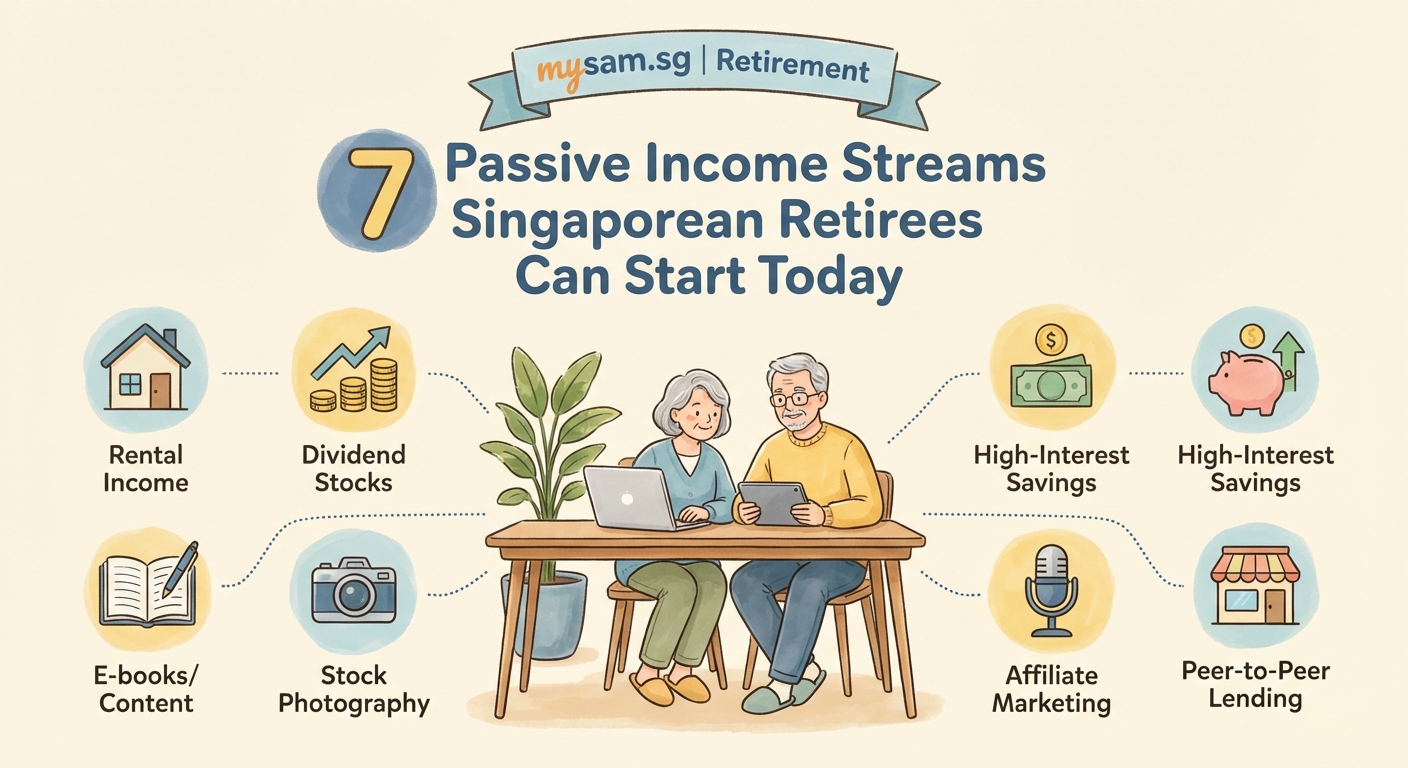
Seven passive income streams that work in Singapore
CPF LIFE top-ups and optimization
Your Central Provident Fund already provides monthly payouts through CPF LIFE. But many retirees leave money on the table by not optimizing their accounts.
If you have cash savings earning minimal interest, consider topping up your Special Account (if you are below 55) or Retirement Account (if above 55). These accounts earn 4% guaranteed interest, higher than most bank deposits.
The annual CPF top-up limit is $8,000 for your own account. You also get tax relief up to $8,000 for self top-ups and another $8,000 for topping up family members’ accounts.
Once you hit 65, CPF LIFE kicks in with monthly payouts for life. The more you have in your Retirement Account, the higher your monthly income. This creates a reliable passive income stream backed by the Singapore government.
Dividend-paying Singapore stocks
Blue-chip Singapore stocks pay dividends quarterly or semi-annually. These payments land directly in your brokerage account without you selling shares.
Local banks like DBS, OCBC, and UOB typically offer dividend yields between 4% and 6%. Singapore REITs often pay even higher yields, which we will cover separately.
To build a dividend portfolio:
- Open a Central Depository (CDP) account if you do not have one
- Choose 8 to 12 established Singapore companies across different sectors
- Invest $50,000 to $100,000 to generate meaningful monthly income
- Reinvest dividends during your early retirement years, then switch to spending them later
A $100,000 portfolio yielding 5% generates $5,000 annually, or about $417 monthly. That covers a significant portion of household expenses for many retirees.
The main risk is share price fluctuation and potential dividend cuts during economic downturns. Stick with companies that have maintained dividends for at least 10 years.
Real Estate Investment Trusts
Singapore REITs let you own commercial property without buying physical buildings. These trusts own malls, offices, hotels, and industrial properties, then distribute 90% of rental income to shareholders.
REITs trade on the Singapore Exchange like stocks but behave more like bonds with their regular distributions. Most pay quarterly, providing consistent cash flow.
Popular Singapore REIT sectors include:
- Retail (CapitaLand Integrated Commercial Trust owns malls)
- Industrial (Mapletree Logistics Trust owns warehouses)
- Healthcare (Parkway Life REIT owns hospitals and nursing homes)
- Hospitality (Far East Hospitality Trust owns hotels and serviced residences)
Healthcare REITs offer the most stability since medical facilities maintain occupancy even during recessions. Retail REITs carry higher risk but often pay higher yields.
A diversified REIT portfolio of $80,000 yielding 6% produces $4,800 yearly, or $400 monthly. You collect rent from dozens of properties without dealing with tenants, repairs, or property taxes.
Rental income from property
If you own a paid-off HDB flat or private property, renting out a room or the entire unit creates substantial passive income.
HDB flat owners can rent out spare bedrooms to Singapore citizens or PRs. A common room in a 4-room flat typically rents for $600 to $900 monthly. A master bedroom fetches $900 to $1,400.
Entire HDB flats rent for $2,000 to $4,000 depending on location and size. Private condos command $2,500 to $6,000 or more.
The process involves:
- Checking HDB rental regulations (you must meet the Minimum Occupation Period)
- Listing your property on PropertyGuru or 99.co
- Screening tenants carefully and signing a proper tenancy agreement
- Collecting deposits and monthly rent
- Handling occasional maintenance issues
Rental income is not entirely passive since you handle tenant issues and property upkeep. But once you find good tenants, the work drops to a few hours monthly.
The tax implications matter too. Rental income above $1,000 annually must be declared to IRAS. However, you can deduct property tax, mortgage interest, and maintenance costs.
Singapore Savings Bonds
Singapore Savings Bonds offer the safest passive income option for risk-averse retirees. These government-backed bonds pay interest every six months with zero default risk.
The interest rate adjusts monthly based on Singapore Government Securities yields. Recent rates have ranged from 2.5% to 3.5% annually.
SSB advantages for retirees:
- Minimum investment of just $500
- Maximum of $200,000 per person
- Full flexibility to redeem anytime without penalty
- Interest paid directly to your bank account
- Backed by Singapore government’s AAA credit rating
To invest, you need a CDP account and internet banking. Applications open on the first business day of each month through ATMs, internet banking, or mobile apps.
A $100,000 SSB investment at 3% yields $3,000 annually, or $250 monthly. Not enough to live on alone, but a solid foundation for conservative retirees who prioritize capital preservation.
Robo-advisor portfolios
Robo-advisors automate investment management using algorithms to build diversified portfolios. They rebalance automatically and reinvest dividends without your involvement.
Singapore has several licensed robo-advisors including Syfe, Endowus, and StashAway. Each offers different portfolio strategies and fee structures.
These platforms typically invest in low-cost Exchange Traded Funds (ETFs) covering global stocks and bonds. Conservative portfolios for retirees might hold 60% bonds and 40% stocks, targeting 4% to 6% annual returns.
The setup process takes about 15 minutes:
- Answer questions about your risk tolerance and investment timeline
- Fund your account via bank transfer
- The robo-advisor builds and manages your portfolio automatically
- Receive quarterly or annual distributions
Fees range from 0.5% to 0.8% annually, much lower than traditional wealth managers. A $150,000 portfolio with 5% returns generates $7,500 yearly, minus about $1,000 in fees, netting $6,500 or roughly $540 monthly.
Robo-advisors suit retirees who want diversified global exposure without picking individual stocks or monitoring markets daily.
Peer-to-peer lending platforms
P2P lending platforms connect borrowers with lenders, letting you earn interest by funding personal or business loans. You become the bank, collecting monthly interest and principal repayments.
Singapore has regulated P2P platforms like Funding Societies (for business loans) and MoolahSense. These platforms vet borrowers and spread your investment across multiple loans to reduce risk.
Expected returns range from 5% to 12% annually depending on borrower credit grades. Higher returns come with higher default risk.
To minimize risk:
- Start with $5,000 to $10,000 to test the platform
- Use auto-invest features to spread funds across 50+ loans
- Focus on Grade A and B borrowers with lower default rates
- Reinvest repayments to compound returns
A $50,000 P2P portfolio earning 8% generates $4,000 annually, or about $333 monthly. However, some borrowers will default, reducing actual returns by 1% to 2%.
P2P lending carries more risk than government bonds but less than individual stocks. It works best as a small portion (10% to 15%) of a diversified retirement portfolio.
Comparing passive income options
| Income Stream | Starting Capital | Monthly Income (Example) | Risk Level | Time to Set Up |
|---|---|---|---|---|
| CPF LIFE top-ups | $8,000+ | Varies by age | Very Low | 1 day |
| Dividend stocks | $50,000+ | $400+ | Medium | 1 week |
| REITs | $30,000+ | $300+ | Medium | 1 week |
| Property rental | Property owned | $600+ | Low-Medium | 2-4 weeks |
| Singapore Savings Bonds | $500+ | $25+ | Very Low | 1 week |
| Robo-advisors | $10,000+ | $200+ | Low-Medium | 1 day |
| P2P lending | $5,000+ | $100+ | Medium-High | 3 days |
Common mistakes retirees make
Chasing high yields without understanding risks ranks as the biggest error. A REIT paying 10% might signal financial trouble, not a great deal. Sustainable yields for Singapore investments typically range from 3% to 7%.
Putting all funds into a single income stream creates concentration risk. If that investment fails, your entire passive income disappears. Spread capital across at least three different streams.
Withdrawing too much too soon depletes your capital base. If you have $200,000 generating 5% annually ($10,000), withdrawing $15,000 yearly shrinks your portfolio and future income.
Ignoring tax implications costs money unnecessarily. Rental income, dividends, and interest may be taxable depending on amounts. Consult a tax advisor to optimize your structure.
Falling for investment scams promising unrealistic returns destroys retirement savings. If someone guarantees 15% monthly returns, run away. Legitimate passive income Singapore investments are regulated by MAS (Monetary Authority of Singapore).
“Retirees should prioritize capital preservation over maximizing returns. A 5% return that you actually receive beats a promised 12% return that disappears in a scam. Stick with MAS-regulated investments and diversify across multiple income streams.” — Financial advisor with 20+ years serving Singapore retirees
Building your passive income plan
Start by calculating your monthly retirement gap. List your fixed expenses (utilities, groceries, insurance, transport) and subtract your CPF LIFE payouts. The difference is what your passive income needs to cover.
If your monthly expenses are $3,000 and CPF LIFE provides $1,500, you need $1,500 monthly from other sources. That requires roughly $300,000 to $360,000 invested at 5% to 6% yields.
Do not have that much capital? Start smaller and build gradually:
- Month 1-2: Open necessary accounts (CDP, robo-advisor, P2P platform)
- Month 3: Invest your first $10,000 in Singapore Savings Bonds for safety
- Month 4-6: Add $30,000 to a dividend stock portfolio with 5-6 blue chips
- Month 7-9: Allocate $20,000 to a robo-advisor for global diversification
- Month 10-12: Consider $10,000 in P2P lending if comfortable with the risk
Review your portfolio quarterly. Are dividends arriving as expected? Do you need to rebalance? Should you shift from higher-risk to lower-risk options as you age?
Most retirees should reduce equity exposure and increase bond allocation every five years. A 60-year-old might hold 50% stocks and 50% bonds. By 70, that could shift to 30% stocks and 70% bonds.
Tax considerations for passive income
Singapore offers relatively favorable tax treatment for passive income compared to many countries. Dividends from Singapore companies are tax-exempt for individual investors because companies already paid corporate tax.
Interest income from Singapore Savings Bonds is also tax-exempt. Bank interest and most bond interest face no tax for individuals.
Rental income requires more attention. You must report it to IRAS if you earn more than $1,000 annually from property rental. However, you can deduct allowable expenses like property tax, mortgage interest, insurance, repairs, and agent fees.
Foreign dividend income and capital gains generally are not taxed in Singapore, though you should verify specific situations with a tax professional.
REITs distribute income that may include taxable and non-taxable components. The REIT will provide tax statements showing the breakdown.
P2P lending interest counts as taxable income. Platforms provide annual statements for tax filing.
Proper tax planning can save thousands annually. Keep detailed records of all investment expenses, dividends received, and interest earned. Consider engaging a tax advisor if your passive income exceeds $20,000 yearly.
Starting with limited capital
Not every retiree has $100,000 ready to invest. If you are working with $10,000 or less, focus on these approaches:
Start with Singapore Savings Bonds. The $500 minimum lets you begin immediately with zero risk. Invest $500 monthly for 12 months to build a $6,000 SSB portfolio earning about $15 to $20 monthly.
Use robo-advisors with low minimums. Some platforms accept $1,000 to start. Contribute $200 monthly to grow your portfolio steadily.
Consider renting out a spare room if you own property. This requires no upfront capital and generates immediate cash flow.
Bank the first year of passive income instead of spending it. If you earn $2,400 in year one, reinvest it to accelerate portfolio growth. Compounding makes a huge difference over 10 to 20 years.
Avoid high-fee products when working with small amounts. A 2% annual fee on a $5,000 portfolio costs $100, eating 20% of a $500 return. Stick with low-cost index funds and robo-advisors charging under 1%.
Monitoring and adjusting your streams
Passive income is not set-and-forget forever. Review your portfolio every three months to check:
- Are dividend payments arriving on schedule?
- Have any companies cut dividends?
- Is your robo-advisor performing as expected?
- Are P2P default rates within acceptable ranges?
- Do you need to rebalance between income streams?
Set calendar reminders for these reviews. Spend 30 to 60 minutes each quarter examining statements and adjusting as needed.
Rebalancing matters because successful investments grow larger, changing your risk profile. If your dividend stocks surge 30% while bonds stay flat, you now have more equity exposure than intended. Sell some winners and buy more bonds to restore your target allocation.
As you age, shift toward safer income streams. A 55-year-old pre-retiree might hold 30% in P2P lending and growth REITs. By 70, that should drop to 10% or less, with more in SSBs and conservative dividend stocks.
Life changes require adjustments too. If you develop health issues requiring more cash reserves, reduce illiquid investments and increase SSB holdings. If you receive an inheritance, diversify the windfall across multiple streams rather than dumping it all into one investment.
Making passive income work for your lifestyle
The best passive income Singapore strategy matches your lifestyle and temperament. Some retirees enjoy researching stocks and actively managing a dividend portfolio. Others prefer completely hands-off robo-advisors.
Consider your comfort with technology. Robo-advisors and P2P platforms require internet banking and mobile apps. If you struggle with technology, focus on dividend stocks through a traditional broker or property rental with a good agent.
Think about liquidity needs. Singapore Savings Bonds offer full liquidity with monthly redemptions. Property rental ties up capital but generates higher income. Balance liquid and illiquid investments based on your emergency fund and expected expenses.
Your risk tolerance matters enormously. Conservative retirees should emphasize CPF top-ups, SSBs, and blue-chip dividends. Those comfortable with more volatility can allocate larger portions to REITs, robo-advisors, and P2P lending.
Geographic preference plays a role too. Some retirees prefer 100% Singapore investments for familiarity and currency matching. Others want global diversification through robo-advisors investing in international markets.
There is no single right answer. A 60-year-old former executive with $500,000 in savings needs a different strategy than a 68-year-old with a paid-off flat and $80,000 in CPF.
Building confidence through small steps
Many retirees feel overwhelmed starting their passive income journey. The solution is beginning with tiny, manageable steps rather than trying to build the perfect portfolio immediately.
This month, open a CDP account and buy $500 of Singapore Savings Bonds. That is it. One small action that takes 30 minutes.
Next month, research three dividend stocks and buy $5,000 worth of one you understand. Maybe DBS because you have banked with them for decades.
The following month, sign up for a robo-advisor and invest $3,000. Let the algorithm handle the details.
Each small step builds confidence and knowledge. After six months of small actions, you will have multiple income streams flowing and understand how each works.
Mistakes will happen. You might pick a stock that cuts its dividend or invest in a REIT during a property downturn. These lessons are valuable. Start small so mistakes cost $500, not $50,000.
Join online communities of Singapore investors and retirees. Forums and Facebook groups offer peer support and practical advice from others building passive income streams.
Consider attending free investment seminars from brokerages, though be wary of high-pressure sales tactics. Take the free education, then make decisions at home after research.
Your retirement income deserves attention
Building passive income Singapore streams transforms retirement from worrying about money to enjoying your golden years. The seven methods covered here offer something for every risk tolerance and capital level.
Start where you are with what you have. A retiree with $20,000 can begin with Singapore Savings Bonds and a small dividend portfolio. Someone with $200,000 can build a diversified mix across five or six streams.
The key is taking action this month, not waiting for perfect conditions. Open that CDP account. Buy your first SSB. Research your first dividend stock. Each step moves you closer to financial comfort and independence.
Your retirement should feel secure, not stressful. Passive income streams working quietly in the background provide that security, letting you focus on family, hobbies, and the experiences you have earned after decades of hard work.