

You could be leaving thousands of dollars on the table every year. Many working professionals in Singapore make CPF voluntary contributions but miss out on the full tax relief available. Even worse, some use the wrong payment methods and lose potential rewards. Getting this right means more money stays in your pocket today while your retirement fund grows faster.
To maximize CPF top up tax relief, contribute up to $8,000 annually to your Special Account or $8,000 to MediSave for yourself, plus $8,000 to loved ones’ accounts. Use the right credit cards for payments to earn rewards. Claim all eligible relief caps during tax filing. This strategy can save you up to $6,400 in taxes yearly at the highest tax bracket while building retirement wealth.
Understanding CPF voluntary contribution tax relief limits
The government rewards you for topping up your CPF accounts. But the rules have specific caps you need to know.
For your own accounts, you can claim tax relief on up to $8,000 in voluntary contributions each year. This applies when you top up your Special Account (SA) or MediSave Account (MA). If you’re above 55, you can top up your Retirement Account (RA) instead.
Here’s where it gets better. You can claim another $8,000 in tax relief for topping up your loved ones’ accounts. This includes your parents, grandparents, spouse, or siblings.
That’s a combined maximum of $16,000 in tax relief annually.
At the highest personal income tax rate of 24%, this translates to $3,840 in tax savings. Even at a more moderate 11.5% tax bracket, you save $1,840.
The math works in your favor. Your money grows at up to 4% per year in your Special Account, and you get immediate tax savings. Both benefits compound over time.
Breaking down the three types of voluntary contributions
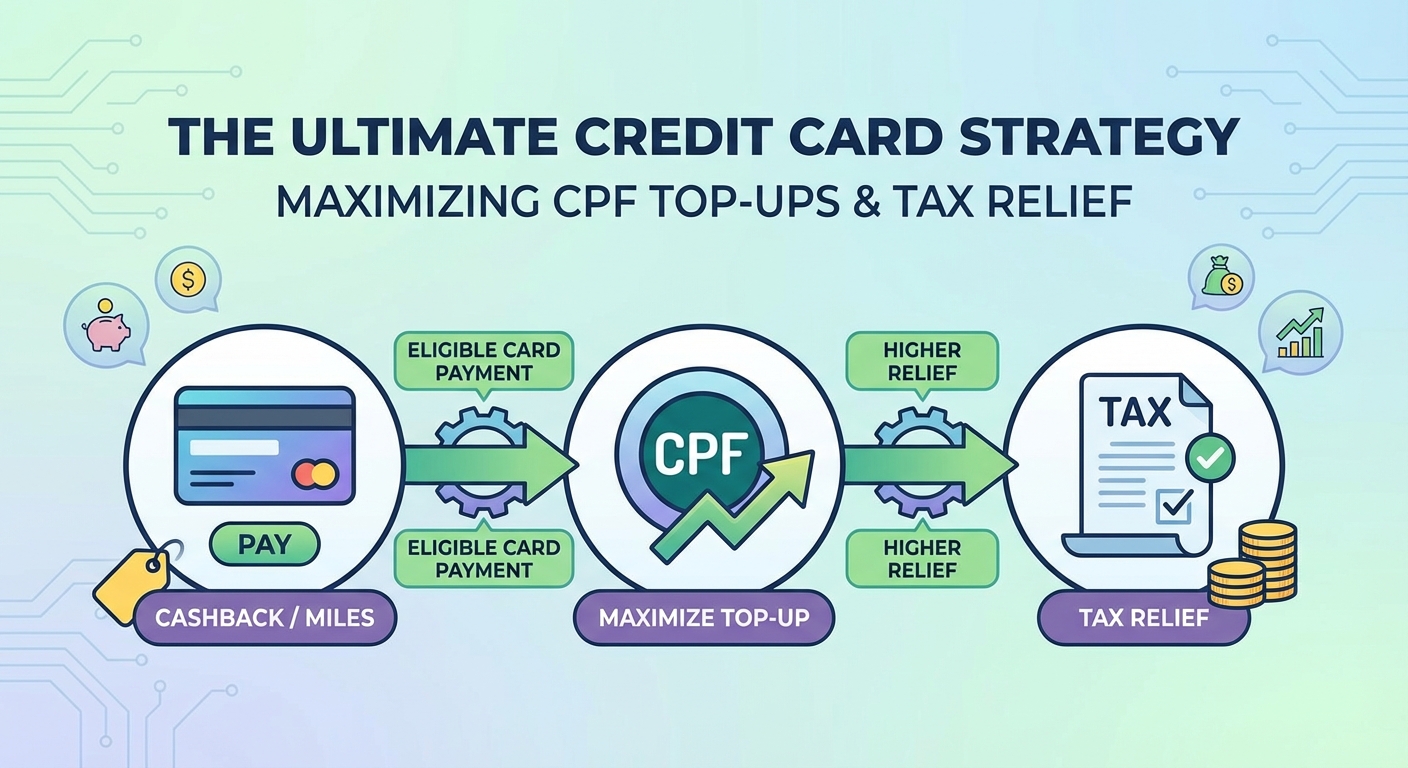
Not all CPF top ups are created equal. Each serves a different purpose and comes with different rules.
Cash top ups to your own accounts
You can transfer cash directly to your SA or MA through various channels. These contributions earn the prevailing CPF interest rates. For SA, that’s 4% per year. For MA, it’s also 4% on the first $60,000 (with up to $20,000 from OA).
The money stays locked until you hit the withdrawal age. This forced discipline helps your retirement fund grow.
Cash top ups to family members
You can help your parents build their retirement savings while reducing your own tax bill. The recipient must be a Singapore citizen or permanent resident. They benefit from the interest earnings, and you benefit from the tax relief.
Retirement Sum Topping Up Scheme (RSTU)
This is specifically for topping up retirement accounts. You can use it for yourself if you’re above 55, or for family members of any age. RSTU contributions go directly toward meeting the Basic Retirement Sum.
“The best time to start CPF voluntary contributions is when you first enter a taxable income bracket. The earlier you start, the more your money compounds, and the more tax you save over your working life.” – CPF Advisory Panel
Step by step guide to maximize your tax relief
Let’s walk through the exact process to claim the full $16,000 in tax relief.
-
Calculate your taxable income and determine your tax bracket. This helps you understand how much you’ll actually save.
-
Top up $8,000 to your own Special Account or MediSave before December 31st of the tax year. You can do this through CPF’s online portal, mobile app, or at SingPost branches.
-
Identify eligible family members who could benefit from a top up. Parents approaching retirement are often the best candidates.
-
Top up another $8,000 to a family member’s account using the RSTU scheme. You’ll need their NRIC and CPF account details.
-
Keep all transaction receipts and confirmation emails. You’ll need these if IRAS requests documentation.
-
When filing your taxes in March or April, ensure both contribution amounts appear in your tax relief claims. IRAS usually auto-includes them, but always verify.
-
Check your Notice of Assessment to confirm the relief was applied correctly.
Choosing the right credit cards for CPF payments
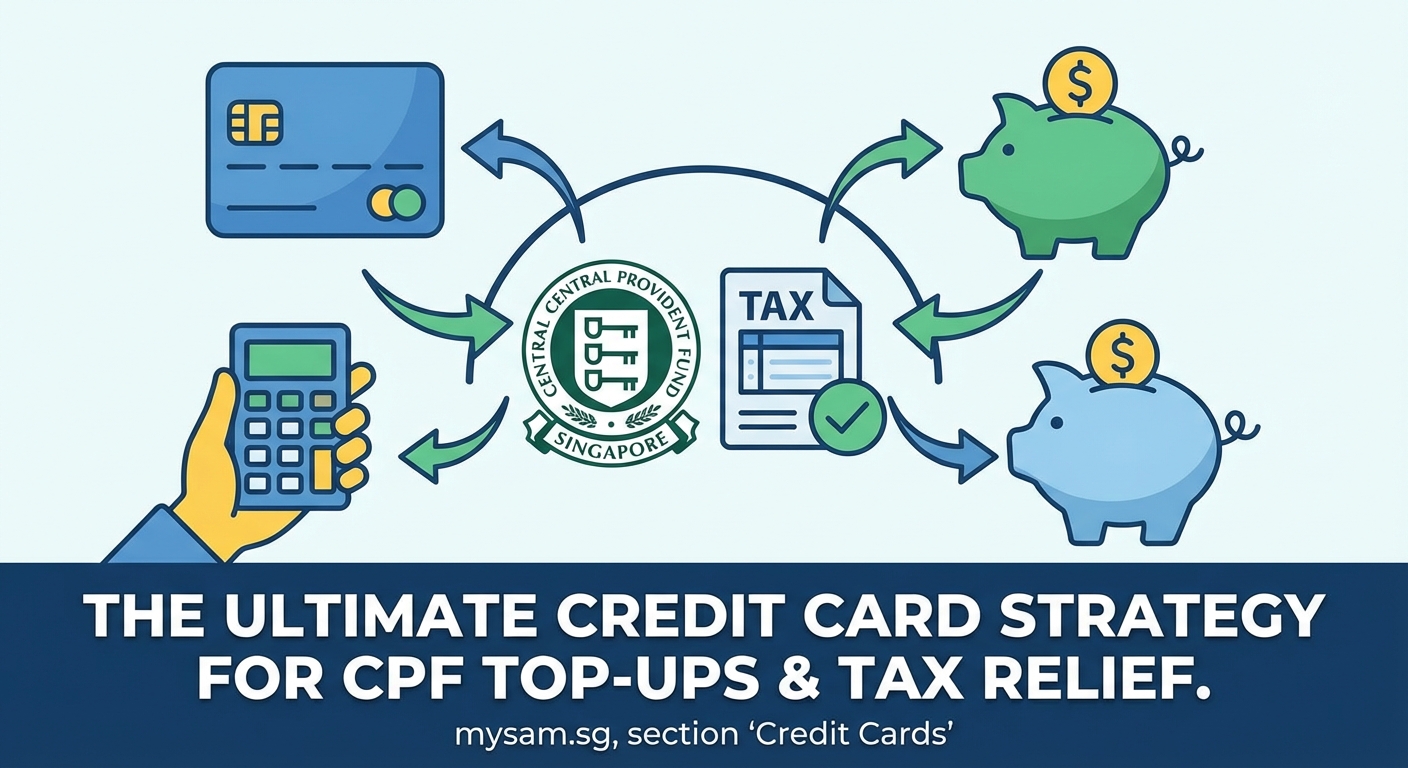
Here’s a secret many people miss. You can pay CPF top ups with credit cards and earn rewards on top of your tax savings.
Not all cards work for government payments. Some exclude CPF transactions from earning points. Others cap the rewards at a low threshold.
Cards that typically work well:
- General spending cards with no category restrictions
- Cards that specifically include government payments in their rewards terms
- Cards with milestone bonuses that count CPF transactions
Cards to avoid:
- Cards that explicitly exclude government payments
- Cards with low rewards caps that you’ve already hit
- Cards charging fees higher than the rewards value
Before making a large CPF payment, call your card issuer to confirm the transaction will earn points. Get written confirmation if possible.
Also consider the payment processing fee. CPF charges a small percentage for credit card payments. Calculate whether your card rewards exceed this fee.
For an $8,000 top up, even a 1% reward rate nets you $80. That’s free money on top of your tax savings and CPF interest.
Common mistakes that reduce your tax relief
Many people think they’re maximizing their benefits but actually leave money on the table.
| Mistake | Why It Hurts | How to Fix |
|---|---|---|
| Topping up in January after tax filing | Miss claiming relief for previous year | Top up by December 31st |
| Exceeding the $8,000 caps | Extra amount gets no tax relief | Track contributions carefully |
| Using wrong account types | Some accounts don’t qualify | Only use SA, MA, or RA |
| Not claiming family top ups | Lose half your potential relief | Use RSTU for eligible relatives |
| Forgetting to verify on tax form | IRAS might not auto-include it | Always double-check your return |
Another common error is making multiple small top ups without tracking the total. You might accidentally exceed the cap and waste money that could have gone elsewhere.
Keep a simple spreadsheet. Log each contribution with the date, amount, and account type. This takes five minutes and prevents costly mistakes.
Timing your contributions for maximum benefit
When you make your CPF top up matters more than you might think.
The December deadline is firm. Any contribution made on January 1st counts toward the next tax year, not the one you’re currently filing for.
But there’s a strategic element beyond the deadline.
If you expect a promotion or salary increase next year, consider delaying your top up. You’ll be in a higher tax bracket, so the same contribution saves you more money.
Conversely, if you’re planning to take unpaid leave or switch to part-time work, make your contributions while you’re still in a higher bracket.
For family top ups, coordinate with siblings. If multiple children want to help parents, split the contributions. Each person can claim up to $8,000 in relief, so spreading it out maximizes the total family benefit.
Some families rotate yearly. One sibling tops up parents this year, another does it next year. This ensures everyone gets tax relief over time.
Combining CPF top ups with other tax relief strategies
CPF voluntary contributions are powerful, but they work even better alongside other tax relief options.
The Supplementary Retirement Scheme (SRS) offers another $15,300 in tax relief for Singapore citizens. That’s on top of your CPF relief.
Life insurance premiums give you up to $5,000 in relief. Course fees for skills upgrading add another $5,500.
Stack these strategically:
- Max out CPF first because it has guaranteed returns
- Use SRS next if you have more cash to invest
- Claim insurance and course fees as available
Your total tax relief can easily exceed $40,000 if you use all available schemes. For someone in the 24% tax bracket, that’s nearly $10,000 in tax savings.
But don’t chase tax relief blindly. Only make contributions you can afford. The money gets locked up for years, so maintain an emergency fund outside CPF.
A good rule of thumb: keep 6 months of expenses liquid before maximizing CPF top ups.
Special considerations for different life stages
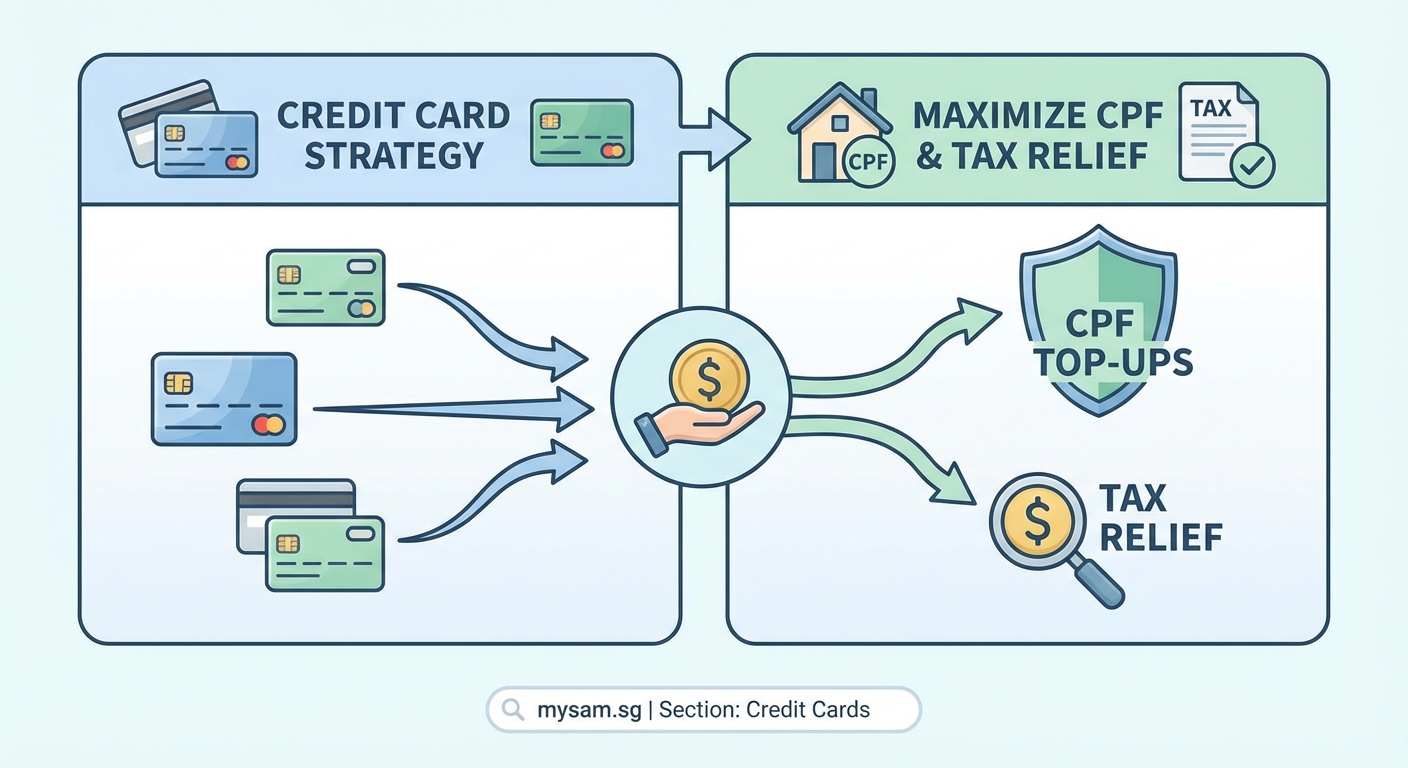
Your CPF strategy should evolve as your career and family situation changes.
Early career (25 to 30)
You’re probably in a lower tax bracket. Focus on building your emergency fund first. Start with smaller CPF top ups, maybe $2,000 to $4,000 annually. This builds the habit without straining your cash flow.
Mid career (30 to 40)
Your income is higher and more stable. This is prime time to max out the full $8,000 personal contribution. If your parents are approaching retirement, add family top ups.
Peak earning years (40 to 55)
You’re likely in the highest tax bracket you’ll ever reach. Maximize everything. The tax savings are substantial, and you’re close enough to retirement that the money will be accessible soon.
Above 55
You can now top up your Retirement Account directly. Focus on meeting your Basic Retirement Sum. Any excess can still go to MA for healthcare needs.
Each stage has different priorities. Adjust your strategy as your life changes.
Making CPF top ups work harder for you
Tax relief is just one benefit. The real power comes from combining multiple advantages.
Your CPF SA earns 4% risk-free. That beats most savings accounts and matches many conservative investment returns. For the portion of your wealth you want kept safe, CPF is hard to beat.
The tax savings effectively boost your return. If you’re in the 15% bracket, your real return becomes 4.7% after accounting for tax relief. That’s exceptional for a guaranteed investment.
CPF contributions also protect your money from creditors in most situations. This asset protection feature matters if you’re self-employed or in a risky profession.
For parents, topping up your children’s CPF when they’re young gives them a massive head start. A $8,000 contribution at age 25 grows to over $35,000 by age 55, assuming 4% interest. That’s purely from compound interest.
Some families use CPF top ups as a form of inheritance planning. Instead of leaving a large estate that might be taxed or disputed, they systematically top up children’s CPF accounts over many years.
Tracking and documenting your contributions
Good record keeping prevents headaches during tax season.
CPF sends confirmation emails for every top up. Save these in a dedicated folder. Create a simple naming system like “CPF_2024_OwnSA_8000.pdf” so you can find documents instantly.
Take screenshots of your CPF account balances before and after each contribution. This provides visual proof if any discrepancy arises.
For family top ups, keep a separate log with:
- Recipient name and NRIC
- Contribution date
- Amount
- Transaction reference number
- Which tax year you’re claiming it for
Most people never need this documentation because IRAS auto-populates the data. But when issues occur, having records saves hours of frustration.
Set a calendar reminder each December 15th. This gives you two weeks to make any final contributions before the year-end deadline.
Your retirement fund deserves this attention
Maximizing CPF top up tax relief isn’t complicated, but it does require intentional action. The difference between doing this right and ignoring it completely can amount to tens of thousands of dollars over your working life.
Start with your own $8,000 contribution. Once that becomes routine, add family top ups. Use credit cards strategically to earn rewards. Track everything carefully.
The best part? This isn’t a one-time task. You can repeat this strategy every single year, building wealth and saving taxes simultaneously. Your future self will thank you for the discipline you show today.
Set aside an hour this week to calculate your optimal contribution amount. Then make it happen before December 31st rolls around.