

You’re scrolling through insurance brochures, and two words keep popping up: term and whole life. One agent swears term is the smartest move. Another insists whole life is the only way to build wealth. Your head is spinning, and you’re no closer to a decision.
Here’s the truth: both types of insurance serve completely different purposes. Choosing between them isn’t about which one is “better.” It’s about which one fits your financial goals, budget, and stage of life.
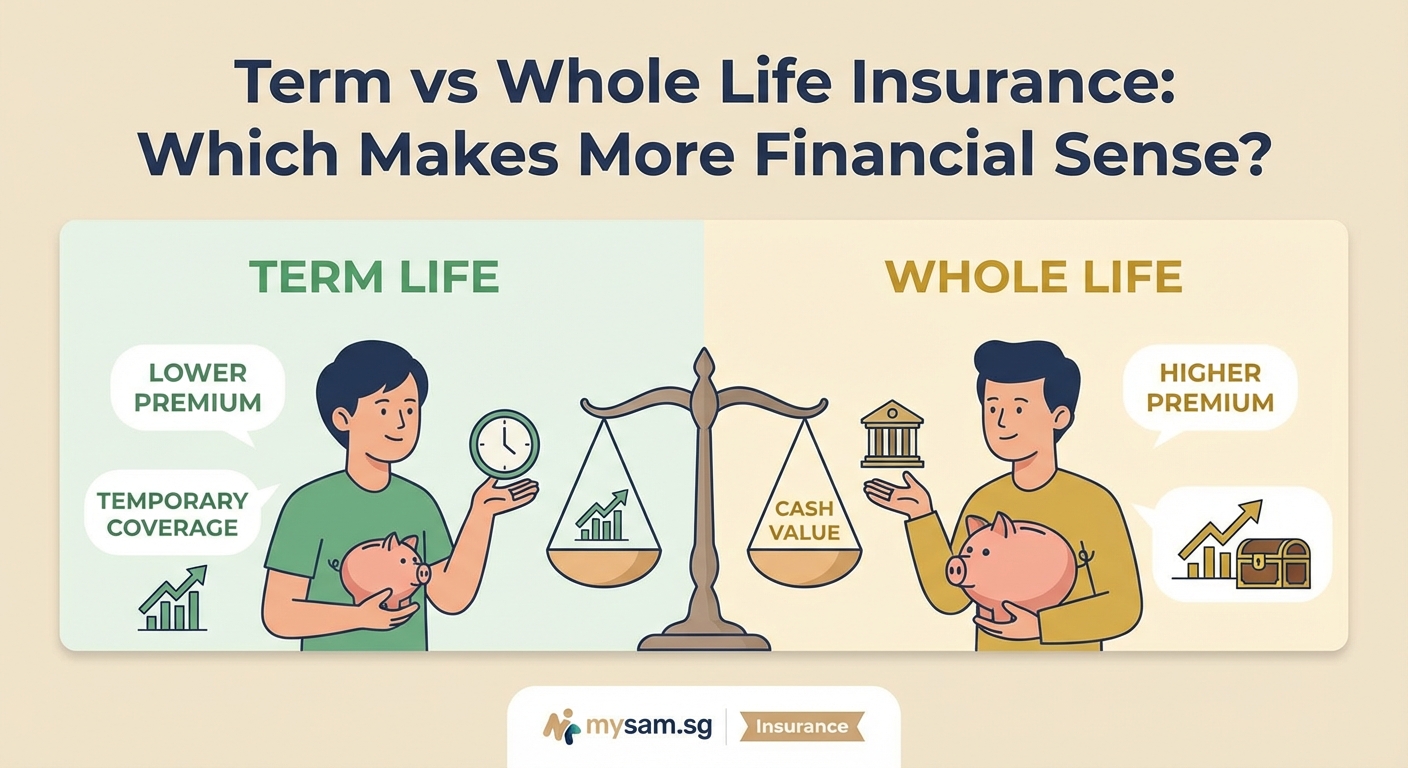
Term life insurance provides pure protection for a fixed period at lower premiums, ideal for covering specific financial obligations. Whole life insurance combines lifelong coverage with a savings component but costs significantly more. Most Singaporeans aged 25 to 50 benefit more from term insurance paired with separate investments, though whole life suits those prioritizing guaranteed cash value and legacy planning over flexibility.
What term life insurance actually covers
Term life insurance is straightforward.
You pay a monthly or annual premium. If you pass away during the policy term (usually 10, 20, or 30 years), your beneficiaries receive a lump sum payout. If you outlive the term, the policy expires with no payout or refund.
Think of it as renting coverage.
Here’s what makes term insurance appealing:
- Low premiums: A 30-year-old non-smoker can get $500,000 coverage for around $30 to $50 per month.
- High coverage amounts: You can afford larger sums to protect your family during critical years.
- Flexibility: Choose a term that matches your mortgage, children’s education years, or working career.
Term insurance works best when you have specific financial responsibilities. A young parent with a new HDB flat and two kids in primary school needs protection now, not 40 years from now.
How whole life insurance works differently
Whole life insurance never expires.
As long as you pay premiums, the policy stays active for your entire life. When you pass away, your beneficiaries receive a guaranteed death benefit.
But there’s more.
Whole life policies build cash value over time. A portion of your premium goes into a savings component that grows at a guaranteed rate, often supplemented by non-guaranteed bonuses.
You can borrow against this cash value, surrender the policy for a payout, or use it to pay future premiums.
Here’s the trade-off: premiums are 5 to 10 times higher than term insurance for the same coverage amount. That same 30-year-old might pay $300 to $500 monthly for $500,000 in whole life coverage.
Whole life insurance appeals to people who want:
- Lifelong protection without worrying about renewals
- A forced savings mechanism
- Legacy planning to leave money for heirs or charity
Breaking down the cost difference with real numbers
Let’s compare two 30-year-old Singaporeans, both non-smokers, looking for $500,000 in coverage.
| Policy Type | Monthly Premium | Total Paid Over 30 Years | Death Benefit | Cash Value at Age 60 |
|---|---|---|---|---|
| Term (30 years) | $40 | $14,400 | $500,000 | $0 |
| Whole Life | $400 | $144,000 | $500,000 | ~$120,000 (estimated) |
The whole life policyholder pays $129,600 more over 30 years.
If they invested that $360 monthly difference in a diversified portfolio earning 5% annually, they’d accumulate around $250,000 by age 60. That’s more than double the cash value of the whole life policy.
This is the classic “buy term and invest the rest” argument.
But it assumes discipline. Not everyone will actually invest the difference. Some people spend it on dining, gadgets, or holidays.
When term insurance makes more financial sense
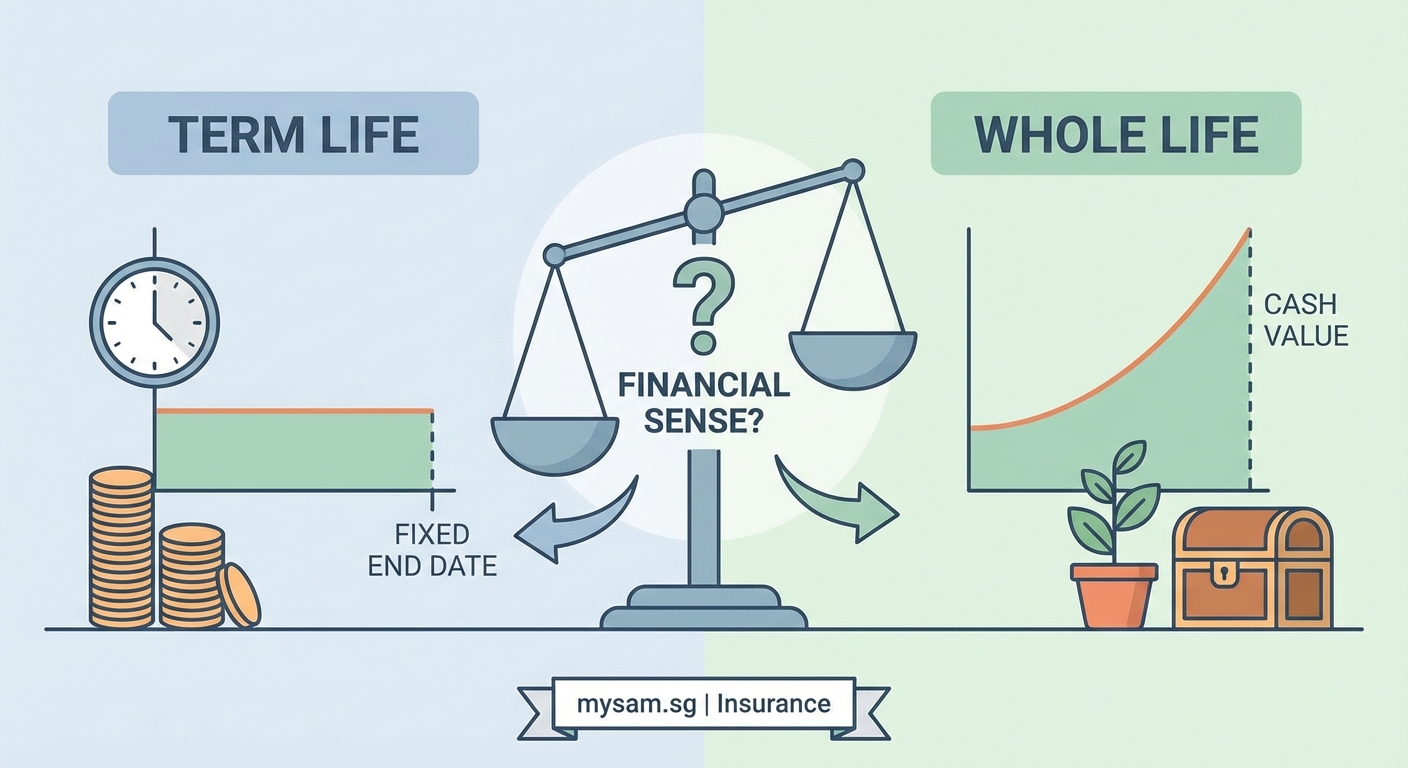
Term insurance suits most Singaporeans in their 20s to 50s.
Here’s why.
Your biggest financial risks are temporary. You need to cover:
- Your outstanding mortgage (which decreases over time)
- Your children’s education costs (until they graduate)
- Your income replacement (until retirement)
Once your kids are financially independent, your HDB is paid off, and your CPF and investments can sustain your retirement, you need less coverage.
Term insurance aligns perfectly with these temporary needs.
It also frees up cash flow for other goals. Instead of locking $400 monthly into a whole life policy, you could:
- Start investing in Singapore with just $100 a month and build a portfolio
- Accelerate your mortgage repayment
- Max out your Supplementary Retirement Scheme (SRS) contributions
- Build a 6-month emergency fund faster
“The best insurance strategy is one that protects your family without crippling your ability to build wealth elsewhere. For most people, that means term insurance paired with disciplined investing.”
When whole life insurance might be the better choice
Whole life insurance isn’t always a bad deal.
It works well if you:
- Struggle with saving discipline: The forced savings component ensures you accumulate something, even if returns are modest.
- Want guaranteed outcomes: You know exactly what you’ll get. No market risk, no guesswork.
- Plan to leave a legacy: If leaving money to children, grandchildren, or charity matters deeply, whole life guarantees a payout regardless of when you pass away.
- Have maxed out other options: If you’re already contributing fully to CPF, SRS, and personal investments, whole life can be an additional wealth-building tool.
Whole life also appeals to high-income earners who value convenience over optimization. If budgeting $500 monthly for insurance doesn’t strain your finances, and you prefer simplicity, whole life offers peace of mind.
The hidden costs and trade-offs you need to know
Both policies have pitfalls.
Term insurance risks:
- Expiration: If you outlive the term and still need coverage, renewing at an older age is expensive.
- No cash value: You get nothing back if you don’t claim.
- Health changes: If you develop a medical condition, getting a new policy later can be difficult or costly.
Whole life insurance risks:
- Opportunity cost: High premiums reduce your ability to invest elsewhere.
- Liquidity: Cash value takes years to build. Early surrender results in losses.
- Non-guaranteed returns: Bonuses depend on the insurer’s performance and can be cut.
- Complexity: Policy illustrations can be confusing, and agents sometimes oversell projected returns.
Many Singaporeans buy whole life policies in their 20s, then surrender them in their 30s when cash flow tightens. Surrendering early means losing money.
How to decide which policy fits your situation
Follow this step-by-step process:
-
Calculate your coverage needs: Use the income replacement method. Multiply your annual income by the number of years your family needs support, then add outstanding debts. For a detailed breakdown, check out how much life insurance you actually need in Singapore.
-
Assess your budget: How much can you comfortably pay monthly without sacrificing other financial goals?
-
Evaluate your savings discipline: Be honest. Will you actually invest the difference if you choose term insurance?
-
Consider your stage of life: Young parents with mortgages usually need term. Older professionals nearing retirement might prefer whole life for legacy planning.
-
Compare quotes: Get proposals from at least three insurers. Look beyond premiums. Check exclusions, claim processes, and insurer reputation.
-
Review annually: Your needs change. A policy that made sense at 28 might not fit at 38.
Common mistakes that cost Singaporeans thousands
Avoid these traps:
- Buying whole life because “everyone does”: Your colleague’s financial situation isn’t yours.
- Underinsuring to afford whole life: It’s better to have $500,000 in term coverage than $100,000 in whole life.
- Ignoring inflation: A $500,000 payout today won’t have the same purchasing power in 30 years. Consider increasing coverage or adding riders.
- Mixing insurance with investment goals: Insurance should protect. Investments should grow wealth. Combining them often means mediocre results in both.
- Surrendering policies early: If you bought whole life and regret it, evaluate whether surrendering now or continuing makes more financial sense. Sometimes holding is better.
Can you combine both types of insurance?
Yes, and many Singaporeans do.
A hybrid approach looks like this:
- Base coverage with term insurance: Get $500,000 to $1 million in term coverage for your peak earning years.
- Smaller whole life policy: Add $100,000 to $200,000 in whole life for guaranteed lifelong coverage and modest cash value.
This strategy gives you:
- High coverage when you need it most
- Permanent protection for final expenses and legacy
- Lower overall premiums than a large whole life policy alone
The key is balancing coverage, cost, and flexibility.
What to ask your insurance agent before signing
Don’t sign anything until you get clear answers to these questions:
- What exactly am I covered for, and what’s excluded?
- How much of my premium goes to coverage versus savings?
- What happens if I miss a payment?
- Can I adjust coverage or premiums later?
- What’s the claims process, and how long does it take?
- Are there better alternatives for my situation?
A good agent will explain trade-offs honestly. A pushy agent will pressure you to buy the most expensive policy.
If you feel rushed, walk away. Insurance is a long-term commitment. Take your time.
Adjusting your coverage as life changes
Your insurance needs aren’t static.
Review your policy when:
- You get married or divorced
- You have children
- You buy a property
- You change jobs or income level
- Your kids graduate and become financially independent
- You pay off major debts
Term insurance is easier to adjust. You can add riders, increase coverage, or let policies expire as needs decrease.
Whole life is less flexible. Adjustments often require buying additional policies or surrendering and repurchasing, both of which can be costly.
Why most Singaporeans benefit from starting with term
If you’re still unsure, start with term insurance.
Here’s why.
Term insurance gives you maximum protection at minimum cost during your highest-risk years. You can always add whole life later if your financial situation improves.
The reverse is harder. If you buy whole life first and realize you can’t afford the premiums, surrendering means losing money.
Term insurance also leaves room for other financial priorities. You can cut your monthly expenses, build an emergency fund, and start investing without feeling stretched.
Once you’ve built a solid financial foundation, you can reassess whether whole life makes sense.
Making insurance work for your money, not against it
The right insurance policy protects your family without draining your ability to build wealth.
For most Singaporeans aged 25 to 50, that means term insurance paired with disciplined saving and investing. You get high coverage when you need it most, and you keep control over your money.
Whole life has its place, especially for legacy planning or forced savings. But it shouldn’t come at the expense of other financial goals.
Take time to understand your needs, compare options, and choose a policy that fits your life today and tomorrow. Your family’s financial security depends on it.