

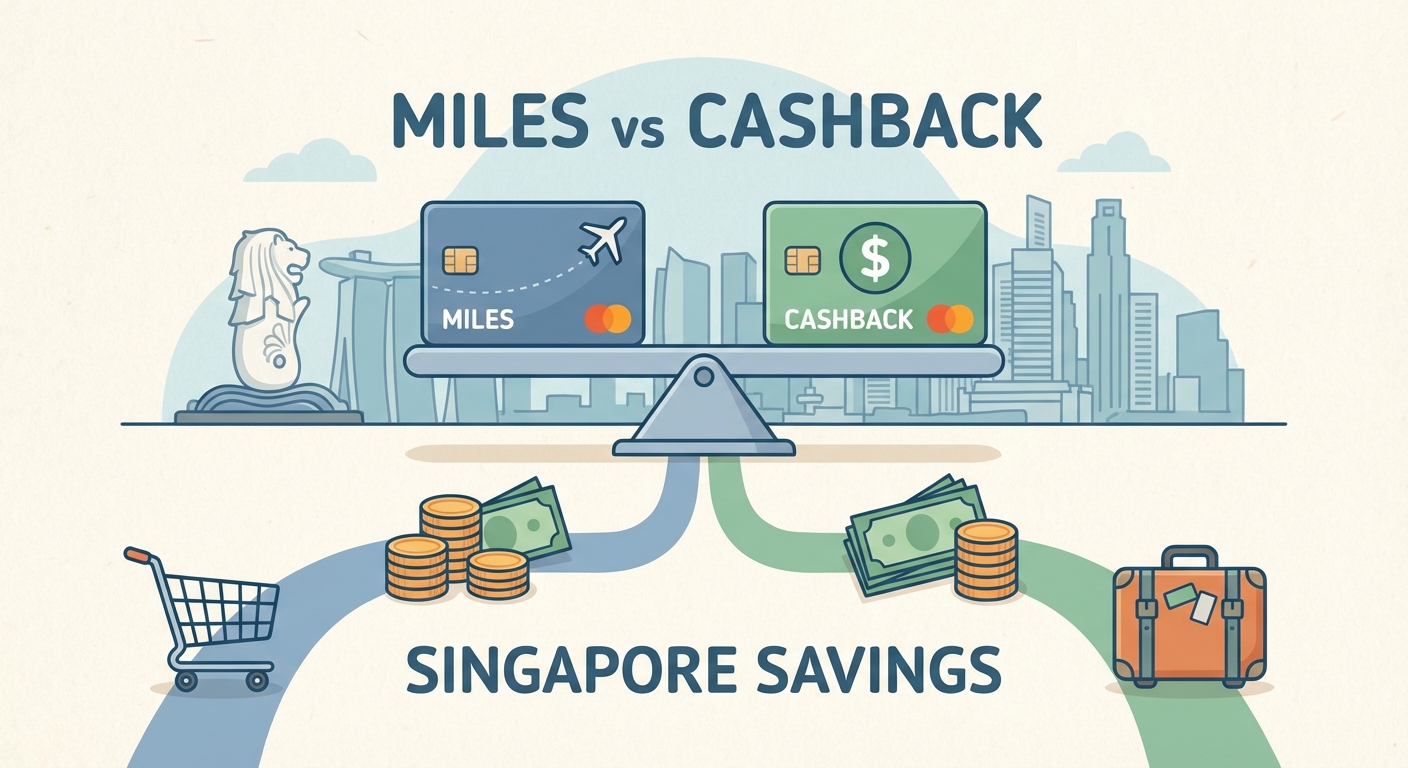
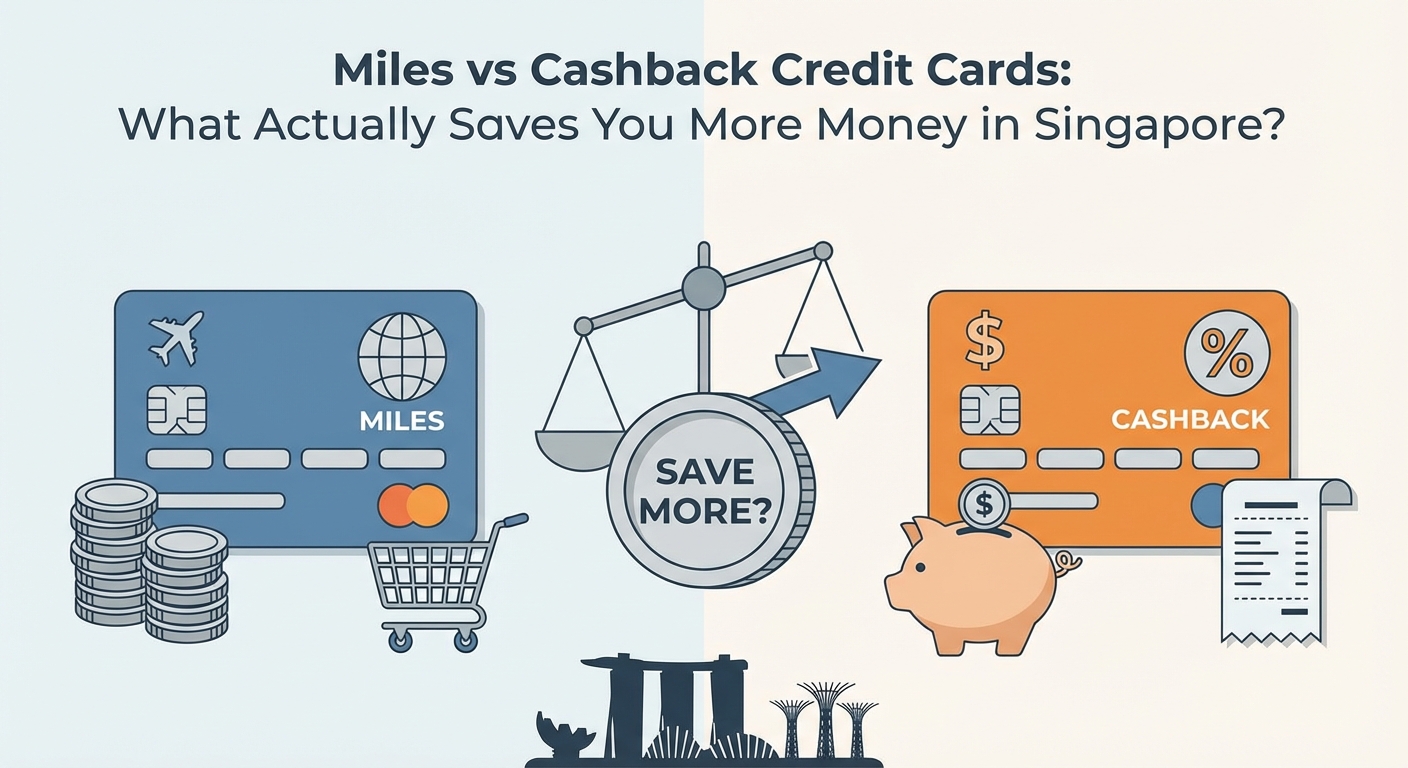
You’ve narrowed your next credit card down to two types: one that gives you air miles, another that pays cashback. Both promise rewards, but which one actually puts more money back in your pocket?
The answer depends on how much you spend, where you spend it, and whether you’ll actually use those miles before they expire. Let’s break down the math, the traps, and the real-world scenarios that matter.
Miles cards reward high spenders who travel regularly and can hit minimum thresholds, often delivering 2% to 4% value when redeemed smartly. Cashback cards suit moderate spenders who want instant, hassle-free returns of 1.5% to 3% without tracking expiry dates or transfer partners. Your spending habits and travel frequency determine which type saves you more money over time.
How miles and cashback rewards actually work
Miles cards convert your spending into points that you redeem for flights, upgrades, or hotel stays. Most Singapore cards earn between 1.2 to 4 miles per dollar, depending on the spending category.
Cashback cards return a percentage of your spending directly to your statement or account. You see the benefit immediately, usually between 1.5% and 3% depending on the card and merchant.
The catch with miles: you need to accumulate enough points to book something worthwhile, and the value per mile fluctuates based on how you redeem. A mile might be worth $0.01 when you book economy, but $0.03 or more for business class.
The catch with cashback: the rate is fixed. You’ll never squeeze more value out of it, but you’ll never lose it to expiry either.
The spending threshold that changes everything
Most premium miles cards require annual spending of $30,000 to $50,000 to waive fees and unlock bonus miles. If you don’t hit that threshold, you’re paying $200 to $500 in annual fees for rewards you might not maximize.
Cashback cards often have lower or no annual fees. Some cap your cashback at $50 to $80 per month, which means high spenders hit a ceiling and stop earning rewards.
Here’s a simple breakpoint: if you spend less than $2,000 per month, cashback cards usually win. Between $2,000 and $5,000, it depends on your travel habits. Above $5,000, miles cards often pull ahead if you travel at least twice a year.
Real value comparison for common spending levels
Let’s run the numbers for three spending profiles.
| Monthly Spend | Cashback (2%) | Miles (2 mpd at $0.02/mile) | Miles (4 mpd at $0.02/mile) |
|---|---|---|---|
| $1,500 | $30 | $60 value | $120 value |
| $3,000 | $60 | $120 value | $240 value |
| $6,000 | $120 | $240 value | $480 value |
These numbers assume you redeem miles at $0.02 each, which is achievable for economy flights within Asia. Business class redemptions can push that to $0.03 or higher, making miles cards even more attractive.
But here’s the problem: many people never redeem their miles. They expire, or the blackout dates make booking impossible, or the transfer ratios to airline programs dilute the value.
Cashback has no such friction. You spend, you earn, you see the money back.
Where miles cards beat cashback every time
If you book business or first class tickets, miles cards win by a landslide. A Singapore to London business class ticket might cost $5,000 in cash but only 100,000 miles, which you could earn with $25,000 in spending on a 4 mpd card.
That same $25,000 on a 2% cashback card gives you $500. The miles redemption delivers 10 times the value.
Miles cards also shine for these situations:
- You travel regularly for work and can use personal cards for reimbursable expenses
- You have flexible travel dates and can hunt for award availability
- You’re comfortable navigating airline loyalty programs and transfer partners
- You want to upgrade your travel experience without paying cash premiums
Where cashback cards make more sense
Cashback wins when you value simplicity and liquidity. You don’t need to research redemption sweet spots or worry about devaluation when airlines change their award charts.
Cashback is better if:
- You travel less than once a year
- You prefer budget airlines that don’t partner with miles programs
- You want to offset everyday expenses like groceries and utilities
- You don’t want to track expiry dates or minimum point thresholds
- You spend moderately and won’t hit the bonus tiers on miles cards
The hidden costs that eat into your rewards
Annual fees are the obvious cost, but several hidden factors reduce your effective return.
Foreign transaction fees: Some miles cards charge 3% on overseas spending, which wipes out the rewards unless you’re earning 4 mpd or more. Always check if your card waives this fee.
Minimum spend requirements: Missing the threshold means paying the full annual fee while earning base-level rewards. That $300 fee turns a 2% return into a loss if you only spend $10,000.
Expiry and devaluation: Miles can expire after 18 to 36 months. Airlines also devalue their programs, meaning the same flight suddenly costs more points. Cashback never expires or loses value.
Redemption friction: Booking award flights takes time. You need to check multiple dates, compare transfer partners, and sometimes call the airline. If your time is valuable, this hassle has a real cost.
How to calculate your personal breakeven point
Follow these steps to figure out which card type saves you more money:
- Add up your monthly spending across all categories for the past six months.
- Separate spending by category: dining, groceries, transport, online shopping, general retail.
- Check which cards give bonus rates for your top spending categories.
- Calculate annual rewards for both card types using your actual spending patterns.
- Subtract annual fees and factor in redemption value (use $0.015 to $0.02 per mile for conservative estimates).
- Compare the net benefit after all costs.
If the difference is less than $100 per year, choose based on convenience. If it’s more than $200, the math makes the decision for you.
Common mistakes that cost you money
Chasing sign-up bonuses without considering long-term value is the biggest trap. You might earn 20,000 bonus miles, but if you never redeem them, they’re worthless.
Other mistakes include:
- Paying annual fees on multiple cards when one would suffice
- Letting miles expire because you forgot to book
- Redeeming miles for vouchers or products at terrible conversion rates
- Ignoring spending caps on cashback cards and earning nothing beyond the limit
- Using the wrong card for each purchase and missing bonus categories
The hybrid approach that works for many people
You don’t have to choose just one. Many Singapore cardholders keep both types and use each strategically.
Use your miles card for:
- Big-ticket purchases that push you toward bonus thresholds
- Overseas travel spending if the card waives foreign fees
- Dining and online shopping if those categories earn 4 mpd or more
Use your cashback card for:
- Everyday expenses like groceries and transport
- Spending that doesn’t earn bonus miles
- Months when you’ve already hit your miles card threshold
The best credit card strategy isn’t about having the most cards. It’s about matching each dollar you spend to the card that returns the most value for that specific purchase.
Tax, insurance, and other spending categories
Some spending types don’t earn rewards at all. Government payments, insurance premiums, and school fees often get excluded or earn only 0.4 mpd.
Check your card’s terms for exclusions. If a large portion of your spending falls into excluded categories, your effective rewards rate drops significantly.
Utilities and telco bills usually earn full rewards, making them good candidates for recurring card charges. Set up auto-pay and collect passive rewards every month.
When to switch from one type to another
Your card strategy should evolve with your life stage.
Switch from cashback to miles when:
- Your income increases and you cross the $3,000 monthly spending threshold
- You start traveling more for work or leisure
- You’re planning a big trip and want to maximize redemption value
Switch from miles to cashback when:
- You’re cutting back on travel
- You’re not hitting minimum spending requirements anymore
- You find yourself letting miles expire repeatedly
- You want to simplify your finances
Redemption strategies that maximize miles value
If you commit to a miles card, learn to redeem smartly. Book flights during off-peak periods when airlines release more award seats. Transfer points to airline partners during bonus promotions to get 20% to 30% more value.
Focus on business class for long-haul flights where the cash price is highest. A $6,000 ticket redeemed for 120,000 miles gives you $0.05 per mile, far better than economy redemptions.
Avoid redeeming miles for merchandise, vouchers, or statement credits. These options typically value miles at $0.005 to $0.01, half what you’d get from flights.
Making the choice that fits your life
The miles versus cashback debate isn’t about which card is objectively better. It’s about which one aligns with how you actually live and spend.
If you travel often, enjoy optimizing redemptions, and spend enough to justify annual fees, miles cards will likely save you more money. If you want simplicity, guaranteed value, and immediate returns, cashback cards are the smarter choice.
Calculate your numbers, consider your habits, and pick the card that works for your wallet. You can always switch later if your situation changes.