

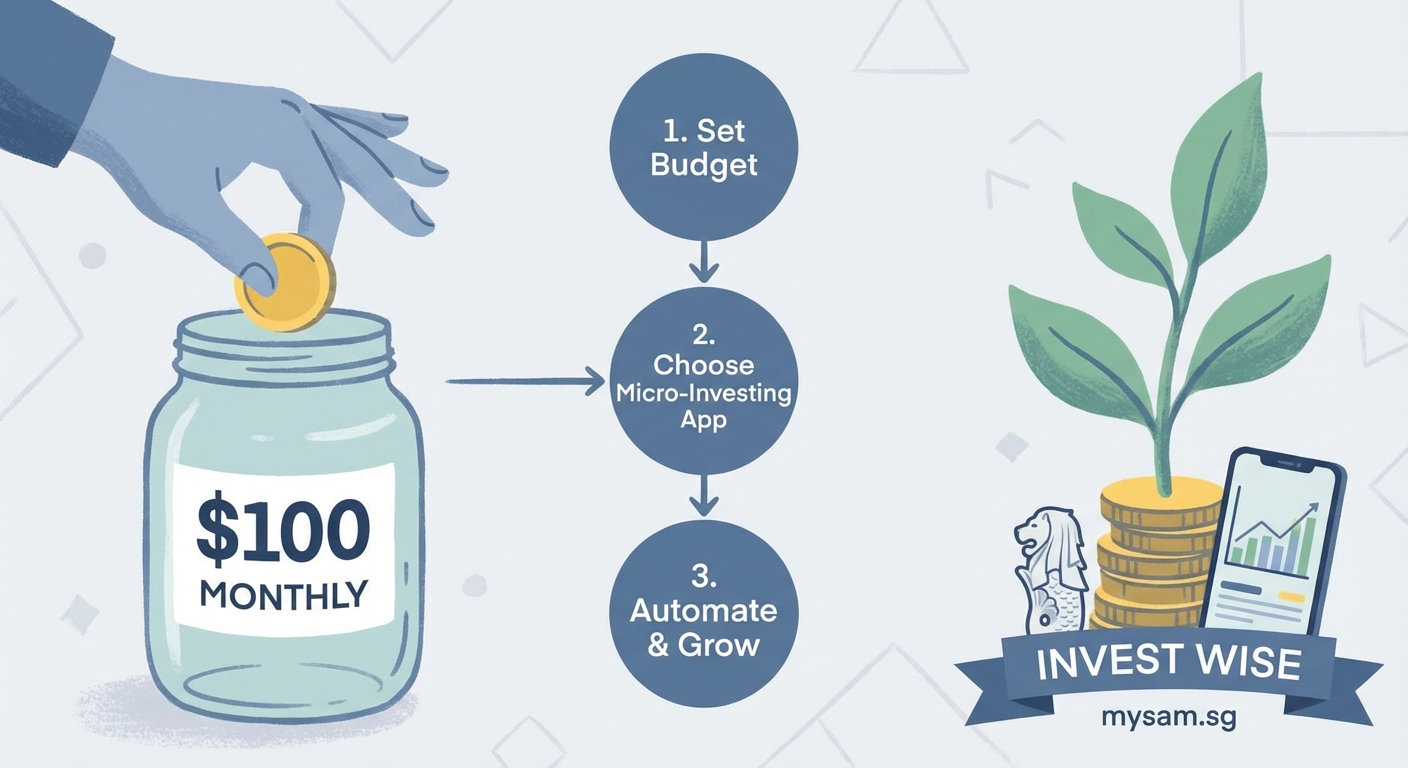
You don’t need thousands of dollars to start investing in Singapore. In fact, you can begin building wealth with as little as $100 a month. Many young professionals and students think investing is only for the rich, but that’s outdated thinking. Today’s investment platforms have lowered the barriers so much that anyone with a smartphone and a hundred bucks can get started.
Starting to invest with $100 monthly in Singapore is completely achievable through robo-advisors, Regular Savings Plans, and fractional investing platforms. Focus on low-cost index funds or ETFs, automate your contributions, and prioritize consistency over timing. Build an emergency fund first, understand platform fees, and choose investments aligned with your risk tolerance and time horizon for sustainable wealth building.
Why $100 monthly matters more than you think
Investing $100 every month might not sound impressive. But compound interest turns small, consistent contributions into substantial wealth over time.
Let’s say you invest $100 monthly for 20 years at an average 7% annual return. You’d contribute $24,000 total. But your portfolio would grow to around $52,000. That’s more than double your contributions, all from disciplined monthly investing.
The real power lies in starting early. A 25-year-old who invests $100 monthly until 65 will likely accumulate more wealth than someone who starts at 35 investing $200 monthly. Time is your biggest advantage when you have limited capital.
Starting small also helps you learn without risking too much. You’ll understand market fluctuations, test different strategies, and build confidence before committing larger amounts later in your career.
Build your emergency fund first
Before you invest a single dollar, make sure you have emergency savings. This isn’t exciting advice, but it’s critical.
Aim for three to six months of living expenses in a high-yield savings account. If you’re living with parents and have minimal expenses, even $3,000 to $5,000 provides a solid buffer.
Why does this matter? Investments go up and down. If you need cash urgently and the market is down 20%, you’ll be forced to sell at a loss. An emergency fund prevents this scenario.
Keep this money separate from your investment accounts. Use a different bank if needed. Treat it as untouchable unless you face a genuine emergency like job loss or medical bills.
Choose the right investment platform
Singapore offers several platforms perfect for investing with $100 monthly. Each has different features, fees, and minimum amounts.
Robo-advisors
Robo-advisors like Endowus, Syfe, and StashAway automate your investments based on your risk profile. They build diversified portfolios of ETFs and rebalance automatically.
Most robo-advisors have no minimum investment amount or very low minimums. Fees typically range from 0.5% to 0.8% annually, plus underlying fund costs.
These platforms are ideal if you want a hands-off approach. Answer a few questions about your goals and risk tolerance, set up monthly transfers, and let the algorithm handle the rest.
Regular Savings Plans (RSP)
Banks and brokers like OCBC, DBS, and Phillip offer Regular Savings Plans. These let you invest fixed monthly amounts into specific stocks or ETFs.
Minimum monthly investments are usually $100 to $200. Fees vary but expect around $1 to $5 per transaction, which matters more when your contributions are small.
RSPs work well if you want to invest in specific index funds like the SPDR STI ETF or global index funds. You get to choose exactly what you buy.
Fractional investing platforms
Platforms like Syfe Trade and moomoo allow fractional share purchases. This means you can buy portions of expensive stocks or ETFs with whatever amount you have.
If a share costs $500 but you only have $100, you can buy 0.2 shares. This flexibility is perfect for small investors who want specific exposure.
Trading fees on these platforms are often lower than traditional brokers, making them cost-effective for monthly contributions.
What to invest in with limited capital
When you’re starting with $100 monthly, simplicity beats complexity. Focus on low-cost, diversified investments.
Index funds and ETFs
Index funds track entire markets rather than individual stocks. They offer instant diversification and typically charge lower fees than actively managed funds.
For Singapore investors with small amounts, consider:
- Global index funds that track the MSCI World or S&P 500
- Singapore index funds like the STI ETF if you want local exposure
- Bond funds for stability as you approach financial goals
The key advantage? You don’t need to pick winning stocks. You’re betting on the entire market’s long-term growth, which historically trends upward despite short-term volatility.
Avoid individual stocks initially
Buying individual company shares with $100 monthly is risky. You lack diversification, and brokerage fees eat into your small contributions.
If one company tanks, your entire portfolio suffers. Index funds spread this risk across hundreds or thousands of companies.
Save individual stock picking for later when you have more capital and experience. For now, broad market exposure serves you better.
Set up automatic monthly contributions
Automation removes the temptation to skip months or spend that $100 elsewhere. Set up a standing instruction from your bank account to your investment platform.
Choose a date right after your salary arrives. If you get paid on the 1st, schedule your investment transfer for the 3rd. This ensures the money moves before you spend it on other things.
Treating your investment like a mandatory bill rather than optional savings dramatically increases consistency. You’re paying your future self first.
Most platforms let you automate both the transfer and the purchase. Once configured, your investments run on autopilot.
Understand the fees you’re paying
Fees might seem small, but they compound negatively just like returns compound positively. A 1% annual fee doesn’t sound like much, but over 30 years it can reduce your final portfolio by 25% or more.
| Platform Type | Typical Annual Fees | Best For |
|---|---|---|
| Robo-advisors | 0.5% to 0.8% + fund costs (0.1% to 0.3%) | Hands-off investors wanting automated portfolios |
| Regular Savings Plans | $1 to $5 per transaction + fund costs | Investors who want to choose specific index funds |
| Fractional platforms | 0.05% to 0.2% per trade + fund costs | DIY investors comfortable managing their portfolio |
Calculate the total cost including platform fees, fund expense ratios, and transaction costs. Lower fees mean more money stays invested and compounds over time.
For $100 monthly investments, a $5 transaction fee represents 5% of your contribution. That’s significant. Look for platforms with percentage-based fees or lower fixed costs.
Common mistakes to avoid
Even with a simple strategy, beginners make predictable errors that hurt long-term returns.
Trying to time the market. You’ll never consistently buy at the bottom and sell at the top. Regular monthly investing through all market conditions historically outperforms trying to time entries and exits.
Stopping contributions during downturns. Market drops are when your $100 buys more shares at lower prices. Continuing to invest during bear markets sets you up for bigger gains when markets recover.
Chasing hot stocks or trends. Cryptocurrency, meme stocks, and whatever’s trending on social media are not suitable for your core long-term portfolio. Speculation is fine with money you can afford to lose, not your monthly investment commitment.
Ignoring tax-advantaged accounts. Once you’re contributing consistently, consider using your Supplementary Retirement Scheme (SRS) for additional tax benefits. SRS contributions reduce your taxable income and grow tax-free until withdrawal.
Withdrawing too early. Investments need time to compound. Pulling money out after a year or two because returns seem slow defeats the purpose. Commit to at least five years, ideally much longer.
“The stock market is a device for transferring money from the impatient to the patient. Starting with small amounts and staying consistent separates those who build wealth from those who just talk about it.” – Adapted investment wisdom for Singapore beginners
Track your progress without obsessing
Check your portfolio quarterly, not daily. Constant monitoring leads to emotional decisions based on short-term noise rather than long-term trends.
Set calendar reminders for March, June, September, and December. Review your performance, rebalance if needed, and adjust contributions if your income increases.
As your salary grows, increase your monthly investment. Going from $100 to $150 or $200 monthly dramatically accelerates your wealth building without feeling like a huge sacrifice.
Celebrate milestones. Your first $1,000 invested. Your first $5,000. When investment returns exceed your contributions in a year. These moments reinforce the habit and keep you motivated.
Scale up as your income grows
The $100 monthly starting point is just that, a starting point. As you progress in your career and earn more, your investment contributions should grow proportionally.
A good rule of thumb is investing 15% to 20% of your gross income. If you’re earning $3,000 monthly, that’s $450 to $600. If you’re at $5,000 monthly, aim for $750 to $1,000.
Don’t wait until you feel ready or until you have a lump sum. Start with what you can afford now and increase gradually. The habit and time in the market matter more than the initial amount.
Consider splitting increases between your regular investment account and tax-advantaged options like SRS once your contributions exceed $300 to $500 monthly.
Your investment journey starts today
Starting to invest in Singapore with $100 monthly is not only possible but a smart move for building long-term wealth. You don’t need to be rich to start. You start to become rich.
Choose a platform that fits your style, whether that’s a robo-advisor for simplicity, an RSP for control, or a fractional investing platform for flexibility. Focus on low-cost index funds that give you broad market exposure without requiring you to pick individual winners.
Automate your contributions, keep fees low, and resist the urge to constantly tinker or time the market. Consistency and patience beat perfect timing every single time.
The best time to start investing was ten years ago. The second best time is today. Your future self will thank you for taking that first step, even if it’s just $100.