
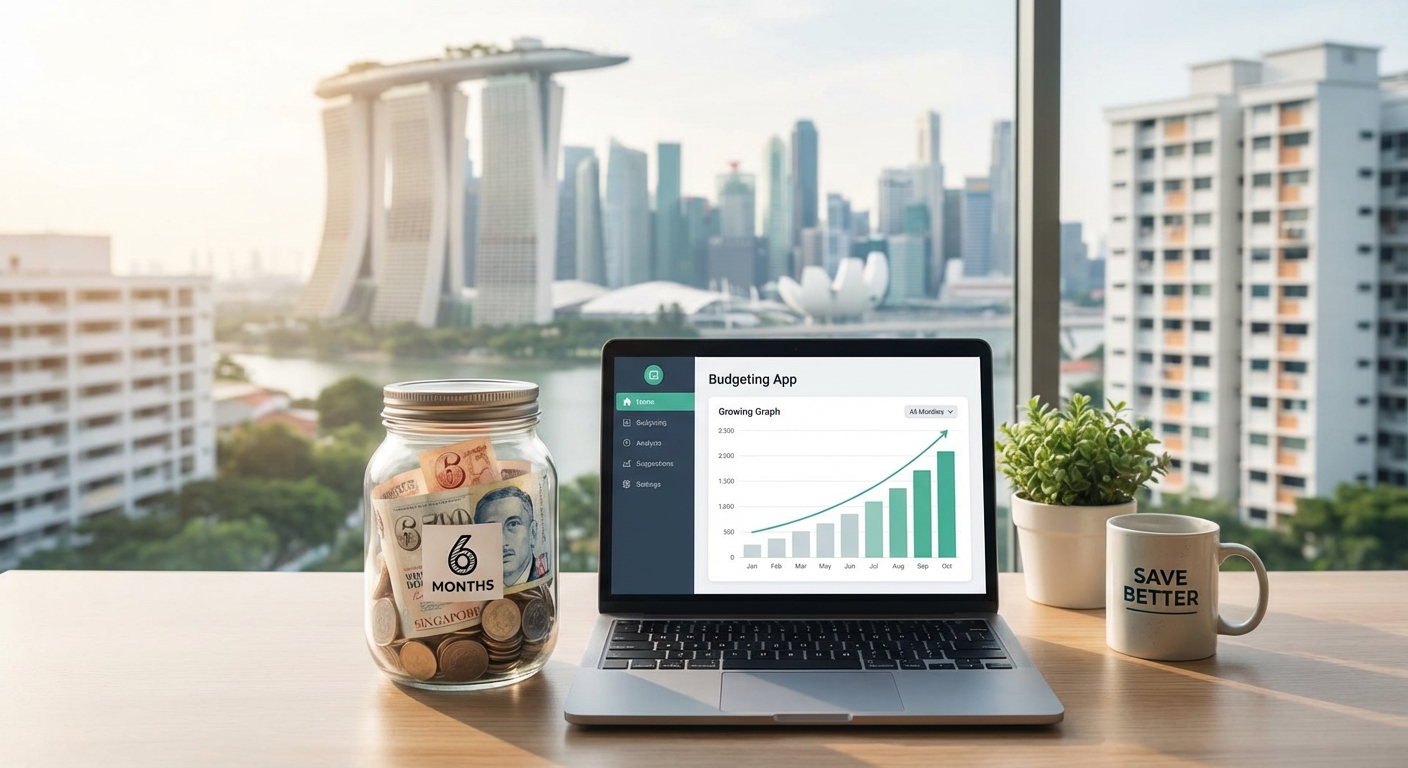
Building an emergency fund sounds like advice for people who already have money to spare. But here’s the truth: it’s actually most important for those of us living paycheck to paycheck. When your car breaks down, your laptop dies, or you suddenly need to see a specialist, having cash ready means you won’t spiral into debt or drain your CPF savings.
An emergency fund covering six months of expenses protects you from unexpected costs without borrowing. Start by calculating your monthly essentials, automate small transfers into a separate savings account, and build gradually using strategies like the 50/30/20 rule. Even saving $50 monthly gets you $3,600 in five years. Focus on consistency over speed, adjust for Singapore’s cost of living, and keep funds accessible but separate from daily spending.
Why six months matters in Singapore
Six months isn’t a random number. It’s the average time most people need to find a new job if they’re retrenched, recover from a medical emergency, or handle a major home repair.
Singapore’s high cost of living makes this buffer even more critical. Rent alone can eat $1,500 to $3,000 monthly. Add utilities, transport, food, insurance, and phone bills, and you’re looking at $3,000 to $5,000 per month for a single person.
That means your target sits somewhere between $18,000 and $30,000.
Sounds massive, right? It is. But you don’t build it overnight.
Calculate your actual monthly expenses
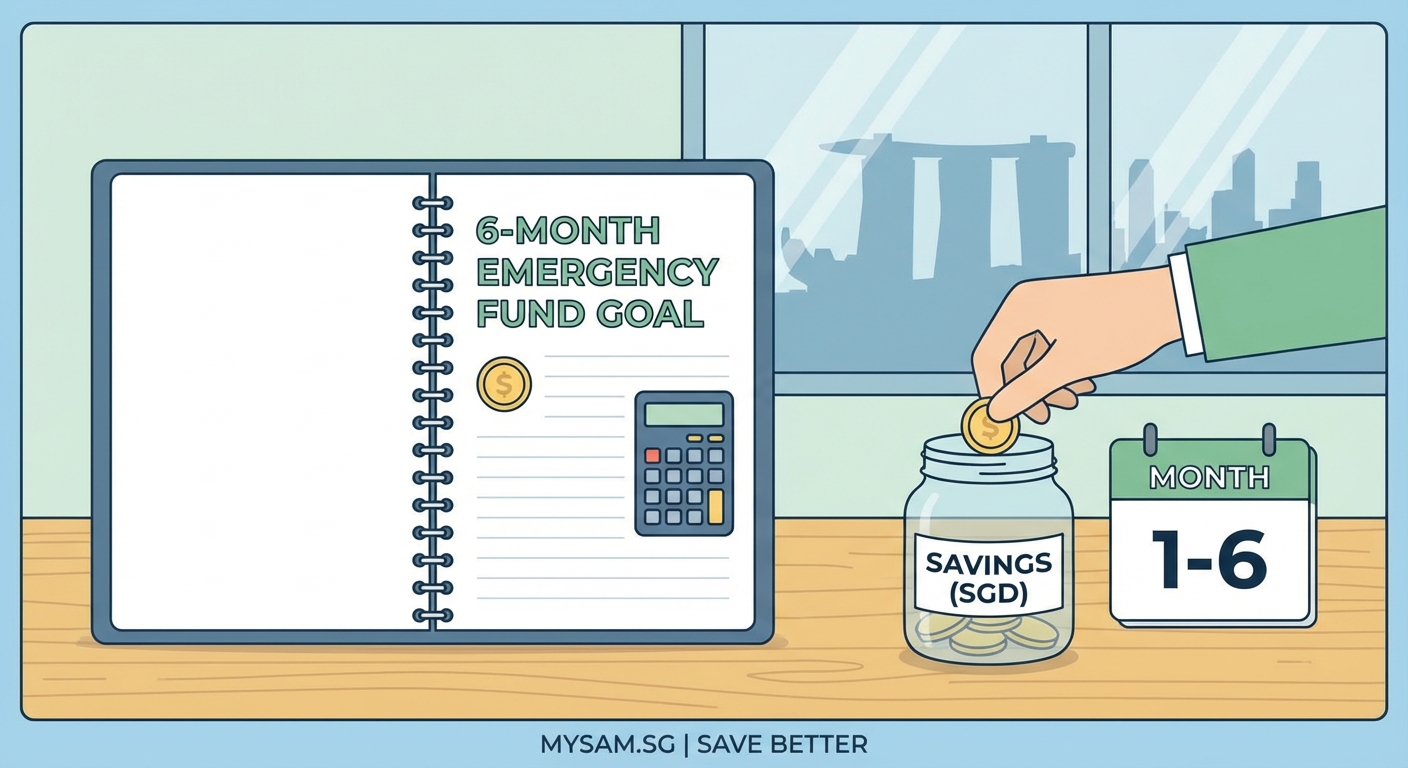
Most people guess their spending. That’s a mistake.
Spend one month tracking every dollar. Use a simple spreadsheet or a free app. Write down everything: your kopi, your Grab rides, your Netflix subscription.
At the end of the month, separate your expenses into two buckets:
Essential expenses (rent, utilities, groceries, transport, insurance, loan payments)
Non-essential expenses (dining out, entertainment, shopping, hobbies)
Your emergency fund should cover only the essentials. If you lose your job, you’re not going to keep your gym membership or eat at hawker centres every day.
Let’s say your essentials total $2,800 monthly. Your six-month target is $16,800.
Write that number down. Make it real.
Set a realistic timeline based on your salary
Here’s where salary matters.
If you earn $3,000 monthly after CPF, saving $16,800 feels impossible. But if you can set aside just 10% of your income, that’s $300 per month. You’ll hit your goal in 56 months, or about five years.
Earning $5,000? Saving 15% gives you $750 monthly. You’ll reach $16,800 in 22 months, under two years.
The table below shows different scenarios:
| Monthly Income (After CPF) | Savings Rate | Monthly Savings | Months to $16,800 |
|---|---|---|---|
| $2,500 | 10% | $250 | 67 months |
| $3,000 | 10% | $300 | 56 months |
| $4,000 | 15% | $600 | 28 months |
| $5,000 | 15% | $750 | 22 months |
| $6,000 | 20% | $1,200 | 14 months |
Don’t let the timeline discourage you. The point isn’t speed. It’s building the habit and having something saved when trouble hits.
Even $1,000 in the bank is better than zero.
Use the 50/30/20 rule as a starting framework
This budgeting method is simple:
- 50% of your income goes to needs (rent, food, transport)
- 30% goes to wants (entertainment, dining, hobbies)
- 20% goes to savings and debt repayment
For someone earning $4,000 monthly:
- $2,000 for needs
- $1,200 for wants
- $800 for savings
If your needs exceed 50%, adjust the ratio. Cut wants to 20% and boost savings to 30%. The rule is a guide, not a law.
The important part is separating your money into clear categories so you know exactly where it’s going.
Open a separate savings account for your fund
Keeping your emergency money in your main account is like keeping cookies on your desk. You’ll eat them.
Open a second savings account. Many Singapore banks offer accounts with zero fees and decent interest rates. Look for:
- No minimum balance requirement
- No monthly fees
- Easy online transfers
- Competitive interest (1% to 2% is standard)
Name the account something specific. “Emergency Fund” or “Do Not Touch” works.
Transfer your monthly savings amount on payday, before you spend anything else. Automate it if possible. Most banks let you set up recurring transfers.
Out of sight, out of mind.
Start small and increase over time
Saving $800 monthly sounds great until your friend’s wedding comes up or your laptop screen cracks.
Start with what feels manageable. $50 per month is fine. $100 is better. The amount matters less than the consistency.
After three months, check your budget. Can you add another $25? Do it.
Every raise, every bonus, every tax refund should boost your emergency fund until you hit your target.
Here’s a simple progression:
- Month 1 to 3: Save $100 monthly
- Month 4 to 6: Increase to $150 monthly
- Month 7 to 12: Increase to $200 monthly
- Month 13 onwards: Increase to $300 monthly
This gradual approach keeps you motivated without feeling deprived.
Cut expenses without feeling deprived
You don’t need to live on instant noodles and cancel your social life.
But you can trim fat without noticing.
Try these:
- Cook one extra meal per week instead of eating out (saves $30 to $50 monthly)
- Switch from Grab to public transport twice a week (saves $40 to $60 monthly)
- Cancel subscriptions you don’t use (Spotify, gym, streaming services you forgot about)
- Buy groceries at neighbourhood markets instead of Cold Storage (saves $50 to $100 monthly)
- Make coffee at home four days a week (saves $40 monthly)
These small changes add up to $200 to $300 monthly without major lifestyle shifts.
Avoid these common mistakes
Building an emergency fund is straightforward, but people still mess it up.
| Mistake | Why It Hurts | What to Do Instead |
|---|---|---|
| Keeping funds in a regular checking account | Too easy to spend | Use a separate savings account |
| Investing the money in stocks | Emergency funds need liquidity, not growth | Keep it in cash or high-interest savings |
| Stopping contributions after small setbacks | Breaks the habit | Resume saving immediately, even if it’s $10 |
| Using the fund for non-emergencies | Depletes your safety net | Define “emergency” clearly before you start |
| Not adjusting for life changes | Your needs grow with marriage, kids, home ownership | Recalculate your target annually |
The biggest mistake? Not starting because the goal feels too big.
What counts as an emergency
This trips people up.
Your friend’s destination wedding in Bali? Not an emergency.
Your laptop dying when you need it for work? That’s an emergency.
Your air conditioner breaking during a heatwave? Debatable, but probably yes.
A sale on that bag you’ve been eyeing? Absolutely not.
“An emergency is something unexpected that affects your health, safety, or ability to earn income. If it can wait a month, it’s not an emergency.” — Financial planning principle used by advisors across Singapore
Write your own definition and stick to it.
Boost your fund with windfalls
Your emergency fund grows faster when you funnel unexpected money into it.
Examples:
- Annual bonuses (put 50% to 100% into savings)
- Tax refunds
- Ang bao money during Chinese New Year
- Cash gifts from relatives
- Retrenchment payouts
- Side hustle income
Let’s say you get a $2,000 bonus. If you save $1,500 of it, you just shaved five months off your timeline.
Windfalls feel like free money, so they’re easier to save than your regular salary.
Keep your fund accessible but not too accessible
Your emergency money needs to be liquid. That means you can get it within 24 to 48 hours without penalties.
Good options:
- High-yield savings accounts
- Money market accounts
- Singapore Savings Bonds (if you don’t mind a one-month delay)
Bad options:
- Fixed deposits with early withdrawal penalties
- Stocks or ETFs
- Cryptocurrency
- Locked investment products
You want boring and safe. This isn’t the place for returns. It’s insurance.
What to do after you hit your target
You did it. You saved six months of expenses.
Now what?
First, celebrate. Seriously. Treat yourself to something small. You earned it.
Then, shift your focus:
- Redirect your monthly savings toward other goals (retirement, home down payment, investment portfolio)
- Keep the emergency fund topped up if you use any of it
- Reassess your target annually (your expenses change as life changes)
Your emergency fund isn’t a one-time project. It’s a permanent part of your financial foundation.
But once it’s built, you can breathe easier knowing you’re covered.
Your safety net starts with the first dollar
Building an emergency fund in Singapore on any salary isn’t about making more money. It’s about being intentional with what you already have.
Start today. Even if it’s $20. Even if your timeline stretches years.
The peace of mind you’ll feel after your first $1,000 is worth more than any purchase you’d make with that money.
Open that separate account this week. Set up the transfer. Watch your safety net grow.
You won’t regret having it when you need it.