
Last reviewed: September 2026
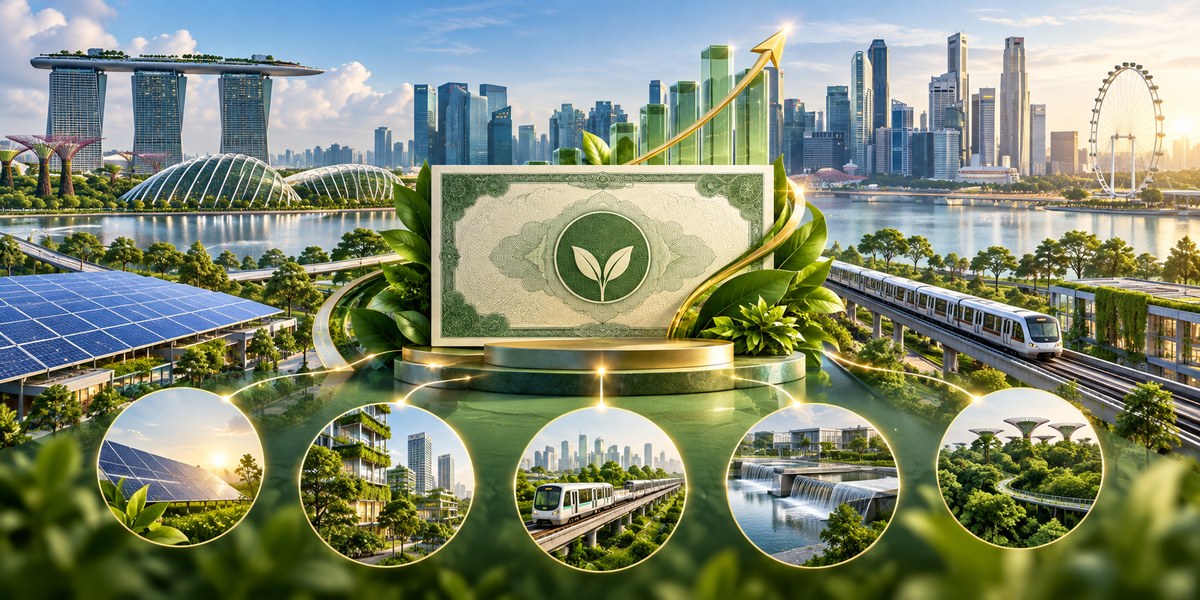
Green bonds help direct capital towards projects with measurable environmental benefits, from cleaner transport to energy-efficient infrastructure. In Singapore, a Singapore green bond can be issued within established frameworks that define eligible projects, how proceeds are managed, and how issuers report on their use.
Singapore’s sovereign Green Bond Framework provides a structured basis for financing qualifying public-sector projects, while statutory boards and companies can also issue green bonds under their own frameworks. DBS also supports businesses and investors seeking to understand how green bonds fit within wider sustainable finance strategies.
Quick Summary
- In one sentence: A Singapore green bond directs capital towards eligible environmental projects under a defined green bond framework.
- Why it matters: Singapore’s public sector plans to issue up to S$35 billion of green bonds by 2030.
- How it works: Frameworks govern eligible uses, proceeds management, reporting, and review.
- Example: Green SGS (Infrastructure) finances qualifying major, long-term green infrastructure.
- Common distinction: Government, Statutory Board, and corporate issuances follow relevant frameworks.
What Is a Singapore Green Bond?
A Singapore green bond is a debt instrument whose proceeds are allocated to eligible projects that deliver environmental benefits under an applicable green bond framework.
International market guidance from ICMA summarises the purpose clearly: “Green bonds enable capital-raising and investment for new and existing projects with environmental benefits.”
For sovereign issuance, Singapore uses Green SGS (Infrastructure) to finance qualifying major infrastructure under the Significant Infrastructure Government Loan Act 2021. Statutory Boards can issue green bonds under their own frameworks, while corporate issuers may also raise green financing for eligible activities.
The defining feature is the use of proceeds. The bond framework identifies eligible categories, sets governance requirements, and establishes reporting expectations so investors can track how capital supports environmental objectives.
Why Singapore Green Bonds Matter
Singapore green bonds support two related objectives. They provide long-term financing for infrastructure and other qualifying projects, while helping develop a deeper domestic green finance market.
The public sector intends to issue up to S$35 billion of green bonds by 2030, covering Government and Statutory Board issuances. As at 1 October 2025, the Government had issued S$7.7 billion of 50-year and S$4.3 billion of 30-year Green SGS (Infrastructure).
For businesses and investors examining how capital can support decarbonisation, DBS provides further context on sustainable finance solutions and financing the green transition in Asia.
How the National Framework Governs Green Financing
The Singapore Green Bond Framework sets a consistent process for deciding which sovereign projects can receive green bond proceeds and how those funds are tracked after issuance. The January 2025 framework aligns with the ICMA Green Bond Principles 2021 with June 2022 Appendix 1, the ASEAN Green Bond Standards 2018, and the Singapore-Asia Taxonomy for Sustainable Finance.
Use of proceeds
Eligible expenditures must fall within one of eight green categories defined by the framework.
Project evaluation and selection
The Green Bond Steering Committee evaluates and selects projects, with the Second Minister for Finance chairing the committee.
Management of proceeds
Net sovereign green bond proceeds are directed to approved projects and are intended to be fully allocated within two years. Pending allocation, proceeds may be held in cash or short-term liquidity instruments.
Reporting and external review
Annual allocation reporting continues until full allocation and when material changes arise. Impact reporting covers environmental benefits and, where available, social co-benefits, while an independent second-party opinion assesses framework alignment with recognised standards.
Which Projects Can Qualify for Green Financing?
The framework groups qualifying sovereign expenditures into eight categories. Each category connects financing with a defined environmental objective and gives investors a clearer view of where proceeds may be directed.
|
Eligible green category |
Typical focus |
|
Renewable energy |
Clean energy generation |
|
Energy efficiency |
Lower energy use |
|
Green buildings |
Resource-efficient buildings |
|
Clean transportation |
Low-emission mobility |
|
Sustainable water and wastewater management |
Water resilience and treatment |
|
Pollution prevention, control, and circular economy |
Waste and resource efficiency |
|
Climate change adaptation |
Resilience to climate risks |
|
Biodiversity conservation and sustainable natural resource and land management |
Ecosystem and land protection |
Together, the categories cover climate mitigation, adaptation, resource efficiency, and ecosystem protection. Projects must also satisfy the framework’s applicable eligibility and screening criteria before receiving sovereign green bond proceeds.
Examples of Singapore Green Bonds in Practice
Scenario 1: Rail expansion
FY2024 saw S$2.8 billion allocated to the Jurong Region Line and Cross Island Line. The Government report states, “In total, S$2.8 billion of green bond proceeds were allocated in FY2024.”
Scenario 2: Green buildings
HDB uses green finance proceeds for qualifying green building projects under its own framework.
Scenario 3: Water and waste infrastructure
PUB and NEA use green financing frameworks to support sustainable water, wastewater, and waste-management projects.
When fully operational, the two rail lines are estimated to save 100,000 to 120,000 tonnes of CO2-equivalent annually.
Common Myths About Green Bond Financing
Myth: All green bonds in Singapore are sovereign
Reality: The Government, Statutory Boards, and corporate issuers can raise green financing under applicable frameworks.
Myth: Green bonds and sustainability-linked bonds use the same structure
Reality: Green bonds dedicate proceeds to eligible projects, while sustainability-linked bonds link financial or structural characteristics to predefined sustainability targets.
Myth: A green label replaces investment analysis
Reality: Investors still assess credit quality, maturity, pricing, liquidity, and other bond risks alongside the environmental framework.
Frequently Asked Questions
Who can issue green bonds in Singapore?
The Singapore Government, Statutory Boards, and corporate issuers can issue green bonds under applicable frameworks and financing arrangements.
What are Green SGS (Infrastructure) bonds?
Green SGS (Infrastructure) are Singapore Government Securities issued to finance eligible major infrastructure projects that meet the sovereign Green Bond Framework.
How does a project qualify for green-bond financing?
A project must meet the relevant issuer framework’s eligibility criteria, environmental objectives, evaluation requirements, and applicable screening conditions.
How are Singapore green-bond proceeds tracked?
Issuers manage allocated proceeds according to their frameworks and provide reporting on allocation and, where applicable, environmental impact.
Are green bonds the same as sustainability-linked bonds?
No. Green bonds earmark proceeds for eligible green projects, while sustainability-linked bonds connect financial or structural terms to sustainability performance targets.
Explore How Green Financing Supports Long-Term Development
Understanding how a Singapore green bond is structured can help issuers and investors assess how financing is connected to eligible environmental projects. Clear frameworks, defined uses of proceeds, and ongoing reporting support greater transparency around how capital is allocated.
Explore DBS’s green bond insights to understand how these instruments can support wider sustainable financing strategies.
Reference and Source Links
- https://www.mof.gov.sg/policies/fiscal/green-bonds/
- https://www.mof.gov.sg/news-resources/newsroom/singapore-green-bond-report-for-financial-year-2024/
- https://www.icmagroup.org/sustainable-finance/the-principles-guidelines-and-handbooks/green-bond-principles-gbp
- https://www.icmagroup.org/assets/documents/Sustainable-finance/2024-updates/Sustainability–Linked-Bond-Principles-June-2024.pdf