
Shopping for groceries at FairPrice, filling up petrol at Esso, or grabbing dinner at your favorite hawker center all add up. What if you could earn money back on every swipe? Cashback credit cards turn everyday spending into real savings, putting dollars back in your pocket month after month. But with so many cards offering different rates, caps, and categories, choosing the right one can feel overwhelming.
Cashback credit cards in Singapore offer 1% to 8% returns on everyday purchases like groceries, dining, transport, and petrol. The best card depends on your spending patterns. Cards with high base rates suit general spending, while category-specific cards reward targeted purchases. Understanding minimum spend requirements, caps, and exclusions helps you maximize returns without paying annual fees or hitting spending thresholds you can’t meet.
How cashback credit cards work in Singapore
Cashback cards return a percentage of what you spend directly to your account or statement. Unlike points or miles that require conversion, cashback is straightforward. You spend $100, you get $2 to $8 back depending on the card and category.
Most cards operate on one of three models. Base rate cards give you a flat percentage on everything, usually 1% to 1.5%. Category cards offer higher rates for specific spending like groceries or petrol, often 3% to 8%. Tiered cards increase your cashback rate after you hit monthly spending thresholds.
Banks cap cashback in various ways. Some limit total monthly cashback to $20 or $50. Others cap specific categories separately. A few premium cards offer uncapped cashback but charge annual fees of $200 or more.
Minimum spend requirements are common. Many cards require $500 to $888 monthly spend to qualify for any cashback. Miss that threshold and you earn nothing that month, regardless of how much you charged.
Top cashback categories for Singaporean households
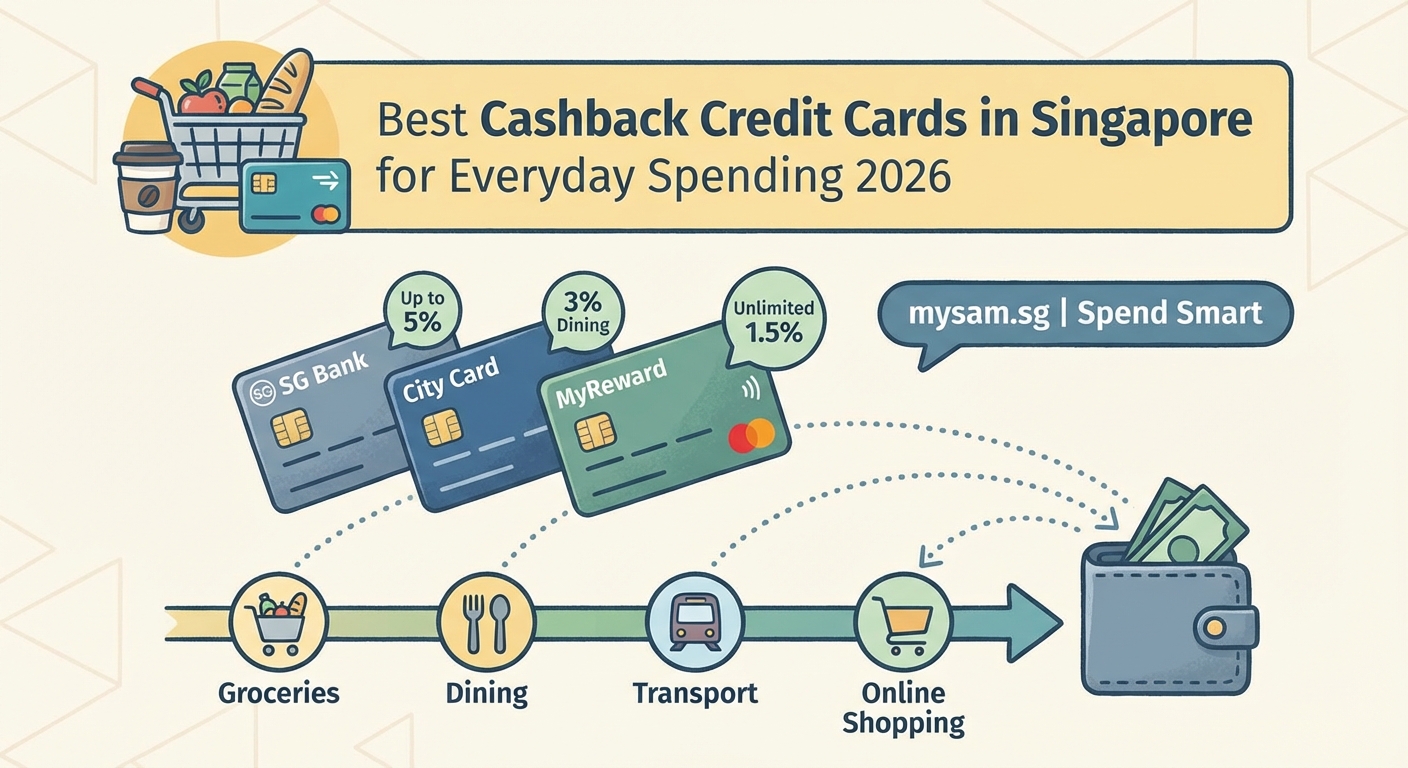
Understanding where your money goes helps you pick the right card. Most Singaporean households spend heavily in four areas.
Groceries represent the biggest opportunity for many families. Weekly trips to NTUC, Cold Storage, or Sheng Siong add up to $400 to $800 monthly for a typical household. Cards offering 3% to 6% on supermarket spending can return $12 to $48 every month.
Dining includes hawker centers, coffee shops, and restaurants. Young professionals eating out regularly can spend $300 to $600 monthly. Dining cashback rates range from 2% to 8% depending on the card and whether you hit spending tiers.
Transport covers MRT, bus, Grab, taxis, and parking. Daily commuters easily spend $100 to $200 monthly. Transport-focused cards offer 3% to 7% on these expenses.
Petrol matters for car owners. Filling up once or twice weekly costs $200 to $400 monthly. Petrol cashback typically runs 3% to 6% at partner stations like Shell, Esso, or Caltex.
Online shopping has grown significantly. Cards treating e-commerce as a separate category offer 2% to 5% on Shopee, Lazada, Amazon, and other platforms.
Choosing between high-rate cards and no-minimum cards
This decision shapes your entire cashback strategy.
High-rate cards promise 5% to 8% cashback but demand monthly minimum spend of $600 to $888. They often cap total cashback at $50 to $80 monthly. These work brilliantly if you consistently hit the threshold through normal spending.
Calculate whether you’ll meet the minimum. Add up your regular monthly charges. Include groceries, dining, transport, utilities, phone bills, insurance, and subscriptions. If the total exceeds the minimum comfortably, high-rate cards make sense.
No-minimum cards offer lower rates, typically 1% to 2%, but require no spending threshold. You earn cashback from dollar one. These suit students, singles, or anyone with variable monthly expenses.
The math matters. A card offering 8% with $888 minimum spend and $80 cap gives you $80 monthly if you spend exactly $1,000. A no-minimum card at 1.5% on the same $1,000 returns just $15. The high-rate card wins by $65.
But if you only spend $600 some months, you’d earn nothing from the high-rate card while the no-minimum card still returns $9. Consistency determines the winner.
Card comparison by spending profile
Different lifestyles need different cards. Here’s how common profiles match up.
| Spending Profile | Monthly Budget | Best Card Type | Expected Monthly Cashback |
|---|---|---|---|
| Single professional, eat out often | $800 to $1,200 | High dining cashback | $40 to $60 |
| Young family, heavy groceries | $1,000 to $1,500 | Supermarket category card | $50 to $90 |
| Car owner, regular petrol | $800 to $1,200 | Petrol-focused card | $30 to $50 |
| Student, variable spending | $300 to $600 | No-minimum base rate | $5 to $12 |
| Frequent traveler, online shopping | $1,000 to $2,000 | E-commerce and travel card | $40 to $80 |
Young professionals who dine out five to seven times weekly benefit most from dining-focused cards. Cards offering 8% on restaurants with a $50 monthly cap return maximum value when you spend $625 on dining.
Families with young children typically spend 30% to 40% of their budget on groceries. A card giving 6% on supermarkets with $60 monthly cap maximizes returns when grocery spending hits $1,000.
Car owners should calculate petrol expenses carefully. If you spend $300 monthly on fuel, a 6% petrol card capped at $20 returns the full amount. Spending more doesn’t increase cashback due to the cap.
Students and young adults with irregular income do better with flexible no-minimum cards. Even earning 1.5% on $400 puts $6 back in your account without pressure to hit thresholds.
Reading the fine print that changes everything
Banks hide important limitations in terms and conditions. These details determine whether a card delivers promised value.
Excluded merchants are common. Many grocery cards exclude online supermarkets, warehouse clubs like Costco, or specialty stores. Dining cards may exclude food courts, hawker centers, or delivery platforms. Always check the merchant category codes that qualify.
Promotional periods create confusion. Banks advertise high cashback rates that only last three to six months. After the promotion ends, rates drop to 0.5% or 1%. Note the expiry date and set a calendar reminder.
Cashback crediting schedules vary widely. Some banks credit cashback within the same billing cycle. Others take 60 to 90 days. A few only credit once annually. Delayed crediting reduces the effective value of your cashback.
Annual fee waivers often require minimum annual spending of $12,000 to $20,000. Miss the threshold and you pay $150 to $200, wiping out months of cashback. Calculate whether you’ll comfortably exceed the waiver requirement.
Foreign currency transactions sometimes earn reduced cashback or none at all. If you travel frequently or shop from overseas websites, verify that international transactions qualify at the same rate.
The biggest mistake I see is people choosing cards based on advertised rates without checking caps and exclusions. A card promising 8% cashback sounds amazing until you realize the $30 monthly cap means you only need to spend $375 to max out. Beyond that, you’re earning nothing on a card that probably has a minimum spend requirement of $888.
Stacking cards for maximum returns
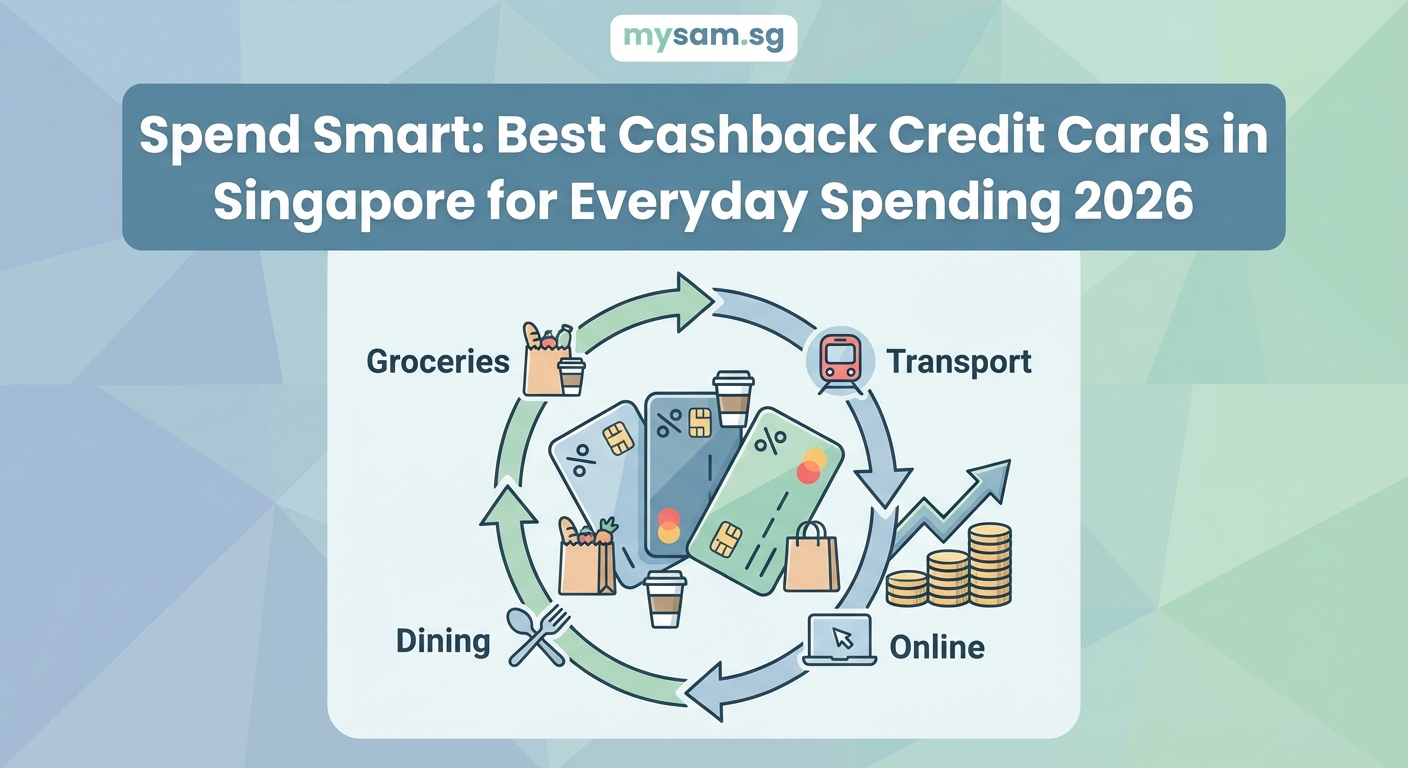
Using multiple cards strategically multiplies your cashback. This approach requires organization but pays off.
The core strategy involves matching each card to its strongest category. Use your grocery card only at supermarkets. Use your petrol card only for fuel. Use your dining card only at restaurants. Use a general cashback card for everything else.
Here’s a practical three-card setup:
- Primary grocery card offering 5% to 6% on supermarkets with $60 monthly cap
- Dining and transport card giving 4% to 8% on restaurants and public transport with $50 cap
- No-minimum base rate card at 1.5% for all other spending
This combination captures high rates where they matter while ensuring you never leave cashback on the table for miscellaneous purchases.
Track your spending monthly to avoid exceeding caps. Once you hit the $60 grocery cap, switch to your base rate card for remaining supermarket purchases that month.
Some households successfully manage four or five cards, each optimized for a specific category. This works if you’re disciplined about tracking. Most people do better with two or three cards to avoid confusion.
Common mistakes that cost you money
Even experienced cardholders make errors that reduce returns.
Chasing signup bonuses without considering long-term value leads to drawer full of unused cards. Signup bonuses of $100 to $200 are attractive, but if the card doesn’t fit your spending pattern, you’ll earn less over time than sticking with your optimized setup.
Ignoring minimum spend in slow months means earning zero cashback despite charging hundreds of dollars. If you’re $100 short of the threshold on the last day of the month, buy grocery vouchers or prepay bills to cross the line.
Forgetting to activate quarterly promotions costs money. Some cards require manual activation each quarter for bonus categories. Miss the activation and you earn base rate instead of the promoted rate.
Paying interest destroys all cashback value instantly. Credit card interest rates run 24% to 28% annually. Carrying a $1,000 balance for one month costs $20 to $23 in interest, wiping out months of cashback earnings. Always pay your full balance.
Overspending to maximize cashback defeats the purpose. Buying things you don’t need to hit a spending threshold or cap costs more than the cashback you earn. Only spend what you would have spent anyway.
How to apply and start earning
Getting your first cashback card takes 15 to 30 minutes online.
- Compare cards based on your actual spending patterns from the last three months
- Check eligibility requirements for minimum income, typically $30,000 to $42,000 annually
- Gather required documents including NRIC, recent payslips, and CPF statements
- Submit your application through the bank’s website or app
- Wait for approval, usually within three to seven business days
- Activate your card and set up online banking to track cashback
- Enable transaction notifications to monitor spending in real time
- Set calendar reminders for minimum spend deadlines and promotion expirations
Many banks offer instant approval for existing customers with good credit history. New-to-bank applicants may wait longer for verification.
Start with one card that matches your largest spending category. Use it exclusively for that category for two months while tracking results. Once comfortable, add a second card for your next-largest category.
Set up automatic payment of your full balance to avoid interest charges. Configure it to pay three days before the due date to account for processing time.
Maximizing value without changing your lifestyle
The best cashback strategy fits seamlessly into your existing routine.
Pay attention to merchant coding. Sometimes the same purchase codes differently depending on payment method. Grabfood orders placed through the Grab app may code as transport, while orders through the restaurant’s website code as dining. Test both to see which earns higher cashback.
Time large purchases strategically. If you’re $200 short of hitting a spending tier that unlocks 8% instead of 4%, and you need to buy a new phone anyway, make that purchase before month-end to capture the higher rate.
Use your card for regular bills that accept credit card payment without fees. Utilities, phone bills, insurance premiums, and streaming subscriptions all count toward minimum spend while requiring zero extra effort.
Buy grocery and retail vouchers when you’re close to hitting caps. If you’ve earned $58 of a $60 monthly grocery cap, buy $50 in FairPrice vouchers to capture the remaining $2 cashback. You’ll use the vouchers anyway.
Split payments with friends and family. If you’re dining with three friends, offer to charge the entire bill and collect cash from them. You hit your minimum spend faster while earning cashback on their portions.
Making cashback work for you
Cashback credit cards transform necessary spending into measurable savings. A well-chosen card returning $50 to $80 monthly adds up to $600 to $960 annually, enough for a weekend getaway or several months of groceries.
Start by tracking your spending for one month. Categorize every expense. Calculate which card would have returned the most cashback. Apply for that card first. Add others only when you’ve mastered using the first one effectively. Your wallet will thank you every month.