
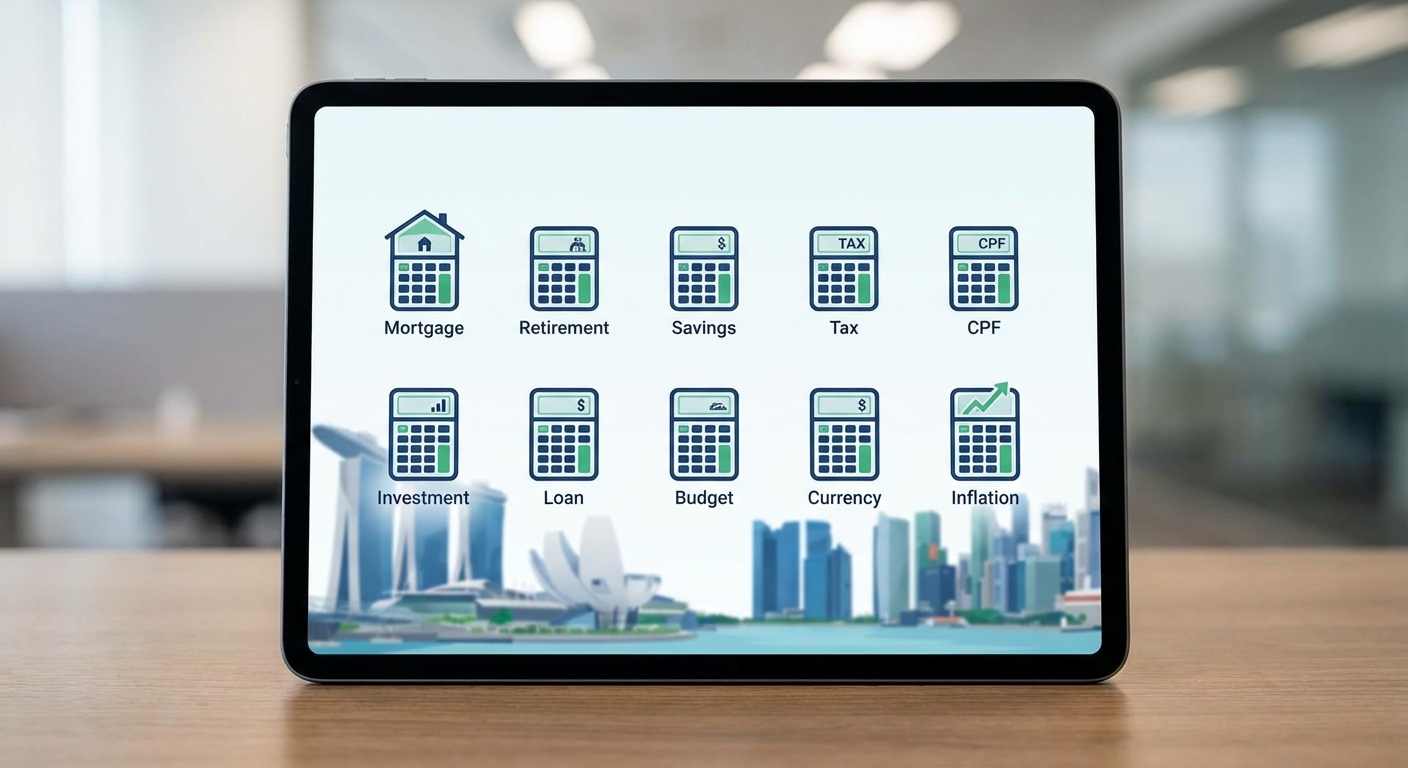
Money decisions feel overwhelming when you’re staring at spreadsheets at midnight, trying to figure out if you can afford that condo or how much to save for retirement. The good news? You don’t need to be a math genius or hire an expensive financial advisor to get clarity. The right financial calculators can give you answers in minutes, not hours.
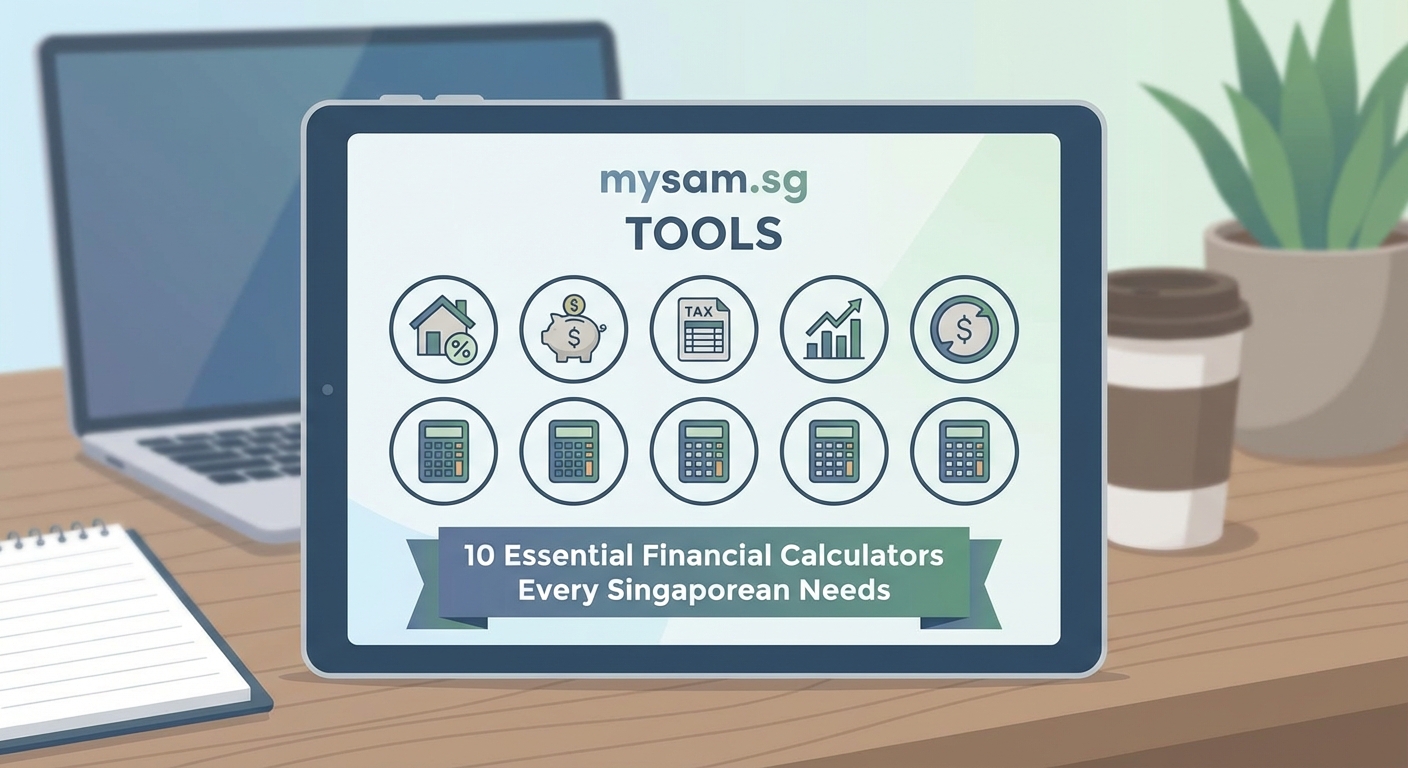
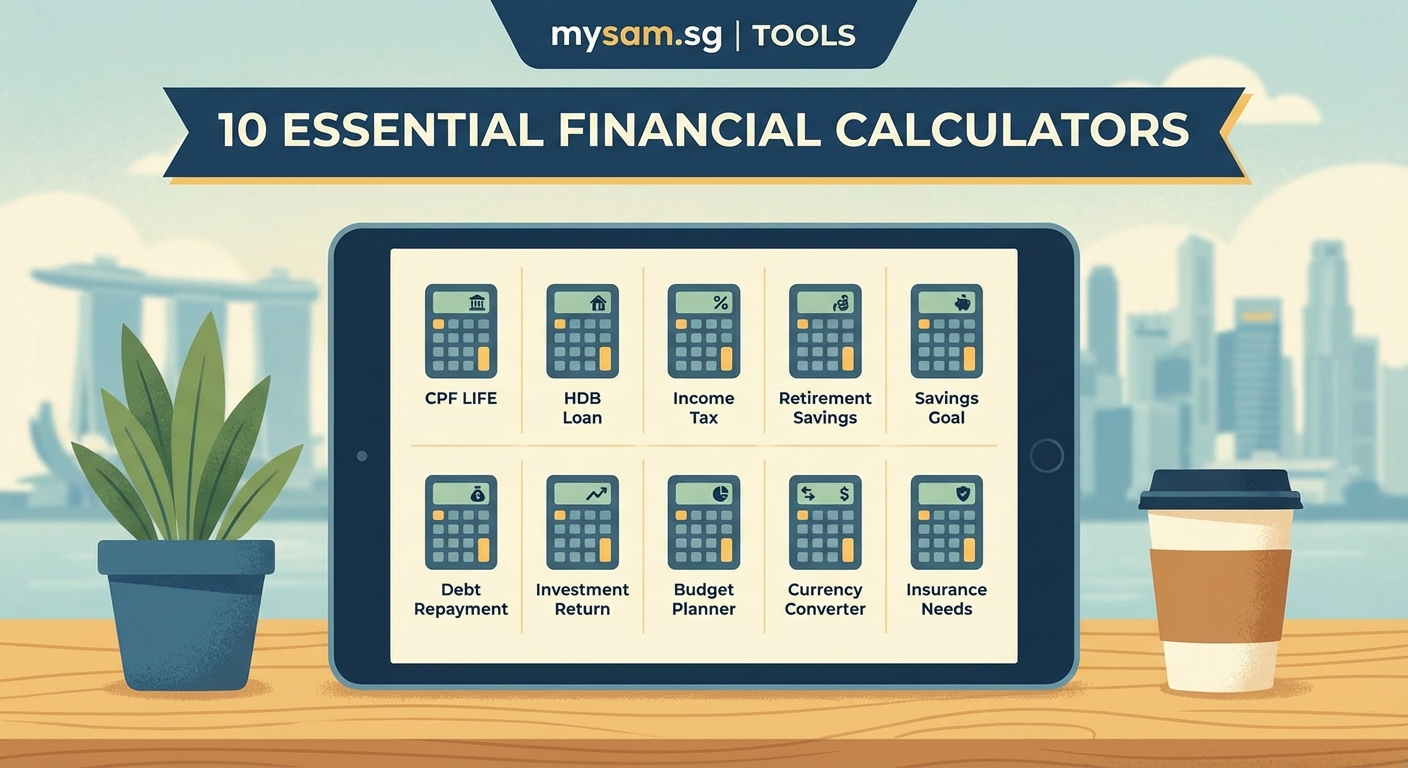
Financial calculators help Singaporeans make informed decisions about CPF, housing, retirement, and investments without complex math. These 10 essential tools cover everything from mortgage affordability to emergency fund planning, giving you clear numbers to guide major life choices. Most are free, easy to use, and tailored specifically for Singapore’s unique financial landscape including CPF contributions and government schemes.
Why financial calculators matter for Singaporeans
Singapore’s financial system is unique. We have CPF, HDB grants, SRS tax relief, and a maze of insurance options that don’t exist anywhere else in the world.
Generic calculators from overseas websites won’t cut it. They can’t factor in your CPF Ordinary Account interest rates, your Medisave contributions, or how much you can actually borrow for an HDB flat.
That’s where Singapore-specific financial calculators come in. They’re built around our system, our rules, and our reality.
Using the right calculator means you stop guessing and start knowing. You’ll see exactly how much house you can afford, whether you’re on track for retirement, and if that insurance policy actually makes sense for your situation.
CPF retirement planning calculator
Your CPF is probably your biggest retirement asset, but most people have no idea if they’re saving enough.
A CPF retirement calculator shows you three critical numbers:
- How much you’ll have in your CPF accounts at age 55
- Your estimated monthly payout from CPF LIFE
- The gap between that payout and your actual retirement needs
Here’s how to use it effectively. Start by entering your current age and CPF balances across all three accounts. Then input your monthly salary and any voluntary contributions you plan to make.
The calculator will project your balances forward, accounting for the different interest rates on each account. Your Ordinary Account earns 2.5%, while your Special Account gets 4%. If you’re below 55, amounts up to $60,000 earn an extra 1% on top of that.
Most Singaporeans are shocked when they see the results. That $200,000 in CPF might sound like a lot, but it translates to only about $1,400 per month in retirement payouts.
“The biggest mistake I see is people assuming their CPF will be enough. Run the numbers early, ideally in your 30s, so you have time to adjust your savings strategy.” – Financial Planning Association of Singapore
If there’s a gap, you have options. You can make voluntary contributions to your Special Account, transfer funds from your Ordinary Account, or build up investments outside CPF to supplement your retirement income.
HDB loan and mortgage affordability calculator
Buying a home is the biggest financial decision most Singaporeans will make. Get it wrong and you’ll be house poor for the next 25 years.
A good mortgage calculator does more than tell you your monthly payment. It shows you:
- Your maximum loan amount based on Total Debt Servicing Ratio (TDSR)
- How much cash and CPF you need upfront
- Your actual monthly cash outflow after CPF deductions
- Total interest paid over the loan period
The TDSR limit is 55% of your gross monthly income. That means all your debt obligations, including your mortgage, car loan, and credit card balances, cannot exceed 55% of what you earn.
For HDB loans specifically, you’re limited to 30% of your income under the Mortgage Servicing Ratio (MSR). This is usually more restrictive than TDSR for public housing.
Let’s say you and your spouse have a combined income of $8,000. Your maximum monthly mortgage payment under MSR would be $2,400. At a 2.6% interest rate over 25 years, that translates to a loan of about $550,000.
But here’s the catch. You still need cash for the down payment, stamp duty, and legal fees. For an HDB flat, that’s typically 10% down payment plus another 3-4% in fees.
| Loan type | Down payment | Interest rate | Maximum tenure |
|---|---|---|---|
| HDB loan | 10% (5% cash + 5% CPF) | 2.6% | 25 years |
| Bank loan | 25% (5% cash + 20% CPF) | 3.5-4.5% | 30 years |
A mortgage calculator helps you see if you can actually afford that dream home, or if you need to adjust your budget.
Emergency fund calculator
Financial experts love to say “save 6 months of expenses” but what does that actually mean for you?
An emergency fund calculator takes your real spending and tells you exactly how much to save. No guesswork involved.
Start by listing your essential monthly expenses:
- Housing (mortgage or rent)
- Utilities and internet
- Groceries and meals
- Transport
- Insurance premiums
- Minimum debt payments
Notice what’s not on that list. Netflix, gym memberships, and dining out don’t count as essentials. Your emergency fund covers survival, not lifestyle.
Multiply that number by 6. That’s your target emergency fund.
For most Singaporeans, that’s somewhere between $15,000 and $30,000. If you’re a single income household or work in a volatile industry, aim for 9 months instead of 6.
Where should you keep this money? Not in investments. Your emergency fund needs to be liquid and safe. A high-yield savings account earning 2-3% is perfect.
Retirement needs calculator
CPF alone won’t fund the retirement you’re imagining. A retirement needs calculator shows you the full picture.
This calculator asks you to think about your retirement lifestyle. Will you travel twice a year? Eat out regularly? Help support your children or grandchildren?
Be honest. Retirement isn’t about surviving on the bare minimum. It’s about living comfortably after decades of work.
The calculator then accounts for inflation. That $3,000 monthly budget today will need to be $5,400 in 20 years at 3% inflation.
Here’s the formula it uses:
- Estimate your monthly retirement expenses
- Multiply by 12 to get annual needs
- Multiply by 25-30 years of retirement
- Adjust for inflation based on years until retirement
- Subtract expected CPF LIFE payouts and other passive income
- The remainder is what you need to save
If that number looks scary, you’re not alone. Most people need $500,000 to $1 million beyond CPF to retire comfortably in Singapore.
The good news? You have time. Starting early makes a massive difference because of compound interest.
Investment returns calculator
Knowing your investment returns sounds simple. You put in $10,000, it grows to $12,000, that’s 20% right?
Wrong. That’s only true if you made a lump sum investment and withdrew it all at once.
Most Singaporeans invest through regular savings plans. You put in $500 every month. Some months the market is up, some months it’s down. Your actual return is much harder to calculate manually.
An investment returns calculator handles this complexity. It accounts for:
- Dollar cost averaging when you invest monthly
- Dividend reinvestment
- Fund fees and expense ratios
- Tax implications for different account types
Let’s say you invest $500 monthly for 20 years at an average 6% annual return. You’d contribute $120,000 total. But your portfolio would be worth about $230,000.
That extra $110,000 is compound interest doing its magic. The earlier you start, the more powerful this effect becomes.
The calculator also helps you see how fees eat into returns. A 2% annual fee might not sound like much, but over 20 years it could cost you $40,000 or more.
Insurance coverage calculator
Singaporeans are either over-insured or under-insured. Rarely is anyone just right.
An insurance calculator helps you find that sweet spot. It looks at your actual needs, not what some agent is trying to sell you.
For life insurance, the basic formula is:
- Outstanding debts (mortgage, car loan, etc.)
- Plus income replacement for dependents (typically 10 years of income)
- Minus existing liquid assets and CPF
If you have a $400,000 mortgage, earn $80,000 annually, and have $100,000 in savings, you need about $700,000 in coverage.
Term insurance is usually the most cost-effective way to get this coverage. A 35-year-old non-smoker might pay $50-70 monthly for $1 million in coverage.
For health insurance, your calculation is different. You need to cover:
- Hospitalization costs beyond what MediShield Life covers
- Potential loss of income during illness
- Critical illness expenses that could derail your finances
Most Singaporeans need an Integrated Shield Plan and a critical illness policy. The calculator helps you determine the coverage amounts that make sense for your situation.
Education savings calculator
University fees in Singapore have been climbing steadily. A local degree now costs $30,000 to $50,000 for the full program. Overseas? Easily $200,000 or more.
An education savings calculator shows you how much to save monthly to hit your target.
Let’s say your child is 5 years old and you want to save $100,000 by the time they’re 18. That’s 13 years of saving.
If you invest in a balanced portfolio earning 5% annually, you need to save about $480 per month. Wait until they’re 10, and that jumps to $950 monthly.
The calculator accounts for:
- Current education costs
- Expected inflation in education (typically higher than general inflation)
- Investment returns on your savings
- Government schemes like the Child Development Account
Some parents use a combination of regular savings, endowment policies, and investments to fund education. The calculator helps you see if your current strategy will actually get you there.
Debt payoff calculator
Credit card debt, personal loans, car loans. They pile up faster than you think.
A debt payoff calculator shows you two strategies: snowball and avalanche.
The snowball method pays off your smallest debt first, regardless of interest rate. This gives you psychological wins that keep you motivated.
The avalanche method tackles your highest interest debt first. This saves you the most money mathematically.
Here’s a real example. You have:
- Credit card: $8,000 at 24% interest, $200 minimum payment
- Personal loan: $15,000 at 8% interest, $400 minimum payment
- Car loan: $25,000 at 3% interest, $500 minimum payment
Your minimum payments total $1,100 monthly. But if you can pay $1,500 monthly and use the avalanche method, you’ll be debt-free in 3.5 years instead of 5 years. You’ll also save about $8,000 in interest.
The calculator shows you exactly how much faster you’ll be debt-free with extra payments, and how much you’ll save in interest.
SRS contribution calculator
The Supplemental Retirement Scheme (SRS) is one of Singapore’s most underused tax breaks.
Contributions are tax-deductible up to $15,300 per year for Singapore Citizens and PRs. If you’re in the 11.5% tax bracket, that saves you $1,759 annually in taxes.
An SRS calculator helps you figure out:
- How much to contribute based on your tax bracket
- Your total tax savings
- Projected SRS balance at retirement
- Tax implications when you withdraw
The catch with SRS is that withdrawals are taxable. But only 50% of your withdrawal is taxed if you wait until the statutory retirement age (currently 63).
Let’s say you contribute $15,300 annually for 20 years, earning 5% returns. You’d have about $535,000 in your SRS account.
When you withdraw $50,000 annually in retirement, only $25,000 is taxable. If you have no other income, you’d pay minimal or zero tax because of personal reliefs.
For high earners, SRS is a no-brainer. For middle income earners, the calculator helps you see if it makes sense given your situation.
Net worth calculator
Your net worth is the clearest picture of your financial health. It’s simply what you own minus what you owe.
A net worth calculator organizes this into clear categories:
Assets:
– Cash and savings
– CPF balances
– Investment accounts
– Property value
– Car value (if owned)
Liabilities:
– Mortgage balance
– Car loan
– Personal loans
– Credit card debt
– Outstanding bills
Your net worth might surprise you. Many Singaporeans have a high net worth on paper because of property appreciation, but are cash poor.
The real value isn’t the number itself. It’s tracking how it changes over time. Your net worth should grow every year as you save, invest, and pay down debt.
If it’s stagnant or shrinking, something’s wrong. You’re either spending too much, not investing enough, or taking on too much debt.
Calculate your net worth quarterly. It takes 10 minutes and gives you a clear financial report card.
Making these calculators work for you
Having access to financial calculators means nothing if you don’t actually use them.
Here’s a simple system. Set a reminder for the first Sunday of every quarter. Spend an hour updating your numbers in each calculator.
Track three things over time:
- Your retirement readiness score
- Your net worth
- Your debt payoff progress
These three metrics tell you if you’re moving in the right direction financially.
Don’t just calculate once and forget. Your situation changes. You get a raise, have a kid, buy a car. Each major life event should trigger a recalculation.
Save your results. Most calculators let you download a PDF or screenshot your results. Create a folder on your phone or computer to track your progress over time.
And here’s the most important part. Use these numbers to make decisions, not just satisfy curiosity. If the retirement calculator shows you’re $200,000 short, that should change your behavior today.
Your financial clarity starts now
These 10 financial calculators give you something most Singaporeans never have: clear numbers about their financial future.
You don’t need to guess anymore. You can see exactly where you stand and what you need to do next. That HDB flat, that retirement dream, that education fund for your kids. It’s all calculable.
Start with the retirement calculator today. It takes 5 minutes and will probably change how you think about your finances. Then work through the others as they become relevant to your life stage.
The sooner you run the numbers, the more time you have to adjust course. Your future self will thank you for taking action today.