

Investing can feel overwhelming when you’re starting out. You hear stories about people losing money by buying at the wrong time, and suddenly the idea of putting your hard-earned cash into the market seems terrifying. But what if there was a way to invest that removes the pressure of perfect timing and actually uses market ups and downs to your advantage?
Dollar cost averaging means investing a fixed amount regularly, regardless of market conditions. This strategy helps Singapore investors reduce timing risk, smooth out purchase prices over time, and build wealth systematically. You buy more units when prices are low and fewer when prices are high, lowering your average cost per unit. It works best with consistent contributions to index funds or ETFs through platforms that support automated monthly investments.
What is dollar cost averaging?
Dollar cost averaging is an investment strategy where you invest the same amount of money at regular intervals, no matter what the market is doing.
Instead of trying to figure out the perfect moment to invest a lump sum, you break it into smaller chunks. You might invest $500 every month, or $200 every two weeks.
The beauty of this approach is mathematical. When prices are high, your fixed amount buys fewer units. When prices drop, that same amount buys more units. Over time, you end up with a lower average cost per unit than if you had bought everything at once at an unpredictable moment.
For Singapore investors, this strategy fits perfectly with how most of us earn money through monthly salaries. You can set up automatic transfers right after payday, turning investing into a habit rather than a decision you agonize over each month.
Why this strategy works for beginners
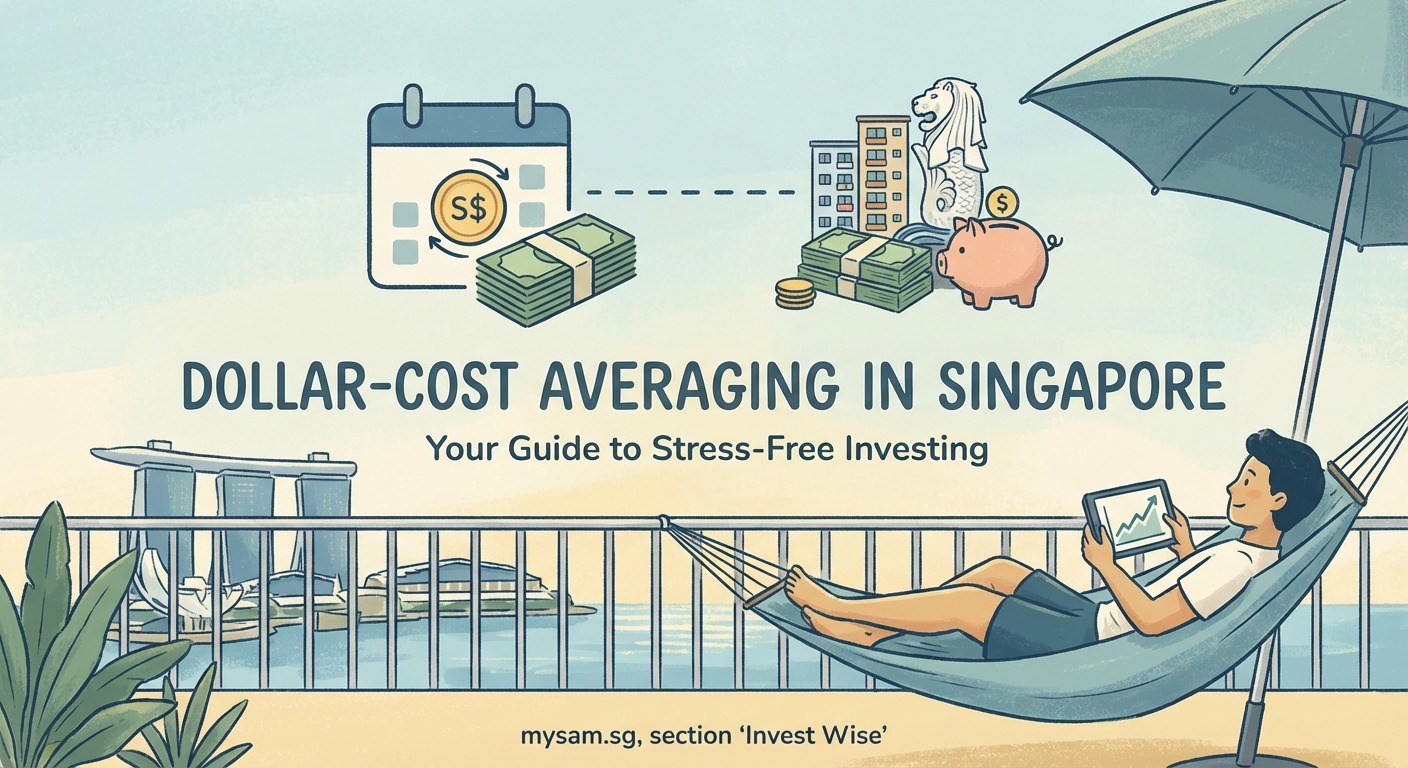
Timing the market is incredibly difficult, even for professionals.
Research shows that most active fund managers fail to beat the market consistently. If experts struggle with timing, beginners have even less chance of getting it right.
Dollar cost averaging removes this pressure entirely. You don’t need to watch charts, read analyst reports, or stress about whether today is the right day to invest. You simply stick to your schedule.
The psychological benefit matters just as much as the financial one. Many new investors freeze when markets drop, worried about losing money. But with dollar cost averaging, market dips become opportunities. Your regular contribution buys more units when everything is on sale.
This mindset shift is powerful. Instead of fearing volatility, you learn to see it as part of the process that actually works in your favor over time.
How to implement dollar cost averaging in Singapore
Getting started requires just a few practical steps.
- Decide how much you can invest regularly without straining your budget. Start with an amount that feels comfortable, even if it’s just $100 or $200 per month.
- Choose your investment vehicle. Index funds and ETFs work well for this strategy because they provide broad market exposure with low fees.
- Select a platform that supports automated investing. Many Singapore brokerages and robo-advisors offer automatic monthly investment plans.
- Set up the automation so money moves from your bank account to your investment account on a fixed schedule, ideally right after your salary comes in.
- Review your contributions annually or when your income changes, but avoid the temptation to pause during market downturns.
The key is consistency. Missing months or stopping during scary market periods undermines the entire strategy.
Best platforms for automated investing
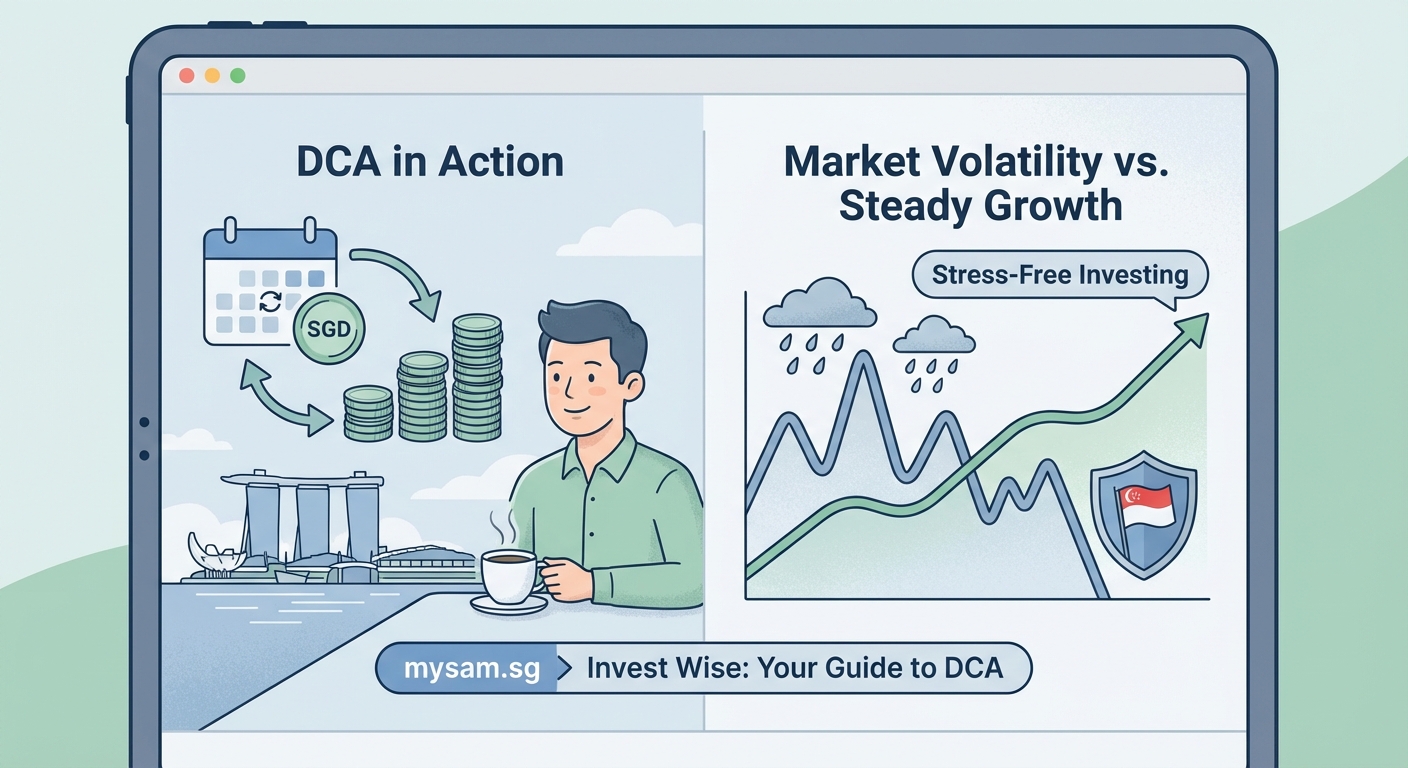
Singapore offers several platforms that make dollar cost averaging easy.
Robo-advisors like Endowus, Syfe, and StashAway specialize in automated investing. They handle the purchasing for you, rebalance your portfolio, and charge reasonable fees. Most allow you to start with small monthly amounts.
Traditional brokerages have also added Regular Savings Plans (RSPs). These let you invest fixed amounts monthly into specific ETFs or unit trusts. The minimum investment varies by platform, but many start at $100 per month.
Banks offer unit trust savings plans, though fees tend to be higher than robo-advisors or discount brokerages. Check the sales charges and annual management fees carefully before committing.
CPF Supplementary Retirement Scheme (SRS) accounts can also work for dollar cost averaging if you’re looking for tax benefits. You contribute regularly to your SRS account, then invest those funds according to your schedule.
Common mistakes to avoid
Even a simple strategy can go wrong with poor execution.
| Mistake | Why it hurts | Better approach |
|---|---|---|
| Stopping during downturns | You miss buying opportunities when prices are low | Maintain contributions especially when scared |
| Investing too much too soon | Strains your budget and forces you to stop | Start small and increase gradually |
| Choosing high-fee products | Fees compound over decades and eat returns | Compare expense ratios and sales charges |
| Switching investments frequently | Resets your averaging and adds transaction costs | Pick solid funds and stick with them |
| Ignoring emergency savings | Forces you to sell investments during emergencies | Build 3-6 months expenses first |
The biggest mistake is overthinking. Dollar cost averaging works because of its simplicity. Complicating it with constant adjustments defeats the purpose.
Dollar cost averaging versus lump sum investing
Research shows that lump sum investing often produces higher returns than dollar cost averaging, assuming you invest immediately rather than holding cash.
This makes sense mathematically. Markets tend to go up over time, so the sooner your money is invested, the more time it has to grow.
But this research assumes you already have a lump sum sitting around, ready to invest. Most Singaporeans don’t have that luxury. We earn monthly salaries and need to invest gradually as we save.
For this majority, the comparison is irrelevant. Dollar cost averaging isn’t about choosing to spread out a lump sum you already have. It’s about investing regularly from your income, which is the only realistic option.
Even if you do receive a windfall like a bonus or inheritance, dollar cost averaging can still make sense psychologically. Investing everything at once requires enormous confidence. Spreading it over 6 or 12 months helps you sleep better, even if it might cost you a small amount of potential returns.
The best investment strategy is the one you’ll actually stick with for decades. If dollar cost averaging helps you stay invested through market crashes and personal doubts, it’s the right choice regardless of what optimal math suggests.
What to invest in
Dollar cost averaging works with any investment, but some choices make more sense than others.
Broad market index funds are ideal. They give you exposure to hundreds or thousands of companies, spreading your risk. Singapore investors often choose funds tracking the S&P 500, MSCI World, or Singapore’s STI.
ETFs offer similar benefits with the flexibility to trade like stocks. Popular options include IWDA (iShares MSCI World), CSPX (S&P 500), and ES3 (STI ETF).
Avoid individual stocks for dollar cost averaging unless you’re willing to do significant research. A single company can go bankrupt, wiping out your investment. Funds and ETFs protect you from this risk through diversification.
Unit trusts work but watch the fees. Active management rarely justifies the extra cost over decades of investing.
How market conditions affect your strategy
Dollar cost averaging performs differently depending on market behavior.
In a steadily rising market, you’ll wish you had invested everything at the start. Each month, you’re buying at slightly higher prices than the month before. Your returns will be positive but lower than lump sum investing would have been.
In a volatile market that bounces up and down, dollar cost averaging shines. You buy more units during the dips and fewer during the peaks, lowering your average cost significantly.
In a declining market, you accumulate units at progressively lower prices. This feels uncomfortable because your portfolio value keeps dropping, but you’re positioning yourself perfectly for the eventual recovery.
In a market that drops then recovers, dollar cost averaging produces excellent results. You bought heavily during the cheap period, and those units gain value as the market rebounds.
The key insight is that you can’t predict which scenario will unfold. Dollar cost averaging protects you reasonably well in all of them.
Tax considerations for Singapore investors
Singapore’s tax environment is unusually friendly for investors.
There’s no capital gains tax, so you don’t pay tax on investment profits when you sell. This removes a major headache that investors in other countries face.
Dividends from Singapore stocks and REITs are generally tax-exempt for individuals. Foreign dividends may be subject to withholding tax by the source country, but Singapore doesn’t add additional tax on top.
The SRS offers a different angle. Contributions reduce your taxable income in the year you make them, similar to a tax deduction. The money grows tax-free inside the SRS account. When you withdraw after age 62, only 50% of the withdrawal is taxable.
Using SRS for dollar cost averaging makes sense if you’re in a higher tax bracket and don’t need the money before retirement. The tax savings boost your effective returns.
CPF is another option, though less flexible. Your regular CPF contributions already function as a form of dollar cost averaging into guaranteed returns. You can invest your CPF Ordinary Account beyond the first $20,000 into approved instruments, effectively dollar cost averaging with money that’s already set aside.
When to adjust your contributions
Life changes, and your investment plan should adapt.
Increase your contributions when you get a raise or bonus. If your salary goes up by $500 per month, consider directing $100 or $200 of that increase to investments. You’ll maintain your lifestyle while accelerating your wealth building.
Decrease contributions if you face financial hardship, but try to avoid stopping completely. Even reducing from $500 to $100 per month keeps the habit alive and continues your progress.
Pause temporarily for major expenses like a home down payment or wedding, but set a specific date to resume. Without a clear plan, temporary pauses become permanent.
Rebalance annually if you’re investing across multiple asset classes. Your stocks might have grown faster than bonds, throwing off your target allocation. Adjust future contributions to buy more of what’s now underweight.
Don’t adjust based on market predictions or economic news. That defeats the entire purpose of dollar cost averaging. The only valid reasons to change are personal financial circumstances or reaching your target allocation.
Real examples from Singapore investors
Consider Sarah, who started investing $300 monthly into a global index fund in January 2020.
The COVID crash in March 2020 was terrifying. Her portfolio dropped 30% in weeks. But she kept her monthly contributions going. In March and April 2020, her $300 bought significantly more units than in January.
By December 2020, the market had recovered. The units she bought during the crash were now worth much more. Her average cost per unit was lower than if she had invested a lump sum in January.
Three years later, she’s still contributing $300 monthly. Her portfolio has grown through contributions and market gains. More importantly, she’s never lost sleep over market timing.
Or take David, who received a $30,000 bonus in 2019. Instead of investing it all at once, he set up a $2,500 monthly investment plan for 12 months.
This meant he was still investing during the 2020 crash, buying at excellent prices. While he might have earned slightly more by investing everything in January 2019, he felt much more comfortable with the gradual approach. That comfort kept him invested through the volatility.
Building wealth over decades
Dollar cost averaging is a long game.
The real power shows up after 10, 20, or 30 years of consistent contributions. Compound growth works its magic, and your early contributions have grown substantially.
A 25-year-old who invests $500 monthly with 7% annual returns will have about $637,000 by age 60. The total contributions are only $210,000. The other $427,000 comes from investment growth.
If that same person increases contributions by just $50 per year to keep pace with salary growth, the final amount jumps to over $900,000.
The exact numbers depend on market returns, which vary. But the principle holds across different scenarios: regular contributions over long periods build substantial wealth.
This strategy won’t make you rich overnight. It won’t give you exciting stories about perfectly timed trades. What it will do is systematically move you toward financial security while you focus on your career, family, and life.
Making it work for you
Dollar cost averaging succeeds because it matches how most people actually live and earn.
You don’t need a large sum to start. You don’t need to become a market expert. You don’t need to watch financial news or stress about daily market movements.
You just need to decide on an amount, set up the automation, and let time do the work.
For Singapore investors, the combination of accessible platforms, tax advantages, and a stable financial system makes this strategy particularly effective. Whether you’re fresh out of school with your first paycheck or mid-career looking to get serious about investing, the approach is the same.
Start small if you need to. Increase gradually as your income grows. Stay consistent through market ups and downs. Review annually but don’t fiddle constantly.
The investors who succeed aren’t the ones who make brilliant trades. They’re the ones who show up month after month, year after year, regardless of headlines or market mood. Dollar cost averaging turns that consistency into a systematic wealth-building machine.