

You’ve watched your CPF balance grow steadily over the years. The guaranteed interest feels safe, but friends keep talking about investing their CPF savings for better returns. Now you’re stuck wondering if you’re missing out on growth or if you should just let your money sit tight.
CPF Ordinary Account earns 2.5% guaranteed interest while Special Account earns 4%. Investing through CPFIS can potentially yield higher returns but carries risk of losses. Your decision depends on investment knowledge, risk tolerance, time horizon, and whether you can consistently beat CPF’s risk-free rates after fees. Most Singaporeans are better off leaving CPF untouched unless they have proven investment experience.
Understanding what CPF gives you without lifting a finger
Your CPF isn’t just sitting idle. The government pays guaranteed interest that compounds yearly without any effort from you.
The Ordinary Account (OA) earns 2.5% per year. Your Special Account (SA) and MediSave Account (MA) earn 4% annually. If you’re 55 and above, you get an extra 1% on the first $30,000 combined balance, and another extra 1% on the next $30,000 for members above 55.
These rates might sound modest compared to stock market headlines. But they come with zero risk. No market crashes can touch them. No company failures can wipe them out.
The interest compounds every year. That means you earn interest on your interest, creating a snowball effect over decades.
For someone with $50,000 in their SA at age 35, that money grows to about $148,000 by age 55 without adding a single dollar. Just from the 4% guaranteed interest alone.
How the CPF Investment Scheme actually works
The CPF Investment Scheme (CPFIS) lets you invest your OA and SA savings in approved financial products.
You can only invest your OA savings after setting aside $20,000. For SA savings, you need to leave $40,000 untouched before you can invest the rest.
The investment options include:
- Unit trusts and exchange-traded funds
- Singapore Government Securities and bonds
- Fixed deposits
- Investment-linked insurance products
- Individual shares from approved lists
- Gold products and property funds
Each category has specific rules and approved product lists. Not every unit trust or stock qualifies. CPF maintains strict criteria for what makes the cut.
You’ll need to open a CPF Investment Account through participating banks. There are three to choose from, and each charges different fees for transactions and account maintenance.
The real costs that eat into your returns
Investment fees can quietly drain your gains over time.
Sales charges for unit trusts typically range from 0% to 3% upfront. Annual management fees run between 0.5% to 2% of your invested amount. Some funds add performance fees on top.
Trading commissions apply when you buy or sell stocks. Minimum charges often hit $25 per transaction, which hurts especially when you’re working with smaller amounts.
Banks charge annual CPF Investment Account fees, usually around $2 per counter per month. If you hold five different investments, that’s $120 yearly just for account keeping.
These costs compound negatively. A 1.5% annual fee doesn’t sound like much, but over 20 years it can reduce your final balance by nearly 25% compared to a no-fee option.
You need to beat not just the CPF guaranteed rate, but also all these fees stacked together. That’s a higher bar than most people realize.
When investing your CPF might make sense
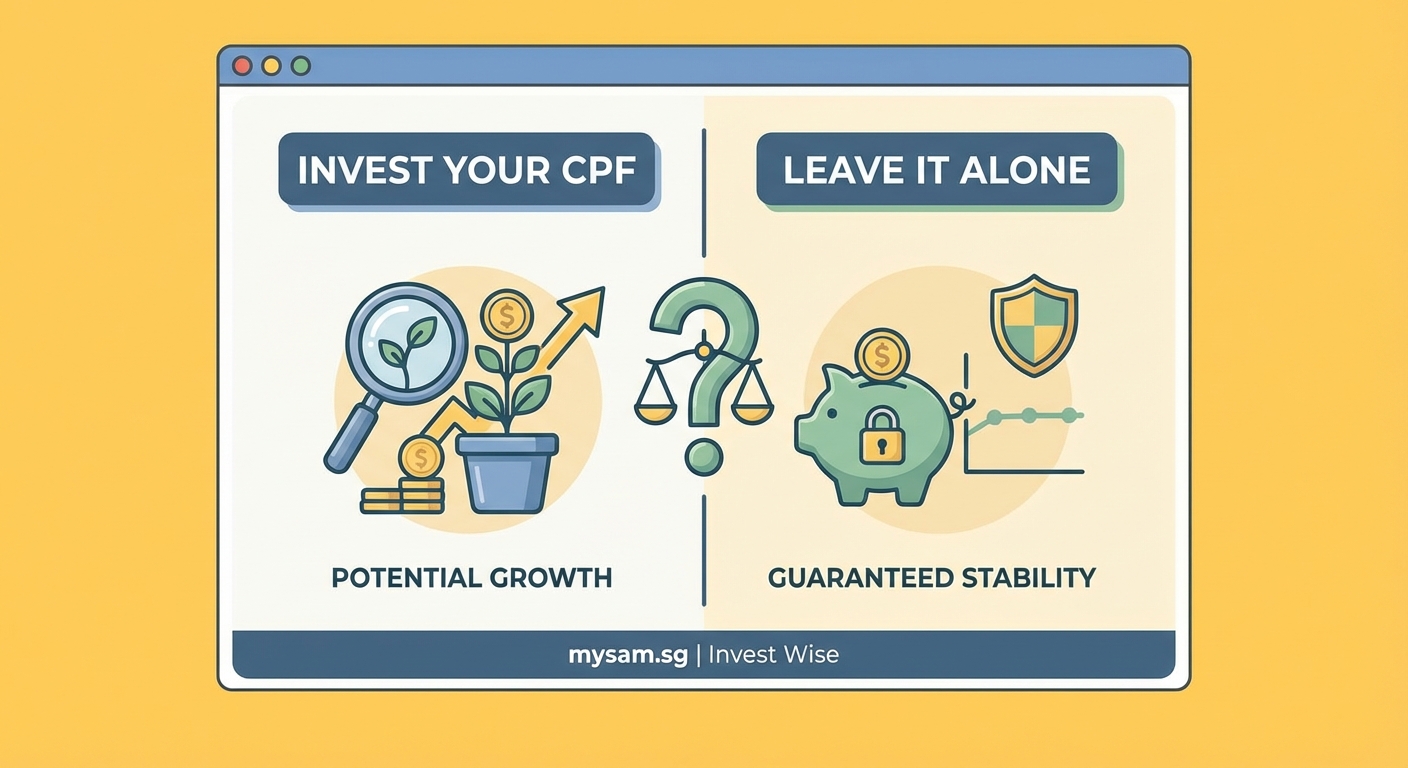
Some situations favor taking the investment route.
You have a long time horizon before retirement. If you’re in your 30s with 25+ years ahead, you can ride out market volatility and potentially capture higher long-term equity returns.
You already have strong investment knowledge and a proven track record. If you’ve successfully managed your own portfolio outside CPF and consistently beaten 4% after fees, you might replicate that success.
You’re investing in extremely low-cost index funds. Some ETFs charge under 0.3% annually and track broad market indices. These give you diversification without the heavy fees that active funds demand.
Your OA balance far exceeds what you need for housing. If you’ve fully paid your property and still have substantial OA funds sitting idle, investing a portion could make sense since you won’t need that money for property payments.
You understand and accept the possibility of losses. Markets drop. Sometimes they drop hard and stay down for years. If losing 30% of your invested CPF won’t derail your retirement plans or cause you sleepless nights, you have the emotional capacity for investing.
When you should definitely leave your CPF alone
Many situations strongly favor keeping your money in CPF untouched.
You’re within 10 years of retirement. Time becomes your enemy when markets crash late in your working life. You might not have enough years to recover from a major downturn.
You have limited investment experience. Reading a few articles or attending one seminar doesn’t prepare you for real market conditions. Most first-time investors make expensive mistakes.
You’re considering active trading or stock picking. Studies show over 80% of active fund managers fail to beat market indices over long periods. Individual investors typically fare even worse.
You need your OA funds for housing payments. If you’re still servicing a mortgage or planning to upgrade, that money serves a clear purpose. Investing it and watching it drop 20% right when you need to make a down payment creates serious problems.
You’re attracted to high-fee products. Insurance-linked investment products often carry hefty charges that make beating CPF rates nearly impossible. Avoid these entirely.
Your risk tolerance is low. If market drops make you panic and sell at the bottom, you’ll lock in losses and defeat the purpose of investing. The guaranteed CPF rate suits conservative temperaments better.
Comparing the numbers across different scenarios
Let’s look at how different approaches play out over 20 years starting with $50,000 in your SA.
| Strategy | Annual Return | Final Amount | Difference from CPF |
|---|---|---|---|
| Leave in SA (4%) | 4.00% | $109,556 | Baseline |
| Low-cost ETF (6% gross, 0.3% fee) | 5.70% | $152,185 | +$42,629 |
| Active fund (8% gross, 2% fee) | 6.00% | $160,357 | +$50,801 |
| Poor stock picks (2% return) | 2.00% | $74,297 | -$35,259 |
| Market crash scenario (-20% year 1, then 6%) | 4.28% | $115,778 | +$6,222 |
The table shows best-case and worst-case outcomes. Notice that even a decent 6% gross return becomes only 5.7% after a low 0.3% fee. Higher fees eat larger chunks.
The poor stock picks scenario isn’t rare. Many investors underperform badly, especially when starting out.
The market crash scenario assumes you stay invested through a 20% drop in year one, then earn 6% annually for the remaining 19 years. You end up slightly ahead, but only if you had the discipline not to panic sell at the bottom.
The three-step process to make your decision
Follow this framework to reach a clear answer for your situation.
-
Calculate your actual hurdle rate. Take the CPF interest rate (2.5% for OA, 4% for SA), add all investment fees you’ll pay, then add another 1% buffer for taxes and trading costs. If you’re looking at SA funds, you need to consistently earn above 5% just to break even against the risk-free option.
-
Assess your investment capability honestly. Have you successfully invested your own money outside CPF for at least three years? Can you explain concepts like expense ratios, asset allocation, and rebalancing without Googling them? If you answered no to either question, your capability isn’t there yet.
-
Stress test your financial plan. Run scenarios where your CPF investments drop 30% and stay down for five years. Does your retirement still work? Can you still afford your housing plans? If these scenarios break your financial goals, you can’t afford the risk.
“The CPF system already provides one of the best risk-adjusted returns available to Singaporeans. Unless you have genuine investment expertise and a long time horizon, trying to beat it often results in worse outcomes after accounting for fees, taxes, and behavioral mistakes.” – Financial planning perspective
What most people get wrong about CPF investing
Many Singaporeans make the same mistakes when thinking about CPF investments.
They compare gross investment returns to CPF rates without subtracting fees. An 8% fund return sounds great until you realize 2% goes to fees, leaving you with 6% net. Suddenly the 4% guaranteed rate looks more competitive.
They forget that CPF interest is completely risk-free. Comparing a guaranteed 4% to a volatile 6% average isn’t apples to apples. The guaranteed return has enormous value that doesn’t show up in simple percentage comparisons.
They underestimate how much time and stress active investing requires. Monitoring markets, rebalancing portfolios, and making buy-sell decisions takes mental energy. For many people, that time is better spent earning more income or developing career skills.
They invest based on recent performance. A fund that returned 15% last year might deliver 2% next year. Past performance tells you almost nothing about future results, yet people consistently chase yesterday’s winners.
They fail to account for behavioral errors. Even with a solid investment strategy, most people buy high when markets feel safe and sell low when fear strikes. These emotional mistakes often cost more than fees.
Special considerations for different life stages
Your age and life situation should heavily influence your choice.
In your 20s and early 30s
You have time on your side but likely limited investment experience. Consider leaving CPF alone while you build investment skills using smaller amounts outside CPF first. Once you’ve proven you can invest successfully for several years, revisit the CPF investment decision.
Your OA balance might still be relatively small anyway. The $20,000 threshold means you can’t invest until you’ve accumulated enough, which naturally delays the decision.
In your late 30s and 40s
This is when the decision gets more nuanced. You might have substantial CPF balances and enough investment knowledge to make informed choices.
If you’ve successfully invested outside CPF and your housing situation is stable, investing a portion of your OA in low-cost index funds could work. Keep your SA untouched for the guaranteed 4% unless you’re very confident in your abilities.
In your 50s and beyond
Time compression becomes your biggest enemy. A market crash at 52 leaves you only 13 years to recover before hitting retirement age.
The math strongly favors leaving your CPF alone at this stage. The guaranteed returns become increasingly valuable as your investment horizon shrinks. Focus on maximizing contributions rather than chasing higher returns through investing.
How to actually start if you decide to invest
If you’ve worked through the decision framework and investing makes sense for your situation, here’s how to proceed carefully.
Open a CPF Investment Account with one of the three participating banks. Compare their fee structures first. Some charge lower transaction fees but higher annual fees, or vice versa.
Start with a small test amount, perhaps 10-20% of your investable CPF balance. This lets you experience real market volatility without risking everything.
Choose low-cost, broad-market index funds or ETFs. Avoid individual stocks, sector-specific funds, and anything with annual fees above 0.5%. Simplicity wins over the long term.
Set up a regular review schedule, perhaps quarterly. Check if your investments still align with your strategy, but resist the urge to constantly trade based on market movements.
Keep detailed records of all transactions and fees. This helps you calculate your true returns and decide whether continuing to invest makes sense.
Making peace with whichever path you choose
There’s no universally correct answer to whether you should invest your CPF.
Some people will invest successfully and end up with significantly more retirement savings. Others will try investing, lose money to fees and poor timing, and wish they’d left everything in CPF.
The guaranteed CPF interest rates already put you ahead of most savings options available anywhere in the world. Choosing to stick with that certainty isn’t leaving money on the table. It’s making a rational choice to accept good, safe returns rather than chasing potentially better but risky ones.
If you choose to invest, do it with money you can genuinely afford to see drop in value. Never invest your entire CPF balance. Keep a substantial safety buffer earning the guaranteed rates.
If you choose to leave your CPF alone, ignore the noise from people bragging about investment gains. They rarely mention their losses or calculate their true returns after all costs. Your money is growing steadily and safely, which is exactly what retirement savings should do.
The best choice is the one that lets you sleep soundly at night while still moving toward your retirement goals. For most Singaporeans, that means leaving CPF savings right where they are.