
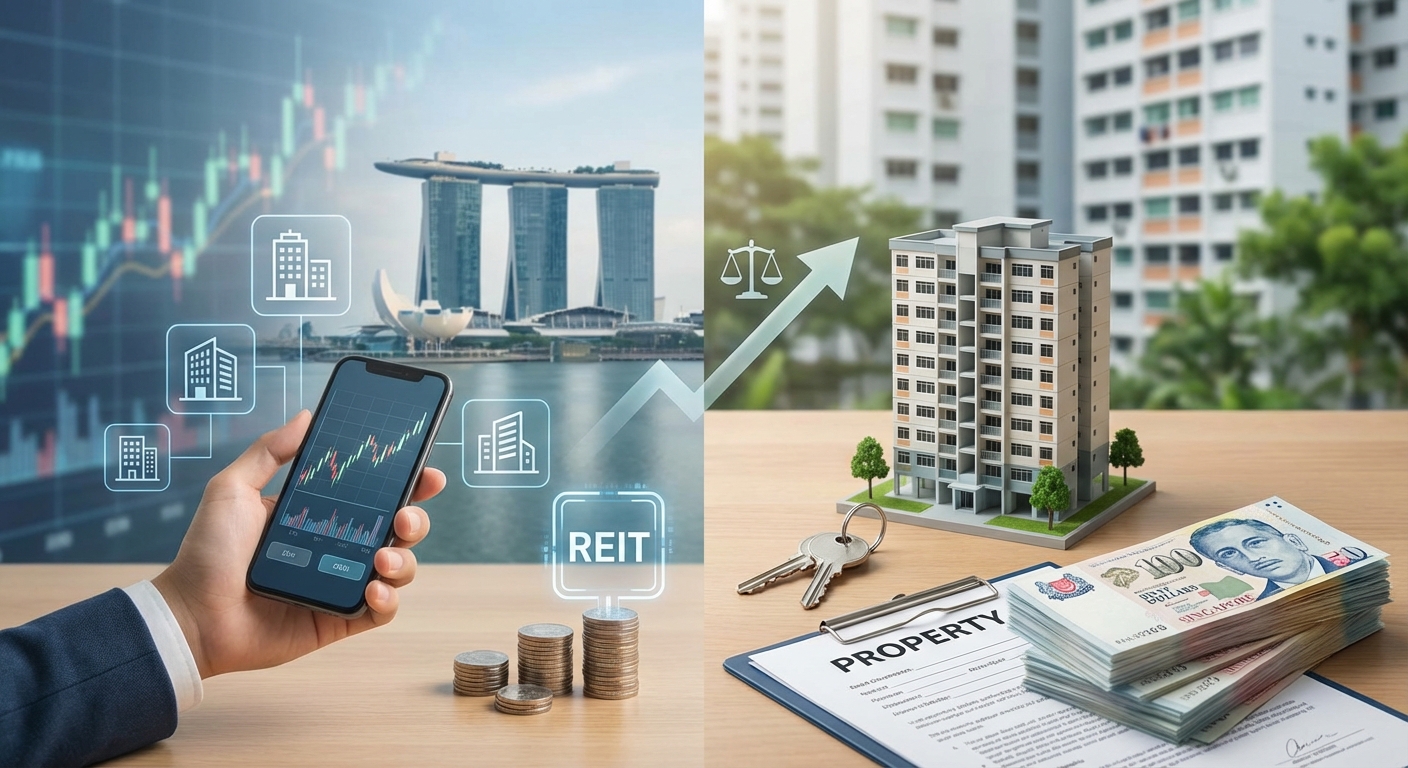
You’ve been saving for years. Your CPF Ordinary Account is growing. Your friends are talking about buying property, but you’ve also heard REITs mentioned at work.
Which one actually makes sense for your money?
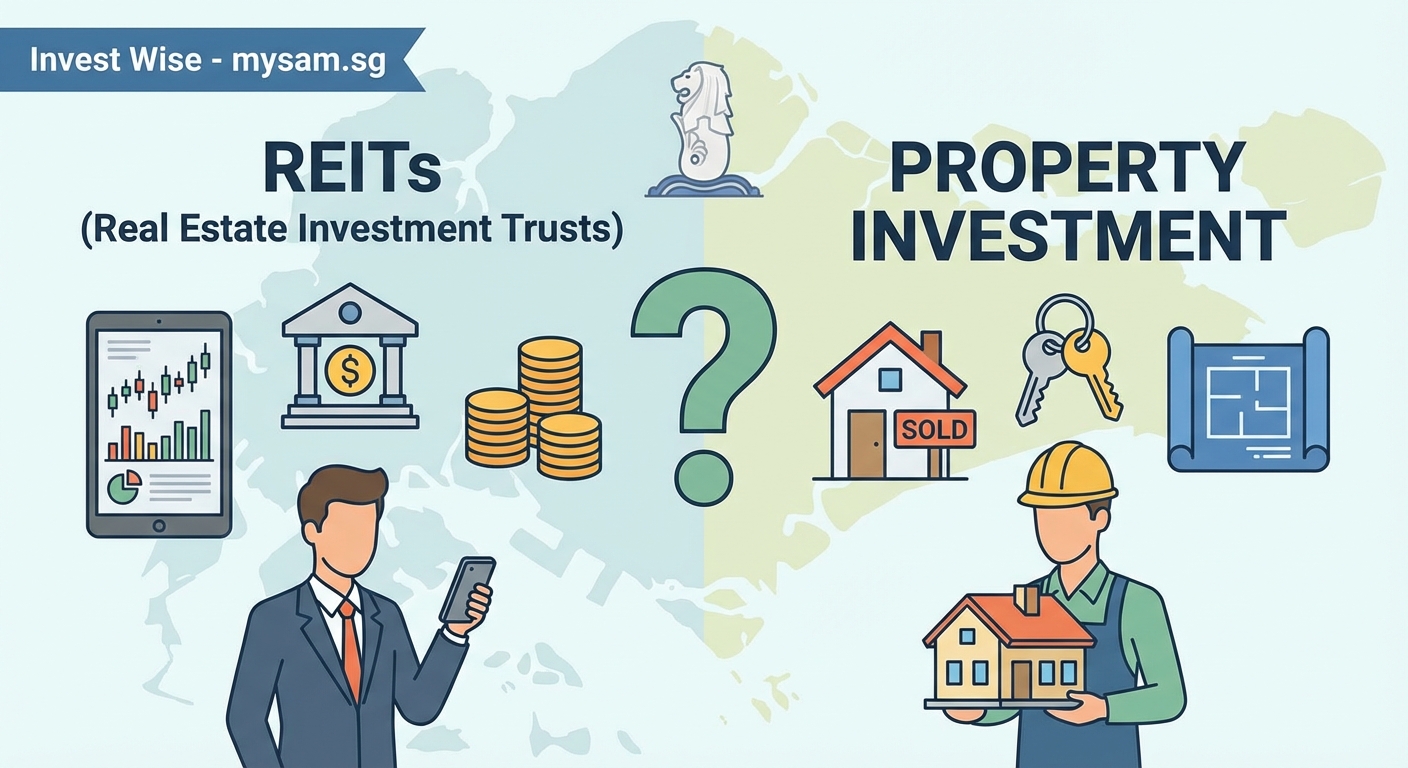
Both REITs and physical property can build wealth through real estate. But they work very differently. One needs hundreds of thousands upfront. The other lets you start with a few hundred dollars. One ties up your cash for years. The other you can sell in seconds.
Let’s break down both options so you can decide which fits your financial situation.
REITs offer lower entry costs (from $1,000), instant liquidity, and passive income without maintenance headaches. Physical property requires $200,000+ upfront, involves active management, and delivers potentially higher returns through leverage and capital appreciation. Your choice depends on available capital, time commitment, risk tolerance, and whether you prioritize flexibility or control. Most balanced portfolios include both over time.
What are REITs and how do they work in Singapore?
Real Estate Investment Trusts (REITs) are companies that own income-producing properties.
They collect rent from tenants. Then they distribute at least 90% of that income to shareholders as dividends.
In Singapore, you can buy REIT shares on the SGX just like stocks. One share might cost $1 to $3. You become a partial owner of shopping malls, office towers, industrial warehouses, or healthcare facilities.
You earn money two ways:
– Regular dividend payments (usually quarterly)
– Capital gains if the share price rises
Singapore has over 40 listed REITs. Some focus on local properties. Others invest across Asia or globally.
The minimum investment is just the cost of one share plus brokerage fees. That means you can start with $1,000 or less.
What does buying physical property in Singapore actually involve?
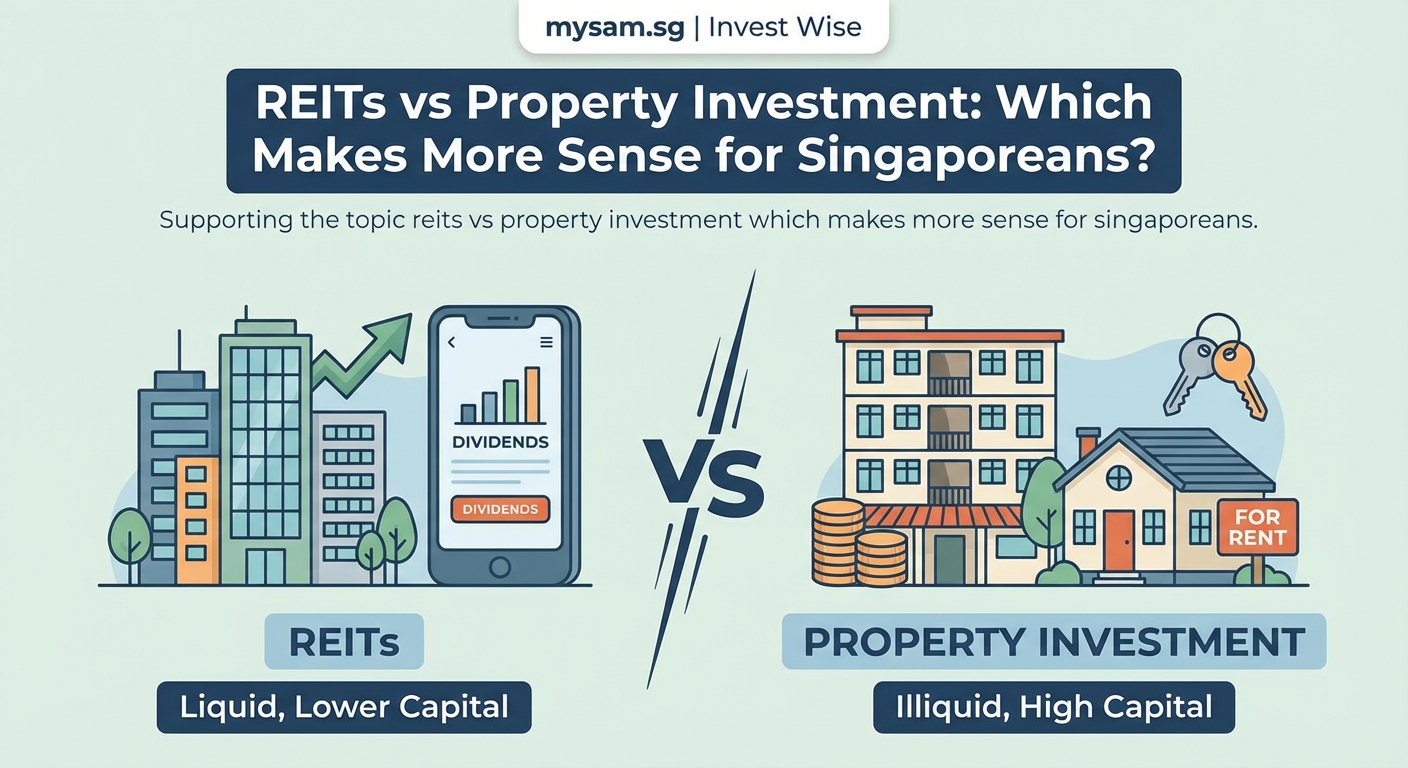
Physical property means you own the entire asset.
You find a unit. Apply for a home loan. Pay the downpayment (minimum 25% for investment properties). Complete legal paperwork. Collect keys.
Then you become a landlord. You find tenants. Collect rent. Handle repairs. Pay property tax. Manage agent fees.
The minimum capital needed is substantial:
| Property Type | Typical Price | Minimum Cash Needed (25%) |
|---|---|---|
| HDB resale flat | $400,000 | $100,000 (CPF allowed) |
| Private condo | $1,000,000 | $250,000 |
| Landed property | $2,000,000+ | $500,000+ |
You also need to budget for:
– Stamp duties (up to 6% of property value)
– Additional Buyer’s Stamp Duty (ABSD) if it’s not your first property
– Legal fees
– Agent commission
– Renovation costs
– Ongoing maintenance
The process takes weeks to months. Once you own it, selling takes months too.
Capital requirements tell you which option is realistic
This is the biggest practical difference.
REITs let you start small. You can buy $500 worth of CapitaLand Integrated Commercial Trust today. Add another $500 next month. Build your position gradually.
Physical property demands a large lump sum upfront. Even with a 75% loan, you need six figures in cash and CPF combined.
For most Singaporeans under 35, REITs are the only realistic starting point. You can begin investing in Singapore with just $100 a month through a regular savings plan that includes REITs.
Once you’ve accumulated $200,000 to $300,000, physical property becomes possible.
“Start with REITs to learn how real estate performs. By the time you can afford physical property, you’ll understand rental yields, vacancy rates, and market cycles much better.” – Financial planner with 15+ years in Singapore
Returns comparison gets complicated by leverage
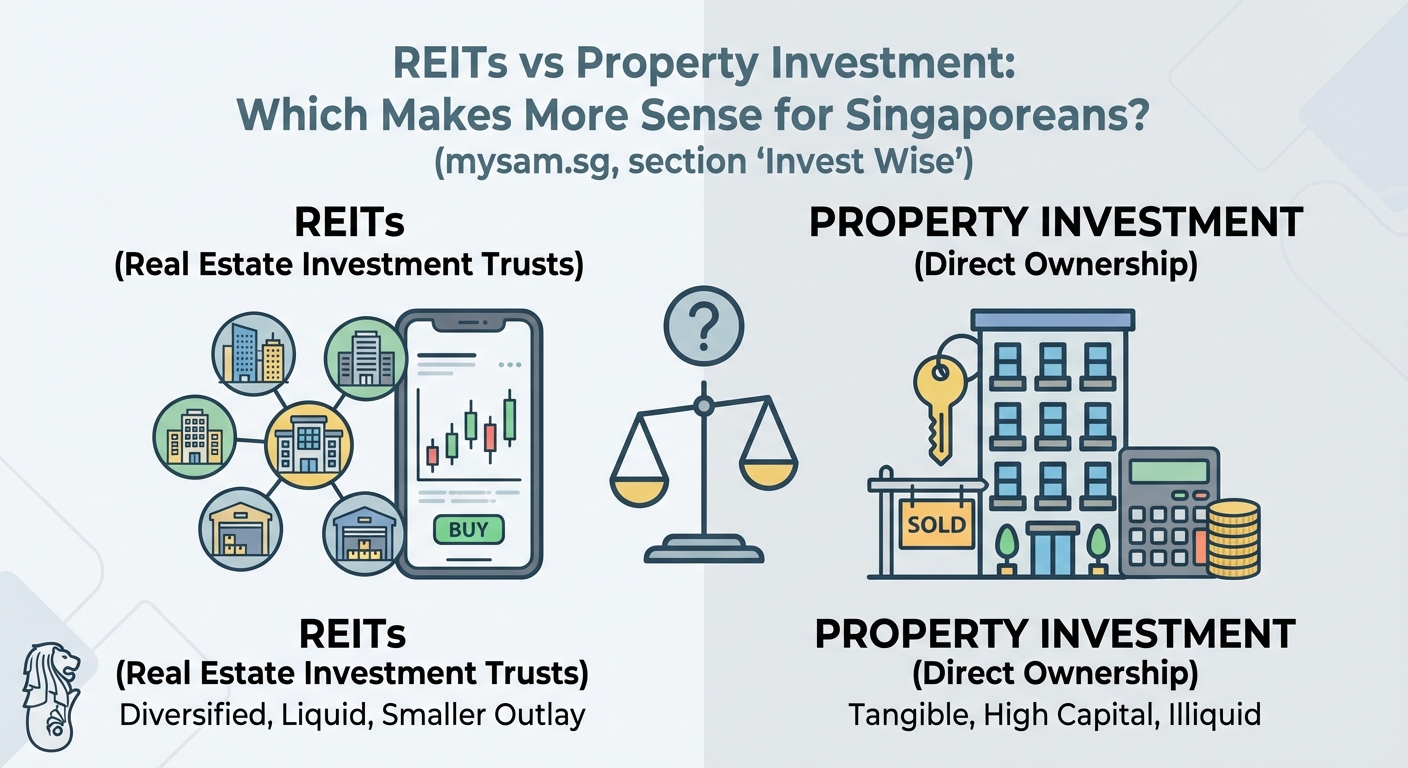
Physical property can deliver higher total returns. But it comes with higher risk.
Here’s why the math gets tricky.
REIT returns:
– Dividend yield: 4% to 7% annually
– Capital appreciation: Variable (can be negative)
– Total return: 5% to 10% in good years
Physical property returns:
– Rental yield: 2% to 4% annually
– Capital appreciation: Variable (historically 2% to 4% long term)
– Leverage amplifies both gains and losses
Let’s use a real example.
You buy a $1,000,000 condo with $250,000 down. You borrow $750,000 at 3% interest.
Rental income: $3,000/month = $36,000/year
Expenses:
– Mortgage interest: $22,500
– Property tax: $4,000
– Maintenance: $3,000
– Management fees: $2,000
– Insurance: $500
Net rental income: $4,000/year on your $250,000 investment = 1.6% cash-on-cash return
But if the property appreciates 3% ($30,000), your total gain is $34,000 on $250,000 = 13.6% return.
The leverage multiplies your gains. It also multiplies your losses if prices drop.
REITs don’t give you this leverage effect. But they also don’t expose you to a $750,000 loan.
Liquidity matters more than most people realize
You can sell REIT shares in seconds during market hours.
You get your money in two business days.
This liquidity is powerful. If you lose your job, face a medical emergency, or find a better investment opportunity, you can access your capital immediately.
Physical property is illiquid.
Selling takes 3 to 6 months on average. You need to:
1. Engage a property agent
2. Market the property
3. Negotiate with buyers
4. Complete legal processes
5. Wait for buyer’s financing approval
During a market downturn, it can take a year or more to find a buyer at a reasonable price.
You can’t sell “half” a property if you only need partial cash. It’s all or nothing.
This illiquidity creates risk. If property prices drop 20% and you need to sell urgently, you’re stuck taking the loss.
Tax treatment differs significantly between both options
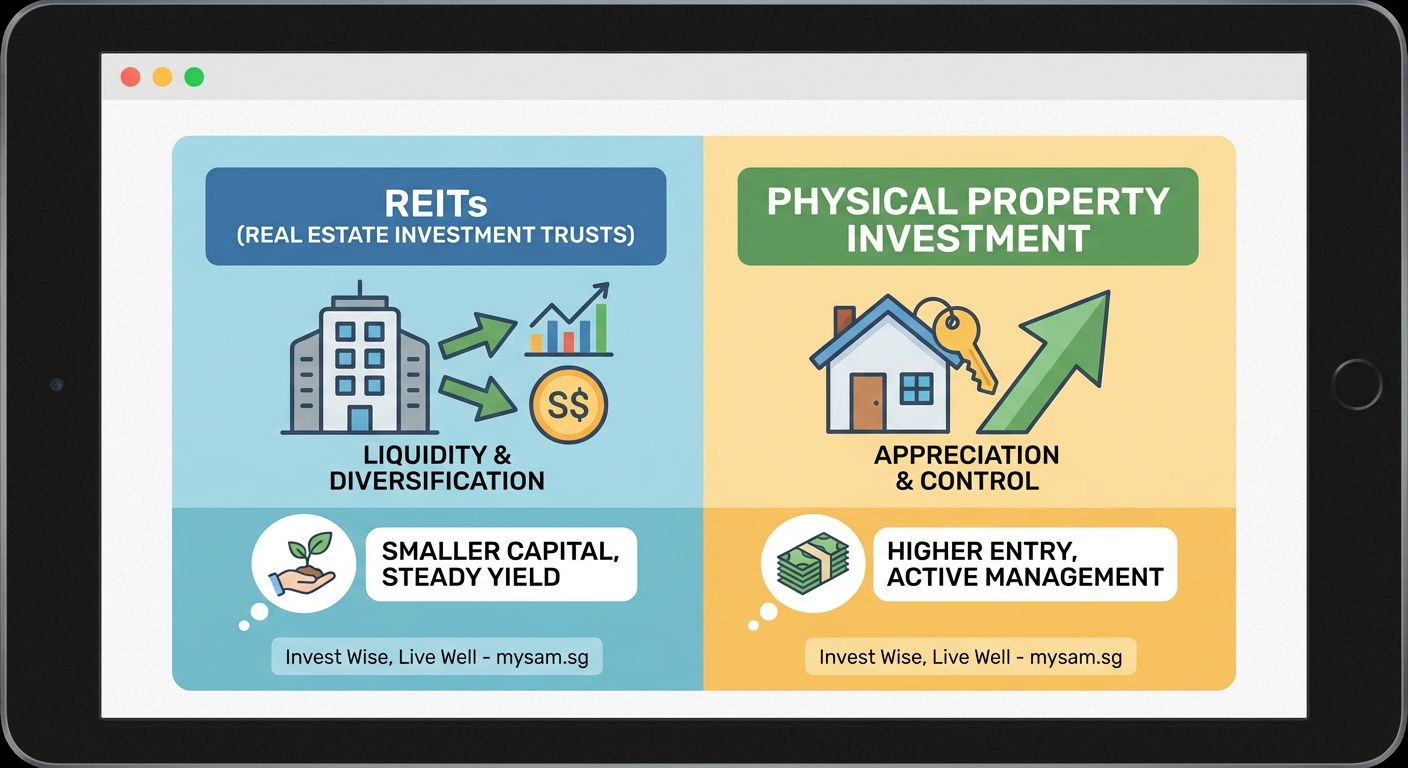
REITs enjoy tax transparency in Singapore.
The REIT itself pays no corporate tax on distributed income. You receive dividends that may be tax-free or taxed at your personal income rate, depending on the REIT structure.
For most Singapore tax residents, REIT dividends are tax-free.
Physical property rental income is taxable.
You must declare rental income on your tax return. You can deduct mortgage interest, property tax, and other expenses. The net rental income is taxed at your marginal rate.
When you sell a property:
– If it’s your primary residence, no capital gains tax
– If it’s an investment property held long-term, generally no capital gains tax
– If you’re buying and selling frequently (property trading), IRAS may tax you as carrying on a business
Stamp duties hit hard on property transactions. Buyer’s Stamp Duty ranges from 1% to 6%. ABSD adds another 20% to 30% for investment properties or foreign buyers.
REITs have no stamp duty on purchases. You pay standard brokerage fees only.
Effort and time commitment separate passive from active investing
REITs are completely passive.
You buy shares. Receive dividends. Check your portfolio occasionally. That’s it.
The REIT management team handles everything:
– Finding tenants
– Negotiating leases
– Building maintenance
– Renovations
– Regulatory compliance
You don’t receive 2 AM calls about burst pipes. You don’t chase late rent payments. You don’t coordinate contractor schedules.
Physical property requires active management.
Even with a property agent, you make decisions constantly:
– Approve repair budgets
– Choose tenants
– Set rental rates
– Handle disputes
– Plan renovations
Vacancy periods mean zero income while you still pay the mortgage, property tax, and maintenance.
Difficult tenants can cause thousands in damages and legal fees.
If you have a demanding career or value your weekends, REITs make more sense. If you enjoy hands-on management and have time to optimize your property, physical ownership can be rewarding.
Diversification works differently for each option
One REIT share gives you fractional ownership in multiple properties.
CapitaLand Integrated Commercial Trust owns shopping malls and office buildings across Singapore. Mapletree Logistics Trust owns warehouses in 10 countries. Parkway Life REIT owns hospitals and nursing homes.
You can buy 5 different REITs for $5,000 total and own pieces of 100+ properties across sectors and geographies.
Physical property concentrates your wealth in one asset.
Your $1,000,000 condo is a single bet on:
– That specific unit
– That building’s management
– That neighborhood
– Singapore’s property market
If that building develops structural issues, your entire investment suffers. If the MRT line planned for your area gets cancelled, your capital appreciation disappears.
The concentrated risk cuts both ways. If your area becomes the next hot neighborhood, you capture all the upside. But you also carry all the downside.
Most financial advisors recommend diversification. REITs deliver it automatically. Physical property requires you to own multiple units, which most people can’t afford.
Financing options and debt levels create different risk profiles
Banks will lend you 75% of a property’s value (more for HDB, less for investment properties).
This leverage is powerful but dangerous.
Your $250,000 downpayment controls a $1,000,000 asset. A 10% price increase means $100,000 gain on your $250,000 = 40% return.
But a 10% price drop means $100,000 loss = -40% return.
If prices drop 25%, your entire downpayment is wiped out. You’re underwater on the loan.
Interest rate changes hit hard too. If rates rise from 3% to 5%, your annual interest jumps from $22,500 to $37,500. That extra $15,000 can turn positive cash flow into negative.
REITs use leverage too, but it’s managed by professionals and spread across many properties.
Singapore limits REIT gearing to 50% of assets. Most maintain 35% to 40% to preserve financial flexibility.
You don’t personally guarantee REIT debt. If a REIT struggles, you might lose your share value, but you won’t owe money to banks.
With physical property, you’re personally liable for the full loan amount. If you can’t make payments, the bank can repossess your property and pursue you for any shortfall.
Market timing affects both investments but differently
Property markets move slowly.
Prices take years to rise or fall significantly. You can’t time the market precisely because transaction costs are high and liquidity is low.
Most property investors buy when they’re financially ready and hold for 10+ years.
REIT prices fluctuate daily with the stock market.
This creates both opportunity and anxiety. You can buy during market dips and sell during rallies. But you’ll also watch your portfolio value swing 20% to 30% in volatile years.
The daily price visibility can be psychologically challenging. Your $500,000 property doesn’t show a minute-by-minute valuation. Your REIT portfolio does.
Many investors make emotional mistakes with REITs, selling during crashes and buying during peaks. The constant price updates trigger bad behavior.
Property’s illiquidity actually helps some people hold long-term. You can’t panic-sell at 3 AM because you saw a scary headline.
How to decide which option matches your situation
Here’s a practical framework.
Choose REITs if you:
– Have less than $200,000 available to invest
– Want passive income without management work
– Value liquidity and flexibility
– Prefer diversification across properties
– Are building wealth in your 20s and 30s
– Want to avoid debt and leverage risk
Choose physical property if you:
– Have $250,000+ in cash and CPF available
– Can handle active management or pay for professional management
– Don’t need liquidity for 10+ years
– Want to use leverage to amplify returns
– Enjoy hands-on control over your investment
– Have time to research locations and manage tenants
Consider both if you:
– Have substantial capital ($500,000+)
– Want balanced exposure to real estate
– Can handle different risk profiles in one portfolio
– Are in your 40s+ with stable income
Many successful investors start with REITs in their 20s and 30s. They build capital and learn about real estate. Then they add physical property in their 40s when they have larger savings and stable careers.
This staged approach reduces risk and builds knowledge progressively.
Common mistakes to avoid with each investment type
| Mistake | REITs | Physical Property |
|---|---|---|
| Chasing high yields | Buying REITs with 9%+ yields often signals trouble (unsustainable distributions or falling prices) | Buying properties in declining areas just because rental yield looks high on paper |
| Ignoring debt levels | Not checking REIT gearing ratios before buying (high debt = higher risk) | Borrowing maximum amount without buffer for rate increases or vacancy |
| Poor diversification | Putting all money in one REIT or one sector | Buying only in one neighborhood or property type |
| Timing obsession | Trying to trade REITs short-term and getting whipsawed by volatility | Waiting years for “the perfect time” and missing the compounding period |
| Neglecting costs | Forgetting that brokerage fees eat into returns on small purchases | Underestimating total ownership costs (maintenance, tax, insurance, vacancy) |
The biggest mistake is doing nothing.
Saving in a bank account earning 0.5% interest means you’re losing money to inflation. Both REITs and property beat cash over the long term.
Start with what you can afford today. Learn as you go. Adjust your strategy as your wealth grows.
Building a complete real estate investment strategy
Most wealthy Singaporeans own both REITs and physical property eventually.
Here’s a sensible progression:
-
Age 25 to 35: Invest $500 to $1,000 monthly in diversified REIT portfolio. Build emergency fund. Focus on career growth.
-
Age 35 to 40: Continue REIT investments. Save aggressively for property downpayment. Research neighborhoods. Consider buying first property when you have $250,000+ available.
-
Age 40 to 50: Own primary residence. Hold REIT portfolio for diversification and liquidity. Consider second investment property if financially comfortable.
-
Age 50+: Rebalance toward income-generating assets. REITs provide steady dividends. Paid-off property provides rental income. Both support retirement.
This isn’t the only path. Some people buy property first and add REITs later. Others stick with REITs exclusively and enjoy the simplicity.
Your strategy should match your:
– Risk tolerance
– Time horizon
– Income stability
– Personal preferences
If you’re just starting your investment journey, REITs offer the easiest entry point. You can begin with small amounts and learn how real estate performs without the stress of property management.
As your wealth grows, you can evaluate whether adding physical property makes sense for your situation.
Both options work. Both have delivered solid returns to Singaporean investors over decades. The key is choosing the one that fits your current financial reality and committing to it long-term.
Your next step toward real estate wealth
REITs vs property Singapore isn’t really a battle.
They’re different tools for different situations and stages of life.
REITs give you immediate access to real estate investing with minimal capital. Property offers control and leverage potential once you have substantial savings.
Most successful investors use both over time, building a balanced portfolio that captures the benefits of each approach.
Start where you are right now. If you have $1,000, buy your first REIT shares this month. If you have $300,000 and stable income, start researching property options.
The worst choice is staying on the sidelines. Real estate has built more wealth in Singapore than almost any other investment class. You just need to pick your entry point and begin.